
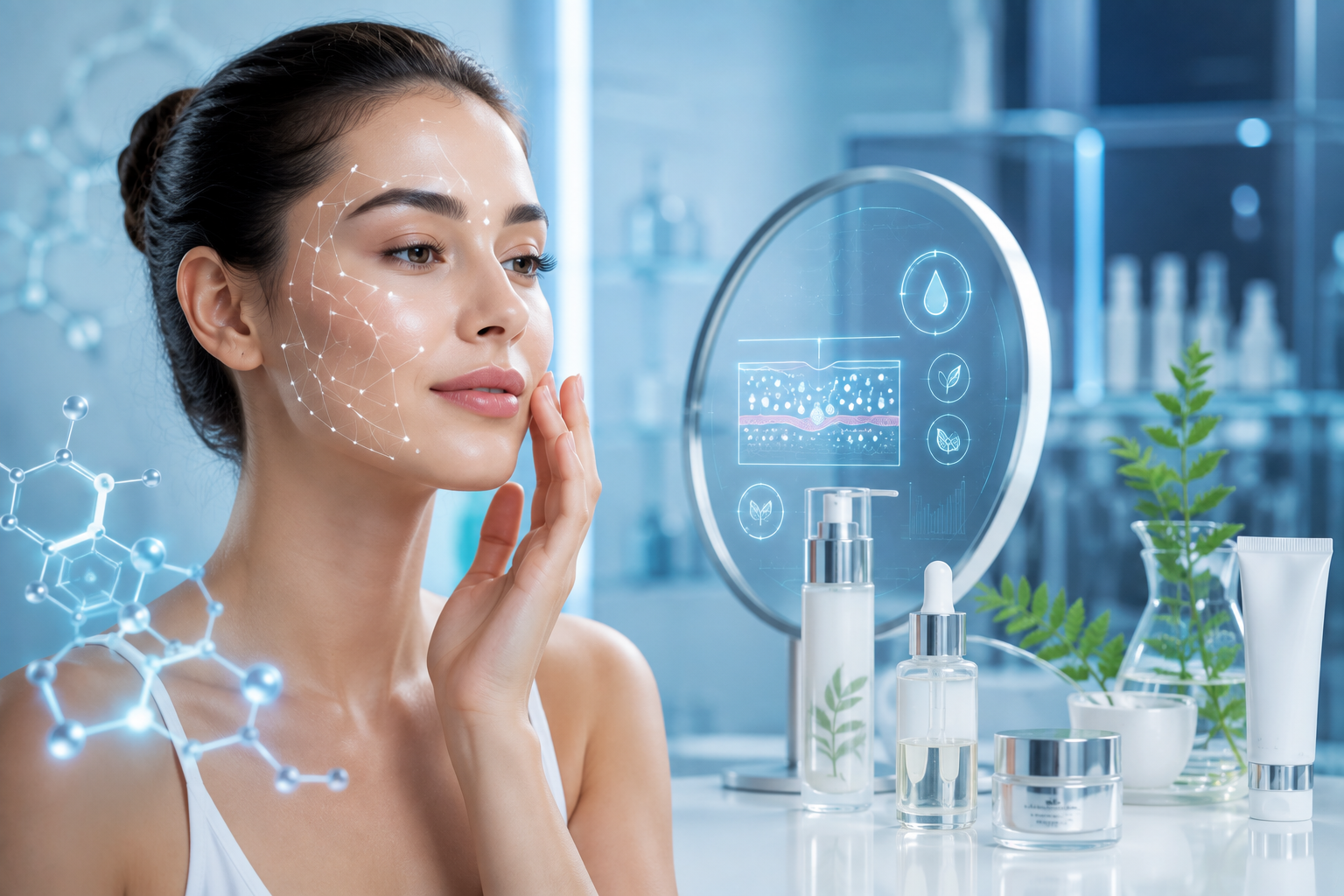

Smart skincare solutions are transforming the beauty and wellness industry by combining artificial intelligence, digital imaging, connected devices, and personalized data with traditional skincare.
Instead of relying entirely on trial and error, consumers can increasingly use technology to understand visible skin characteristics, monitor changes, and receive more personalized recommendations.
AI-powered applications can evaluate facial images for features such as texture, pigmentation, blemishes and signs associated with aging. Researchers are also studying how artificial intelligence can support dermatology, digital skin imaging, and disease assessment.
The opportunity is significant, but so is the need for caution.
A smartphone application that suggests a moisturizer is very different from software claiming to diagnose a suspicious skin lesion. The American Academy of Dermatology warns that applications designed to diagnose skin conditions, including skin cancer, may have low accuracy and advises people to seek diagnosis from a board-certified dermatologist.
The future of skincare, therefore, may not be technology replacing expertise.
It may be technology helping people make more informed decisions while professionals remain responsible for medical diagnosis and treatment.
What Are Smart Skincare Solutions?
Smart skincare solutions use digital technologies to make skincare more personalized, measurable or responsive.
They can include:
- AI-powered skin analysis
- Smartphone-based skin imaging
- Personalized product recommendations
- Connected skincare devices
- Digital skin diaries
- Teledermatology platforms
- Environmental monitoring
- Wearable sensors
- Automated routine tracking
- Data-driven beauty applications
Some technologies focus primarily on cosmetic concerns.
Others are being developed for medical or dermatological applications.
This distinction matters because not every skincare technology should be evaluated by the same standard.
A beauty application might help users compare changes in visible texture over time.
A clinical imaging system, by contrast, may be designed to support medical professionals in evaluating disease.
Understanding the purpose of the technology is the first step toward using it responsibly.
How Artificial Intelligence Is Changing Skincare
Artificial intelligence has become one of the most visible technologies in personalized beauty.
Modern AI systems can analyze digital images and identify visual patterns that would be difficult to measure consistently through casual observation.
A 2025 review of AI in customized skincare described applications using computer vision to evaluate characteristics such as texture, pigmentation, hydration-related features, and blemishes.
This creates an interesting shift.
Traditional skincare recommendations often begin with broad categories such as oily, dry, combination or sensitive skin.
AI can potentially introduce more detailed observations.
Instead of simply identifying a broad skin type, software may attempt to examine specific concerns across different parts of the face.
That information can then be used to support more personalized recommendations.
AI Skin Analysis Through Smartphones
Smartphones have made digital skin analysis more accessible.
A consumer can take a photograph and allow an application to analyze visible characteristics.
Researchers have also investigated smartphone-based AI systems for dermatological applications, including the assessment of suspicious skin lesions.
However, image quality matters.
Research on digital skin imaging has warned that poor-quality patient photographs can reduce diagnostic interpretability. Lighting, camera quality, focus, image angle and skin presentation can all influence the usefulness of an image.
For everyday skincare tracking, consistency is therefore important.
Taking photographs under similar lighting and from similar angles can make comparisons more meaningful.
Personalized Skincare Is Moving Beyond Skin Type
Personalization has become one of the biggest promises behind smart skincare solutions.
Two people may both describe themselves as having dry skin while experiencing very different concerns.
One may struggle primarily with sensitivity.
Another may notice uneven pigmentation.
Someone else may have dryness combined with acne.
Technology allows brands and digital platforms to collect more information before making recommendations.
This information might include:
- Visible skin characteristics
- User age
- Skin sensitivity
- Existing routine
- Climate
- Lifestyle
- Product preferences
- Reported concerns
- Previous product responses
Algorithms can then use those inputs to narrow down recommendations.
The goal is not necessarily to create a completely unique cosmetic formula for every individual.
Sometimes the biggest improvement comes simply from reducing irrelevant recommendations.
Smart Skincare Devices Are Becoming More Sophisticated
Skincare technology is not limited to smartphone applications.
Connected beauty devices increasingly combine sensors, software and hardware.
Depending on the device, technology may be used to measure or estimate characteristics such as moisture, surface appearance or environmental exposure.
Other devices use controlled forms of light, heat, vibration or cleansing technologies.
The important question is not whether a device looks advanced.
It is whether the technology has credible evidence supporting the benefit being claimed.
Consumers should distinguish between:
technology that measures something
and
technology that has been proven to improve something.
Those are not automatically the same.
A device may accurately measure a particular characteristic without having evidence that its recommended treatment produces meaningful improvement.
Smart skincare should therefore remain evidence-led rather than gadget-led.
Digital Skin Tracking Could Change Everyday Routines
One of the most practical applications of intelligent skincare may be simple monitoring.
Most people evaluate their skincare routines from memory.
They may believe a product improved their skin but struggle to remember what their skin looked like six weeks earlier.
Digital tracking can provide greater consistency.
A skincare application could allow users to document:
- Breakouts
- Redness
- Dryness
- Product changes
- Skin texture
- Pigmentation
- Environmental conditions
- Routine consistency
Over time, that record may make patterns easier to identify.
For example, a user might notice irritation repeatedly appearing after introducing certain products.
Another person may notice seasonal dryness becoming worse during particular weather conditions.
The technology does not automatically identify the cause.
But better records can support better observations.
Environmental Data Can Make Skincare Smarter
Skin does not exist independently of the environment.
Temperature, humidity, sun exposure, pollution and indoor climate can influence how skin feels and behaves.
This creates opportunities for smart skincare solutions that combine personal information with environmental data.
A skincare application could potentially adjust routine recommendations when local conditions change.
For example, it might suggest that users pay greater attention to moisturization during periods of dry weather or remind them about sun protection when ultraviolet exposure is elevated.
The American Academy of Dermatology notes that environmental factors such as sun exposure and air conditioning can contribute to dry or irritated skin even in hot weather.
This type of contextual recommendation illustrates where digital skincare can become genuinely useful.
The technology does not need to diagnose disease.
It can simply help users make their existing routines more responsive.
Smart Skincare Solutions and Dermatology
The most significant applications of AI in skin health may eventually extend well beyond cosmetics.
Artificial intelligence is being extensively researched in dermatology.
Studies have explored AI for skin cancer image classification, disease severity assessment, digital imaging and clinical decision support.
The American Academy of Dermatology has also highlighted AI-driven diagnostic tools, telemedicine and digital skin mapping as important emerging areas within dermatology.
These developments could potentially improve screening, support clinicians and expand access to specialist knowledge.
But the distinction between assistance and diagnosis remains essential.
AI Should Not Replace a Dermatologist
Consumer applications can create a dangerous impression of certainty when interpreting skin conditions.
The AAD specifically cautions that diagnostic skincare applications may not be sufficiently accurate and recommends professional evaluation for diagnosis.
Research has reached similar conclusions.
A prospective multicenter study of a smartphone application found that diagnostic accuracy remained imperfect, although the technology showed potential as a tool for helping users decide when medical attention might be appropriate.
The most responsible role for AI may therefore be supporting decisions rather than making definitive medical conclusions independently.
Inclusivity Is a Major Challenge for AI Skincare
Artificial intelligence is only as reliable as the data and validation behind it.
This becomes particularly important in dermatology because skin appearance varies considerably across populations.
Recent research has found that AI models can perform less accurately when identifying certain skin conditions in darker skin tones.
That raises an important question for both skincare companies and technology developers:
Was the system trained and tested on a genuinely diverse population?
An algorithm that works well for one demographic cannot automatically be assumed to work equally well for everyone.
Inclusive datasets, independent validation and transparent testing will therefore be essential if smart skincare technologies are to earn long-term trust.
Data Privacy Is Becoming Part of Skincare
A traditional moisturizer collects no personal data.
A smart skincare application potentially collects a great deal.
Depending on the service, users may provide:
- Facial photographs
- Age
- Skin concerns
- Product preferences
- Routine information
- Location information
- Health-related information
- Behavioral data
That information can improve personalization.
It can also create privacy concerns.
Consumers should understand what information is collected, where it is stored, how long it is retained and whether it is shared with third parties.
For companies operating in this market, privacy should not be treated as a small compliance issue.
Facial and health-related data can be particularly sensitive.
Trust may become one of the biggest competitive advantages in intelligent beauty.
Smart Skincare Still Needs Basic Skincare
Technology can make skincare more sophisticated.
It cannot make the fundamentals irrelevant.
The American Academy of Dermatology continues to emphasize straightforward skincare principles, including appropriate cleansing, moisturizing and protection based on individual needs.
This is an important reality.
Someone does not necessarily need a complicated 12-step routine simply because technology can recommend one.
A smarter skincare routine may actually be simpler.
Technology can help identify what matters and eliminate unnecessary experimentation.
The goal should be effective skincare, not maximum product consumption.
How Consumers Can Evaluate Smart Skincare Technology
As intelligent beauty products become more common, consumers need a practical way to evaluate them.
Look for Clear Claims
Ask what the technology actually does.
Does it measure visible skin characteristics?
Does it recommend products?
Does it track routine changes?
Or does it claim to diagnose a medical condition?
The greater the medical claim, the stronger the supporting evidence should be.
Look for Evidence
Check whether the company provides credible research supporting the technology.
Marketing phrases such as “AI-powered” or “clinically inspired” do not themselves prove effectiveness.
Understand the Limitations
Reliable companies should explain where their systems may be less accurate.
Technology that claims perfect results should be approached carefully.
Protect Your Data
Review privacy settings and understand what happens to uploaded photographs and other personal information.
Seek Professional Advice When Necessary
Persistent acne, unusual moles, rashes, painful skin conditions or other concerning changes should not be managed solely through a beauty application.
A board-certified dermatologist is trained to diagnose and treat skin conditions.
Why Beauty Brands Are Investing in Intelligent Skincare
The commercial opportunity behind smart skincare is significant because personalization can address one of beauty’s oldest challenges.
Customers frequently struggle to understand which products are appropriate for them.
Traditional beauty retail relies heavily on packaging, advertising, recommendations and personal experimentation.
Intelligent technologies can add a consultation layer.
A consumer might complete an assessment, upload an image and receive a smaller selection of potentially relevant products.
For brands, this can improve the shopping experience.
For consumers, it can reduce decision fatigue.
The important issue is whether the recommendations are genuinely personalized or simply another way to promote products.
Trust will depend on that difference.
AI Could Transform Skincare Research
AI may also change how skincare companies develop products.
Large datasets can potentially help researchers identify patterns in consumer responses, ingredients, formulations and visible skin characteristics.
Computer vision can make image assessment more standardized.
Digital tools can help researchers monitor changes over longer periods.
These technologies could potentially shorten parts of the research process while creating richer datasets.
However, algorithms do not eliminate the need for carefully designed clinical research.
Technology can process information more quickly.
Scientific quality still depends on the study design and the evidence supporting the conclusions.
Teledermatology Expands the Smart Skincare Ecosystem
Another important development is teledermatology.
Digital consultation platforms allow patients to share photographs and information with healthcare professionals without always requiring an immediate in-person appointment.
Skin imaging, teledermatology and artificial intelligence are increasingly being studied together because each technology can complement the others.
For example, digital imaging can capture the concern.
Telemedicine can connect the patient with a professional.
AI may eventually assist in organizing or analyzing information.
The dermatologist remains responsible for clinical judgment.
This hybrid model may prove more valuable than attempting to remove healthcare professionals from the process entirely.
The Future of Smart Skincare Solutions
The next generation of smart skincare solutions is likely to become more integrated.
Instead of separate applications for product recommendations, image tracking, environmental information and professional consultations, these functions could eventually exist within interconnected platforms.
A future skincare system might combine:
- Regular skin imaging
- AI-assisted visual analysis
- Environmental monitoring
- Personalized routines
- Product compatibility data
- Progress tracking
- Professional consultation
- Connected skincare devices
The result could be a more continuous approach to skin management.
Rather than choosing products based on broad marketing claims, consumers could make decisions based on a combination of personal observations, scientific evidence and professional guidance.
That is where intelligent skincare becomes more meaningful.
The Bigger Picture
The most important development in smart skincare is not the arrival of more technology.
It is the possibility of better information.
Smart skincare solutions can help people understand visible changes, monitor routines, personalize product choices and become more aware of factors affecting their skin.
Artificial intelligence can strengthen image analysis.
Connected devices can generate new data.
Digital platforms can make tracking easier.
Teledermatology can improve access to professional expertise.
But intelligence should not be confused with certainty.
AI systems have limitations.
Image quality affects results.
Algorithms may perform differently across populations.
Consumer applications cannot replace qualified medical professionals when diagnosis is required.
The smartest approach to skincare may therefore combine technology with something much more traditional: good judgment.
Use data to understand more.
Use evidence to choose carefully.
Use technology to support your routine.
And when a skin concern becomes medical rather than cosmetic, use professional expertise.
That balance could define the future of intelligent skincare.
Stay connected with Business Herald for the latest business news, insights, and updates.
Follow us on Facebook, Instagram, LinkedIn, and YouTube.
Join our growing community on WhatsApp and Telegram for real-time updates delivered directly to you.