

How familiar companies make money, what customers are paying for, and where each approach can become expensive. Business models explain how a company earns money, pays its costs, and keeps enough profit to continue operating.
You encounter them throughout the day. Buying a phone involves a product sale. Watching Netflix involves a subscription. Booking accommodation through Airbnb creates income for a host and a fee for the company arranging the reservation.
The customer sees a price and decides whether to pay. Behind that price are decisions about manufacturing, staffing, delivery, support and the likelihood of another purchase.
A business can attract plenty of customers and still struggle financially. Orders may be expensive to fulfil. Stock may remain unsold. Marketing may cost more than the customers it brings in will ever spend.
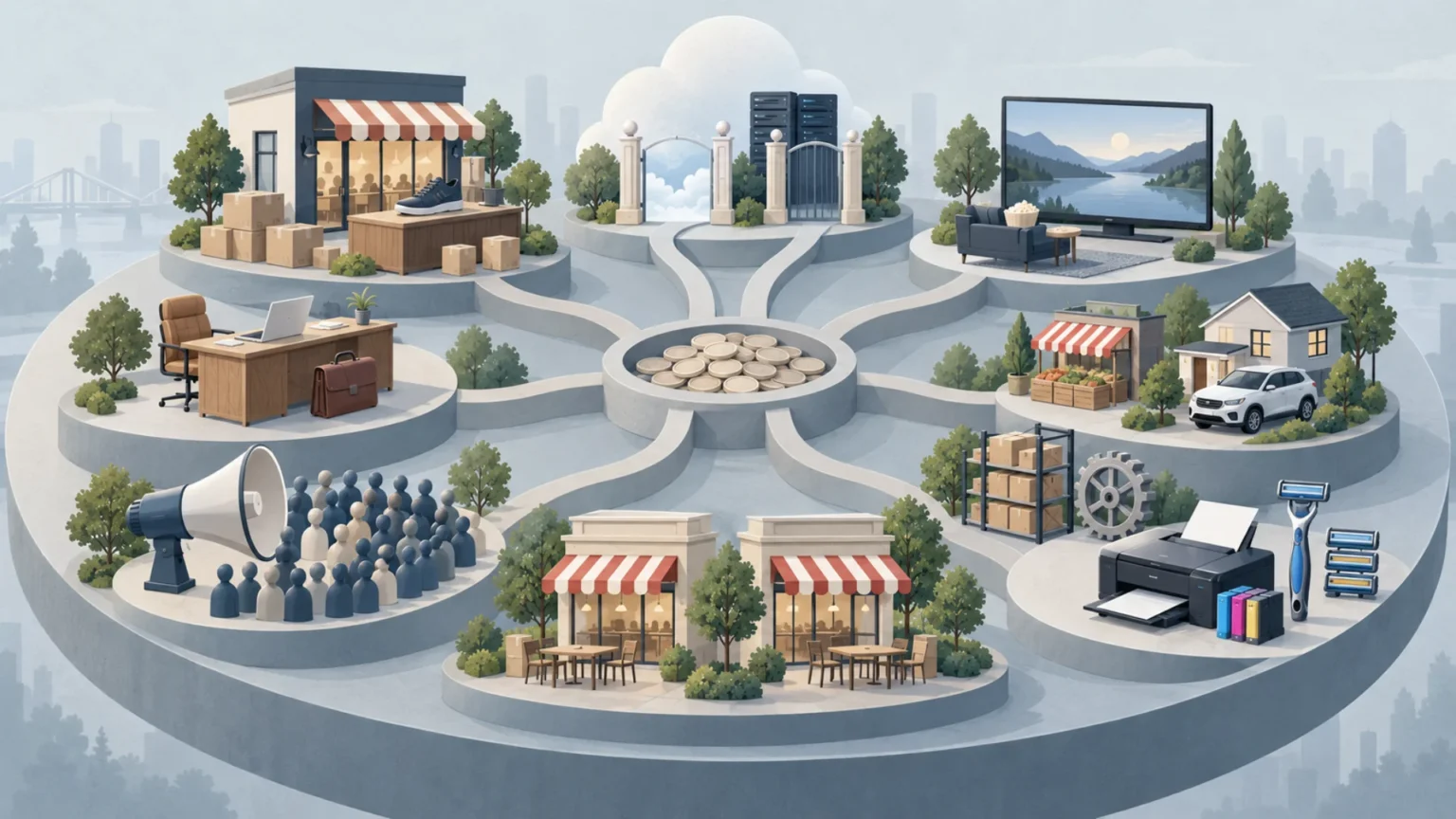
The following eight models explain how those problems arise and how companies try to manage them. They often overlap. Spotify combines subscriptions with free access and advertising, while a franchise can sell products under a brand owned by another company.
Product Sales And The Cost Of Unsold Stock
Nike has to decide how many shoes to produce before it knows exactly how many people will buy them. That gap between spending and selling is one of the central challenges of a product business.
Under this model, customers pay to own an item. The company earns a profit when the payment exceeds the costs associated with making and selling it.
Apple’s devices and Nike’s footwear are familiar examples. Neither operates exclusively through product sales. Apple also sells services, while Nike distributes through wholesale partners as well as its own stores and digital channels.
A desirable product gives a company room to charge more. Design, reliability and reputation can encourage customers to return, while related products offer opportunities to expand.
But manufacturing requires money before sales arrive. Materials, production, transport and storage must be financed. If demand disappoints, discounts may be necessary to clear stock.
Returns create further expenses. A returned item may require inspection, repair or a lower resale price. The original sale can become much less profitable than it appeared.
Selling directly to customers gives a company greater control over pricing and presentation. It also makes the company responsible for attracting shoppers, delivering orders, and handling complaints.
When examining this model, look beyond the selling price. Gross margin means the revenue remaining after the direct cost of the goods sold, usually expressed as a percentage of revenue. That amount must still help cover marketing, administration, and other expenses. Inventory turnover measures how quickly stock sells and is replaced. Slow-moving stock can leave a business short of cash even when its products appear profitable.
Services And Consulting Require Careful Pricing
An experienced consultant can begin trading without a factory or warehouse. Knowledge, professional credibility and a few client relationships may be enough to secure the first assignments.
Services businesses charge for work, expertise, or an ongoing responsibility. An agency might run a marketing campaign. A consultant might improve a company’s operations. A technology provider might maintain its systems.
Accenture illustrates the range. Its consulting work includes defined projects, while managed services involve continuing responsibilities for clients.
The model can be attractive because it requires relatively little physical stock. Specialist knowledge may command substantial fees, and a dependable provider can build relationships lasting years.
The difficulty is estimating how much work a promise will require.
On an hourly contract, additional work generally increases the customer’s bill. Under a fixed-price agreement, the provider commits to completing an agreed assignment for a set amount. If the work takes longer than expected, the provider may absorb the additional cost.
A request that sounds small during a meeting can require another specialist, several revisions, and new approvals. Clear agreements help prevent those expenses from accumulating unnoticed.
Staff must also be paid between assignments. Hiring before contracts are secured raises costs; waiting too long can leave the business unable to deliver. Losing one large client can expose how dependent the company has become on that relationship.
Better tools and processes can improve profitability, but pricing needs to reflect how the work is delivered. Automation that reduces billable hours may lower revenue under an hourly agreement while increasing profit on a fixed-price project.
Subscriptions Depend On Customers Renewing
A subscription charges customers regularly for continuing access to a product or service.
Netflix collects monthly payments for viewing access. Adobe uses subscriptions extensively for its creative and document software.
For customers, the arrangement can reduce the initial expense and provide access to improvements over time. For companies, existing subscribers make future revenue easier to estimate.
That predictability is limited. Someone may cancel a streaming service after finishing a series or reviewing household spending. Professional software can be harder to replace because people have built their skills, files, and working routines around it.
Both businesses collect recurring payments, but customers have different reasons for staying.
Providers must continue spending too. Content, maintenance, infrastructure, and support all require funding. A subscription cannot justify itself indefinitely through the enthusiasm that secured the first payment.
Customer cancellations are commonly called churn. High churn becomes particularly expensive when attracting subscribers requires substantial marketing spending.
If a customer leaves before the company recovers the cost of winning their business, the relationship may produce a loss. A growing subscriber count can conceal that problem.
Retention, meaning how many customers continue paying, should therefore be examined alongside the cost of serving them. A subscriber who stays for years and needs little support has different economics from one who leaves after a heavily discounted month.
Freemium Accommodates People Who Never Pay
Freemium combines a usable free version with a paid offering that provides additional benefits.
Spotify and Dropbox are well-known examples. People can use their free services and later decide whether the additional features justify payment.
Free access reduces the hesitation involved in trying something unfamiliar. It allows the product to become part of someone’s routine before the company asks for money.
The challenge is deciding what belongs in each version. A generous free service may leave customers satisfied indefinitely. A heavily restricted one may frustrate them before they discover anything worth buying.
Free users still create expenses. Storage, infrastructure, support, and content must be paid for. Spotify also earns advertising revenue from its free service, combining two approaches to support the business.
Freemium differs from a free trial. A trial expires after a specified period. A free tier can remain available indefinitely.
Registration numbers alone reveal little about whether the arrangement works. An abandoned account is unlikely to produce an upgrade. Businesses need to examine active usage and the proportion of relevant users who become paying customers.
That proportion is called the conversion rate. It is useful only when the company clearly defines which users it is measuring.
The paid offering works best when it addresses a need customers have already experienced, such as insufficient storage or missing controls. People need a practical reason to upgrade.
Marketplaces Need Buyers And Providers In The Same Place
A traveller looking for accommodation in Lisbon needs suitable options in Lisbon. Thousands of listings elsewhere do not solve the problem.
A marketplace brings buyers and providers together, usually earning fees when transactions occur.
Airbnb connects travellers with hosts. Uber connects customers with drivers and other service providers through its platforms.
These companies can expand without purchasing every property or vehicle involved. Providers supply the underlying assets or labour, while the platform organises discovery, booking and payment.
However, the total money spent through a platform is not necessarily its revenue. Gross bookings means the overall value of transactions. The platform’s own revenue is calculated separately and depends on its business and accounting arrangements.
Building a marketplace requires attracting both sides. Providers hesitate without customers, and customers hesitate without enough suitable providers.
Discounts and incentives can encourage participation. They also make it harder to establish whether people would continue using the service at prices that support the business.
As participation grows, the platform can become more useful. More suitable providers attract customers, whose spending encourages providers to return. This benefit must develop within the relevant locations and categories.
The business also pays for support, payment systems, fraud prevention and disputes. A platform remains involved when a booking goes wrong, even if someone else owns the property.
Customers and providers may eventually arrange transactions directly. Convenient payments, reliable service and useful protections give them reasons to keep using the platform.
Advertising Requires An Audience That Pays Attention
Advertising businesses earn money from organisations that want to reach an audience.
Google and Meta are familiar examples. People use their services to search, watch, read and communicate. Advertisers pay for opportunities to reach those users.
The arrangement can support services people might not pay for directly. Advertisers gain access to audiences relevant to their products and can assess whether their spending produces results.
Context affects the value of that access. Someone searching for an emergency plumber may be ready to buy. Someone watching entertainment may remember a brand without making an immediate purchase.
The provider has to balance commercial demands with the user experience. More advertisements can increase revenue while making the service less enjoyable.
Advertiser spending can also fall when businesses become cautious. Changes in privacy rules and measurement tools can affect the usefulness of advertisements, while infrastructure and moderation expenses continue.
Smaller publishers face another vulnerability when their audience depends heavily on search engines or social platforms. A change in traffic can reduce income before operating costs can be adjusted.
Large audience figures are encouraging, but advertisers need evidence that people are paying attention and responding.
Franchising Shares A Brand Between Different Owners
Franchising allows an independent operator to run a business using another company’s brand and operating system.
McDonald’s and Marriott provide well-known examples. Most McDonald’s restaurants are franchised. Marriott franchises hotel brands and also has separate agreements to manage properties for their owners.
The franchisor owns the brand and grants operating rights. The franchisee runs the local business under the agreement.
For the franchisor, the arrangement supports expansion through other operators’ investment and effort. For the franchisee, recognition, training, and established procedures can reduce some of the uncertainty of starting from nothing.
The operator still carries local expenses. Wages, rent, maintenance and financing must be covered alongside franchise charges.
Royalties are ongoing payments for using the brand and system, often calculated as a percentage of sales. An outlet may therefore owe royalties even when it earns little profit.
Operators also accept restrictions on decisions such as suppliers, products and presentation.
The franchisor must maintain standards across businesses it does not fully control. Poor service at one outlet can damage the wider reputation. Opening too many locations close together can weaken existing operators.
A recognised name may help bring customers through the door. The individual outlet still needs enough income after expenses and fees to make ownership worthwhile.
Razor And Blades Revenue Comes From Repeat Supplies
This model links an initial product with purchases required to keep using it. Gillette sells razor handles and replacement cartridges. HP sells printers and supplies such as ink and toner.
The first purchase establishes a relationship that can generate further sales for years. Customers gain a familiar system, and suppliers benefit from recurring demand.
The original product does not have to be sold at a loss. The defining feature is the connection between equipment and continuing purchases of supplies.
Frequent use makes the arrangement more attractive. Reliable performance and convenient replenishment can encourage customers to stay.
High replacement costs can have the opposite effect. Customers may seek alternative supplies, refill options or a different system.
Habits can change too. A printer left unused generates little demand for ink. A customer who changes their shaving routine may buy fewer cartridges.
Equipment sales therefore reveal only part of the opportunity. The business needs to know how much equipment remains in use and how often customers purchase supplies.
Business Models Need To Fit The Customer
Copying a famous company’s payment method does not reproduce its economics. Its reputation, distribution, and customer relationships may have taken decades to develop.
A subscription requires continuing demand. A marketplace requires useful participation on both sides. A franchise requires a local operator who can earn enough after paying the brand.
Combining models can create opportunities, provided the additional revenue justifies the work. Free access may lead to subscriptions. Equipment sales may support recurring supplies. An established platform may attract advertisers.
Before expanding, a company should understand what it earns from a customer after delivery, support and acquisition costs. It should also know when that money arrives. Profit recorded in the accounts cannot pay an immediate bill if the cash is still tied up in unsold stock or an unpaid invoice.
Stay connected with Business Herald for the latest business news, insights, and updates.
Follow us on Facebook, Instagram, LinkedIn, and YouTube.
Join our growing community on WhatsApp and Telegram for real-time updates delivered directly to you