
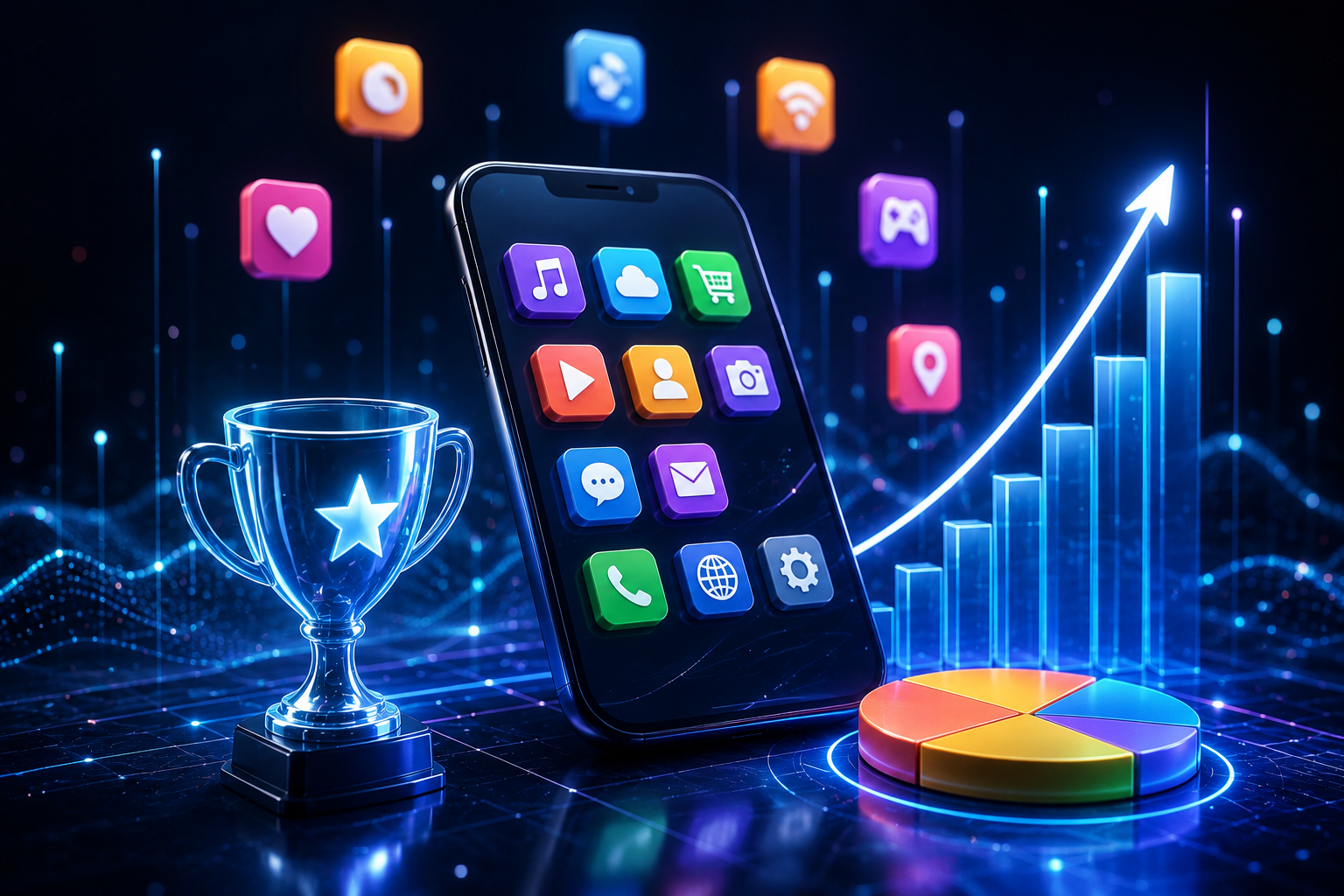

Must-have applications have become deeply integrated into the way people work, communicate, create, travel, learn and manage everyday life.
Yet the definition of a great app is changing.
A few years ago, an innovative application might have stood out because it introduced an entirely new digital service. Today, users already have access to millions of apps, and simply offering another feature is rarely enough.
The applications gaining attention now tend to do something more important.
They remove friction.
They understand context.
They personalize experiences.
They use artificial intelligence where it creates genuine value.
And perhaps most importantly, they give users a reason to return.
Apple’s 2025 App Store Awards recognized 17 apps and games for technical ingenuity and cultural impact, while Google Play’s Best of 2025 awards similarly emphasized ingenuity, usefulness and quality. These selections offer an interesting window into what modern users increasingly value in digital experiences.
The lesson is clear.
The race to create the next must-have application is no longer just about building more technology.
It is about building better experiences.
What Makes Must-Have Applications Stand Out?
A must-have application solves a meaningful problem so effectively that users begin to treat it as part of their routine.
That does not necessarily mean the app needs hundreds of features.
In fact, some of the strongest applications succeed because they do one thing exceptionally well.
Google Play named Focus Friend by Hank Green its Best App of 2025 in the United States, describing it as a simple tool designed to help people disconnect from distractions and remain present.
The example is important because it challenges a common assumption in technology.
Innovation does not always mean complexity.
Sometimes innovation means identifying a familiar problem and solving it in a more engaging, intuitive or effective way.
Modern must-have applications often share several characteristics:
- A clear purpose
- Simple onboarding
- Intuitive navigation
- Personalization
- Fast performance
- Strong visual design
- Useful notifications
- Cross-device accessibility
- Intelligent automation
- Respect for user time
These elements may appear basic, but together they determine whether an app feels essential or disposable.
AI Is Becoming a Core Feature of Innovative Applications
Artificial intelligence has quickly moved from being a headline feature to becoming infrastructure inside many applications.
The most interesting change is not simply that apps now include AI.
It is how AI is being used.
Successful applications increasingly integrate artificial intelligence into specific workflows rather than treating it as a standalone novelty.
Apple’s 2025 App Store Awards highlighted Tiimo, the iPhone App of the Year, for combining visual planning with AI that helps turn goals into practical next steps. Apple also recognized Detail for AI-assisted video editing and Essayist for helping users handle academic formatting and writing workflows.
In India, Google Play reported that AI had become foundational across several award-winning applications. It highlighted invideo AI for text-to-video creation, Toonsutra for AI-enhanced comic experiences, and District for using AI to analyze user preferences and local dining trends.
The pattern suggests an important principle for app developers:
AI becomes valuable when the technology disappears into the experience.
Users do not necessarily want an app because it contains artificial intelligence.
They want an app because it helps them accomplish something faster, better or more creatively.
Personalization Is Becoming Essential
One-size-fits-all applications are becoming less competitive.
Users increasingly expect digital experiences to adapt to their interests, habits and circumstances.
Streaming platforms recommend content.
Fitness applications adjust workouts.
Financial apps categorize spending.
Travel platforms surface relevant destinations.
Shopping applications personalize product discovery.
Local discovery apps can recommend restaurants and events based on individual interests.
Google highlighted this trend when discussing District, its Best App of 2025 in India. The platform combines movies, events and dining while using AI to interpret individual taste profiles and real-time local trends.
This is where personalization becomes more than convenience.
It becomes a competitive advantage.
The strongest must-have applications can reduce the amount of searching, filtering and decision-making users need to perform.
Instead of presenting every possible option, they help identify the most relevant one.
Simplicity Has Become a Form of Innovation
Technology companies frequently assume that innovation requires adding functionality.
Users often experience the opposite.
Every new button, tab, menu or notification creates another decision.
The most successful applications frequently hide complexity behind simple interfaces.
A sophisticated recommendation engine may operate in the background while the user sees only a few relevant suggestions.
An advanced AI model may analyze information invisibly while the interface presents one clear answer.
A productivity platform may integrate dozens of processes while giving users a straightforward daily view.
This principle is visible across many award-winning applications.
Apple’s 2026 Design Awards continue to recognize apps based not only on technical achievement, but also on innovation, interaction, inclusivity, visual quality and overall user experience.
Great technology therefore needs great restraint.
The user should benefit from complexity without being forced to manage it.
Must-Have Applications Solve Everyday Problems
Another major shift in application innovation is the move toward everyday utility.
The next breakthrough application does not necessarily need to create an entirely new behavior.
It can improve an existing one.
Consider the daily activities people already perform:
- Planning their schedules
- Managing finances
- Editing content
- Learning languages
- Taking notes
- Tracking health
- Booking experiences
- Communicating
- Shopping
- Managing work
Each activity contains friction.
Apps that remove that friction can become indispensable.
Google Play’s 2025 selections included applications focused on concentration, personal growth, language learning, note-taking, sleep and everyday productivity.
That diversity demonstrates why the concept of a “must-have app” is becoming increasingly personal.
There may no longer be one universal application of the year.
Instead, there are applications that become essential within particular moments of a person’s life.
The Rise of Multi-Device Experiences
Modern users rarely operate from one screen.
They may begin a task on a smartphone, continue it on a tablet and complete it on a computer.
Wearables add another layer.
Smart TVs, cars and connected devices expand the ecosystem further.
As a result, must-have applications increasingly need to think beyond the smartphone.
Google named Luminar: Photo Editor its Best Multi-device App of 2025, highlighting the ability to use AI-powered editing tools across different devices.
Apple’s awards also span iPhone, iPad, Mac, Apple Watch, Apple TV and Vision Pro, illustrating how applications are increasingly designed around ecosystems rather than individual devices.
The strongest experiences allow users to move naturally between devices without losing context.
That means synchronizing:
- Accounts
- Preferences
- Files
- Progress
- History
- Settings
- Notifications
Continuity is becoming an important part of application design.
Attention Is Becoming the New Battleground
Modern applications compete for something more limited than storage space.
They compete for attention.
Users receive messages, notifications, emails, videos, advertisements and recommendations throughout the day.
Every application wants engagement.
But excessive engagement can become counterproductive.
This is why tools designed to help people focus are gaining relevance.
Google’s selection of Focus Friend as its Best App of 2025 reflects a wider shift toward digital products that respect attention rather than constantly attempting to capture it.
This creates an interesting challenge for developers.
Traditional app metrics often reward:
- More sessions
- Longer usage
- More notifications
- Higher engagement
But the best user experience may sometimes involve helping users finish a task quickly and leave.
The future of application design may therefore involve optimizing for value rather than simply time spent.
Local Relevance Can Create Global-Quality Apps
Another important trend is the rise of applications designed around specific regional behaviors.
Innovation does not have to begin in Silicon Valley or target every market simultaneously.
Google Play’s 2025 India awards demonstrated how locally relevant experiences can become major platforms.
District was named India’s Best App of 2025 for bringing together entertainment, events and dining in a format designed around urban Indian users. Google also highlighted Indian applications incorporating AI, regional content and culturally relevant experiences.
This suggests a powerful opportunity for developers.
Global technology standards can be combined with local customer understanding.
A company may use:
global technology + local insight + specialized distribution
to create an application that feels unusually relevant to its target users.
That can be difficult for generic global platforms to replicate.
Design Still Matters in an AI-First World
Artificial intelligence may dominate technology discussions, but design remains fundamental.
Users rarely evaluate an application based on the sophistication of its code.
They evaluate how it feels.
Is it intuitive?
Is it attractive?
Can they find what they need?
Does it respond quickly?
Does it feel trustworthy?
Apple’s Design Awards explicitly recognize qualities including innovation, interaction, inclusivity, social impact and visual design.
This reflects an important reality.
Powerful technology with poor usability remains a poor product.
As AI makes software development faster and more accessible, design quality may become an even stronger differentiator.
When more companies can build technically capable products, the companies that understand human behavior may stand out.
Privacy Will Define Trust in Must-Have Applications
Personalization requires data.
AI often requires data.
Recommendations require data.
Location services require data.
Connected experiences require data.
This creates a growing tension.
Users want applications to understand them, but they also want control over their information.
A useful app may know:
- Where someone is
- What they search for
- What they buy
- What they watch
- Who they communicate with
- What they create
- What their routines look like
That can create remarkable convenience.
It also creates responsibility.
Developers building the next generation of must-have applications need to treat privacy as part of product design rather than a legal document hidden behind the settings menu.
Trust can become a competitive advantage.
An application that explains clearly what it collects and why may be better positioned to build long-term relationships with users.
Why Some Innovative Apps Fail
Innovation alone does not guarantee adoption.
Many technologically impressive applications disappear because they fail to solve a sufficiently important problem.
Common reasons include:
Too Much Complexity
The product offers more features than users actually need.
Weak Product-Market Fit
The technology works, but customers do not value it enough to build a habit around it.
Poor Onboarding
Users leave before understanding the benefit.
Notification Overload
The application creates annoyance instead of usefulness.
No Clear Differentiation
The product looks similar to dozens of alternatives.
Weak Retention
Users download the app but do not return.
Innovation Without Purpose
The company builds around a technology rather than a meaningful user problem.
This is why app store charts alone do not tell the complete story.
Downloads can indicate curiosity.
Retention indicates value.
The App of the Future May Be a Super App
One of the emerging questions in application design is whether users will continue juggling dozens of individual tools.
AI could change that model.
Instead of opening separate applications for planning, search, writing, travel and productivity, users may increasingly interact with broader AI platforms capable of handling multiple tasks.
The concept is similar to the super-app model that has already succeeded in parts of Asia.
The difference is that generative AI and intelligent agents could make these platforms more adaptive.
This creates two possible futures.
One is consolidation, where a few large platforms handle a growing share of everyday digital tasks.
The other is specialization, where smaller applications win because they provide deep expertise and better experiences for specific needs.
Both models can coexist.
General-purpose platforms may handle broad requests.
Specialized apps may dominate where expertise, community or unique workflows matter.
What Developers Can Learn From the Year’s Best Applications
Looking across Apple and Google’s recent award selections, several patterns become visible.
The strongest apps tend to combine:
Intelligent Assistance
Technology handles work that would otherwise require time or specialist knowledge.
Clear User Value
The benefit is immediately understandable.
Thoughtful Design
The interface makes complex capabilities easy to use.
Personalization
The experience becomes more relevant over time.
Emotional Connection
The application does not simply function well. It feels enjoyable, useful or meaningful.
Cross-Device Thinking
The experience follows users wherever appropriate.
Responsible Innovation
Technology serves a purpose rather than existing purely as a marketing feature.
These qualities offer a useful roadmap for anyone building digital products.
What Users Should Look for in a Must-Have Application
For users, the easiest way to evaluate a new application is to ignore the hype and ask practical questions.
Does it solve a real problem?
Does it save time?
Is it easier than the alternative?
Does it protect personal information?
Does it work reliably?
Does it reduce complexity?
Will you realistically use it after the first week?
The best application is rarely the one with the longest feature list.
It is the one that earns a permanent place in your routine.
The Bigger Picture
The idea of the “application of the year” is changing.
Innovation is no longer measured only by introducing something that has never existed before.
Increasingly, innovation means taking complicated technology and making it genuinely useful.
The best must-have applications combine artificial intelligence, personalization, design, simplicity and contextual understanding without overwhelming the user.
Apple’s recent App Store and Design Awards emphasize technical ingenuity, user experience and design, while Google Play’s winners demonstrate the growing importance of usefulness, focus, AI integration and multi-device experiences.
The next great application may not be the one that demands more of our attention.
It may be the one that understands what we need, helps us accomplish it faster and then gets out of the way.
That represents a more mature definition of innovation.
Not technology for technology’s sake.
Technology that earns its place in everyday life.
Stay connected with Business Herald for the latest business news, insights, and updates.
Follow us on Facebook, Instagram, LinkedIn, and YouTube.
Join our growing community on WhatsApp and Telegram for real-time updates delivered directly to you.