

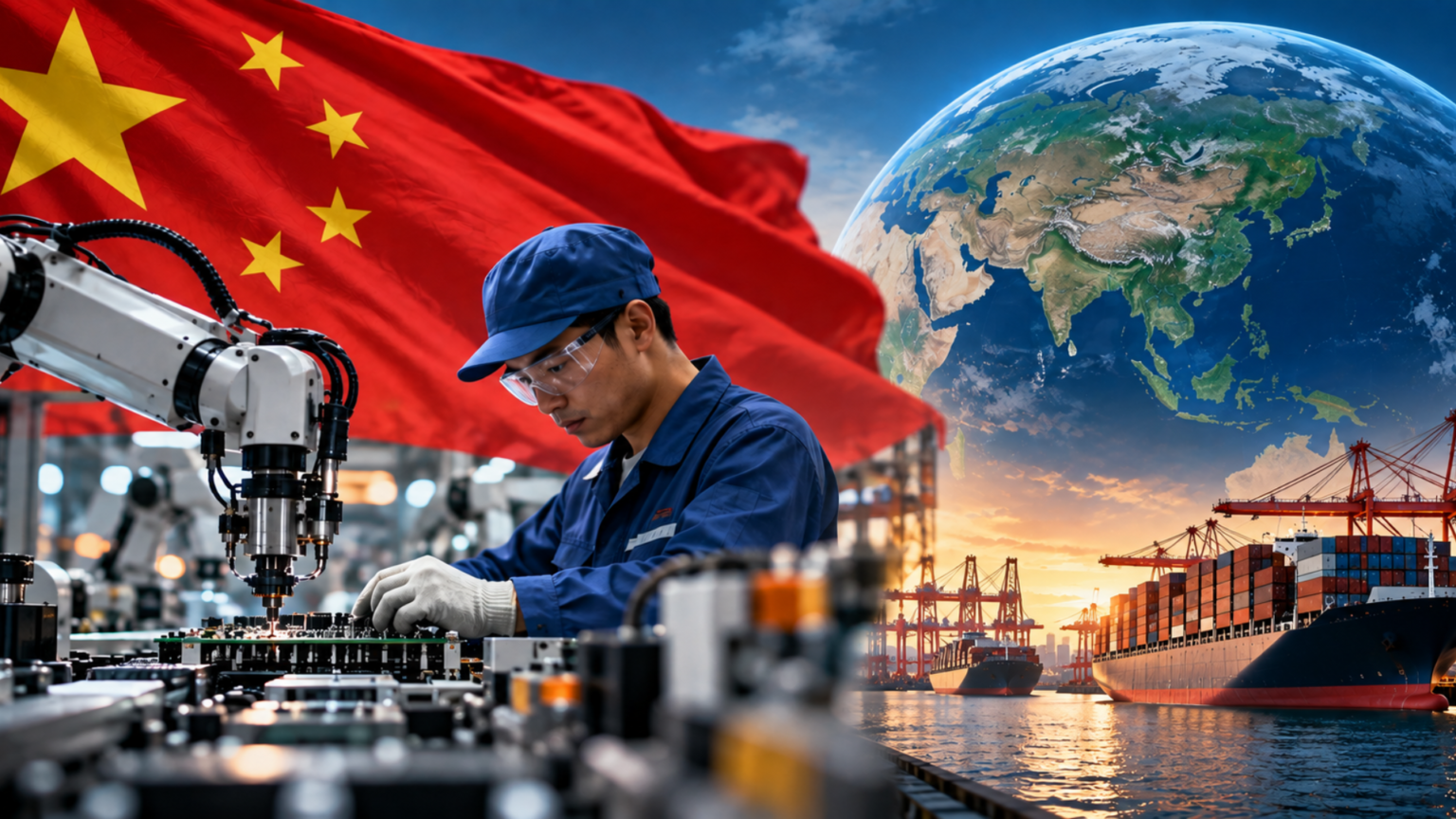

Little Giants occupy the parts of the industrial economy that rarely attract public attention but can determine whether entire production systems advance or stall. They build precision components, specialist materials and critical technologies that larger manufacturers cannot readily replace. China has spent years identifying these companies and drawing them into a coordinated national strategy.
The objective extends well beyond helping small businesses grow. Beijing wants to cultivate specialist manufacturers capable of closing technological gaps, strengthening domestic supply chains and reducing dependence on foreign expertise in industries central to future economic and geopolitical power.
The latest expansion of the programme makes the scale of that ambition clearer. A five-year plan released in September by 10 Chinese government agencies aims to increase the number of nationally recognised Little Giants to 22,000 by 2030.
It also seeks to establish 600 national clusters of specialised small and medium-sized enterprises, raise revenue per employee by about 15 per cent and increase annual research and development spending by industrial SMEs by more than 8 per cent.
The sectors include robotics, advanced materials, new energy, quantum technology, brain-computer interfaces and embodied artificial intelligence. Progress in each depends not only on large companies or state laboratories, but also on obscure suppliers producing precise components, instruments and materials.
That is the central idea behind the strategy. Industrial power often rests with companies most consumers will never encounter.
The Companies Behind The Finished Product
A modern robot, electric vehicle, semiconductor production line or medical device is assembled from layers of specialised knowledge. One company may build precision reducers for robotic joints. Another may produce industrial sensors able to withstand extreme temperatures. A third may manufacture a chemical coating essential to battery performance.
These businesses rarely receive the attention given to consumer brands. Yet replacing them can be difficult and slow. Their value lies in accumulated engineering knowledge and the ability to solve narrow technical problems repeatedly. One overlooked supplier can determine whether an entire production line operates.
China’s Little Giants policy is designed around this reality. The companies selected are expected to be specialised, technically sophisticated and capable of producing distinctive or innovative products. Many occupy critical positions within supply chains rather than selling complete products to consumers.
Official figures published in 2025 said China had already identified more than 17,600 national-level Little Giants. Nearly 80 per cent operated at important points in supply chains, showing that the new target expands an established system rather than launching an experiment.
Industrial Policy Becomes More Selective
China’s industrial development has long been associated with enormous state-owned companies, sprawling manufacturing zones and subsidies directed towards sectors chosen in Beijing. The Little Giants programme introduces a more selective layer to that model.
Instead of supporting companies simply because they are small, policymakers are attempting to identify firms whose expertise corresponds with national industrial priorities. Certification can improve access to grants, tax advantages, bank credit, public research programmes, venture capital and potential customers. Local governments, universities and state-owned enterprises may all become part of the support network.
The approach resembles an industrial scouting system. Authorities identify technically capable businesses and try to accelerate their development. The aim is to create domestic suppliers capable of filling technological gaps.
China already has a vast SME economy. According to the OECD, it had about 60 million small and medium-sized businesses in 2024. They contribute roughly 60 per cent of GDP, 70 per cent of technological innovation, 80 per cent of urban employment and half of tax revenue. Only a narrow proportion will receive the most valued specialist designations.
Self-Reliance Begins With Components
The policy has acquired greater strategic importance as trade restrictions and geopolitical tensions expose China’s dependence on foreign technology. Export controls affecting advanced semiconductors have demonstrated how access to a small number of critical tools, designs and materials can constrain a much larger industry.
Beijing is therefore trying to deepen domestic capability throughout the production chain. A locally manufactured robot is not independent if its most important sensors, software or control systems remain imported. The same logic applies to energy storage, telecommunications equipment and semiconductor fabrication.
Research from the Cambridge Industrial Innovation Policy group found that around three-quarters of the Little Giants certified between 2019 and 2022 operated in the priority sectors identified under the Made in China 2025 strategy. The continuity is revealing. China has adjusted the language of industrial policy, but the underlying objective remains the construction of stronger domestic capabilities in advanced manufacturing.
The latest plan will allow qualified smaller companies to participate in major national science and technology programmes. That could bring firms closer to publicly funded research, large-scale testing facilities and procurement opportunities that would otherwise remain beyond their reach.
Patient Capital For Slow Technical Work
Specialist manufacturing does not always suit conventional venture capital. Developing an industrial material or precision component may require years of testing, certification and customer trials. Revenue arrives slowly, while the market may be too narrow to produce the rapid expansion many investors expect.
China’s plan responds by promising more “patient capital”, a phrase used for investment willing to wait longer for returns. It also calls for increased bank lending, improved access to bond and equity markets and a second phase of the national SME development fund.
But patient capital is not automatically disciplined capital. Government guidance can extend the time available for genuine innovation, or it can postpone recognition that a company is commercially weak. The quality of selection, oversight and eventual withdrawal will matter as much as the volume of funding.
The Risk Of Producing Too Many Winners
China’s industrial policy has generated formidable manufacturing ecosystems. It has also produced duplication, excess capacity and competition among local governments backing fashionable sectors.
When official designation improves access to money and prestige, companies have an incentive to shape themselves around the criteria. Patents and technological claims can become instruments for securing recognition rather than evidence of durable advantage. Local authorities may also back similar projects in several neighbouring regions.
The result can be an uncomfortable paradox. A programme intended to cultivate highly specialised firms may encourage imitation if too many participants pursue the same politically favoured opportunity.
Research on early-stage Chinese technology firms has cautioned against treating patents as proof of productive innovation. Customer adoption, revenue and productivity offer more demanding tests.
The 2030 target of 22,000 Little Giants will therefore need to be judged by more than the number of certificates issued. The stronger questions concern how many firms establish defensible technology, win demanding customers and compete without permanent protection.
A New Challenge For Global Manufacturers
For decades, advanced economies retained an advantage in the machinery and industrial systems used inside factories, even as final assembly shifted towards China. German, Japanese and American suppliers occupied profitable positions upstream.
That division is changing. Chinese companies are increasingly selling industrial robots, machine tools, battery equipment and other capital goods abroad. Their competitive position combines lower costs with access to an extensive domestic manufacturing base, dense supplier networks and customers willing to test products quickly.
If Little Giants become globally capable suppliers, competition will intensify in the business-to-business markets that have traditionally received less political attention than electric vehicles or consumer electronics. The next “China shock” may not consist mainly of finished products arriving in Western shops. It may come through the machinery and intermediate goods purchased by factories across emerging markets.
This prospect will sharpen disputes over subsidies. OECD research has found that Chinese industrial firms receive substantially more government support than competitors in other major economies. The United States, Europe and parts of Asia are responding with grants, procurement policies and trade restrictions.
China’s programme could therefore prompt other countries to build their own versions of specialist-manufacturer policy. The challenge will be supporting genuinely valuable capabilities without protecting every company that describes itself as strategic.
Scale Alone Will Not Settle The Race
The strategy recognises that innovation is an ecosystem rather than a sequence of isolated breakthroughs. Laboratories can generate knowledge, but factories require suppliers, engineers, testing facilities, finance and customers. China has become effective at connecting these elements and moving products from prototypes to industrial scale.
Subsidies alone do not explain that strength. China also benefits from engineering talent, infrastructure, concentrated supply chains and a market capable of supporting rapid experimentation. Foreign executives increasingly visit its manufacturing centres to study the speed at which hardware can be designed, tested and revised.
Still, scale can conceal weakness. A large number of supported firms does not guarantee original research, efficient investment or international trust. Chinese manufacturers may face barriers involving data security, intellectual property, export controls and political resistance. Some technologies will also remain dependent on foreign tools or scientific collaboration despite determined efforts at localisation.
The Contest Is Moving Below The Brand
The Little Giants programme offers a useful view of where global industrial competition is heading. The most consequential companies may not be the businesses with the largest advertising budgets or the most recognisable founders. They may be specialist manufacturers controlling a process or component that hundreds of other companies require.
China wants more of those companies, and it is constructing a system intended to find them early, finance them patiently and connect them with national priorities. Whether that system produces lasting technological strength or another cycle of state-backed excess will depend on commercial discipline as much as political commitment.
Other countries face their own decision. They can dismiss the programme as another expression of Chinese subsidy policy, or examine why small industrial suppliers have become strategically important. Rebuilding manufacturing capacity requires more than attracting a famous factory. It requires cultivating the less visible businesses that make advanced production possible.
That is the contest now taking shape. The largest industrial powers are competing through some of their smallest companies.
Stay connected with Business Herald for the latest business news, insights, and updates.
Follow us on Facebook, Instagram, LinkedIn, and YouTube.
Join our growing community on WhatsApp and Telegram for real-time updates delivered directly to you.