

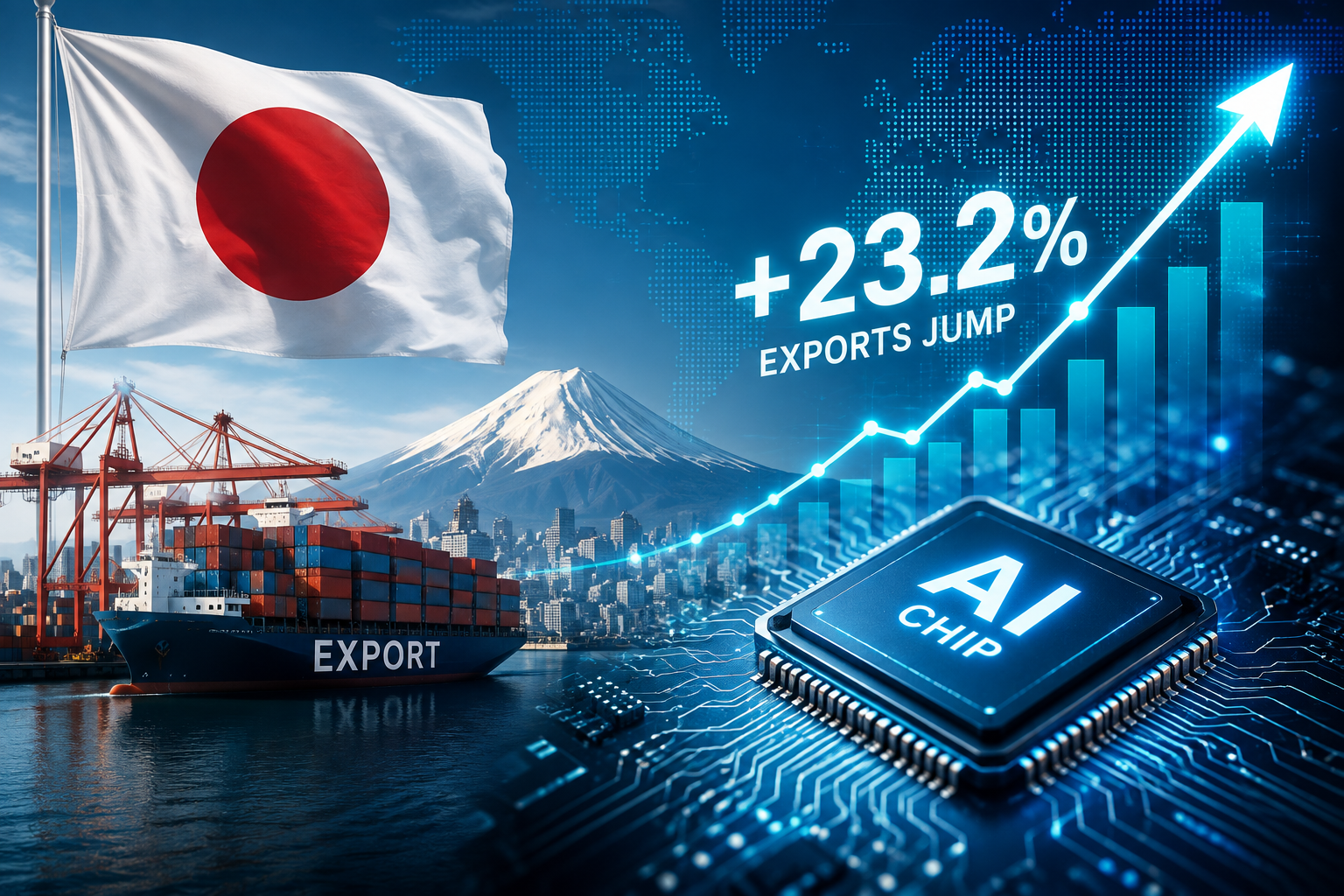

Japan exports rose to an all-time monthly high in July, giving one of the clearest signs yet that the global investment boom around artificial intelligence is beginning to show up in national trade data.
Exports increased 23.2% from a year earlier to a record ¥11.5 trillion, or roughly $72.6 billion, beating the 19.9% rise expected by economists surveyed by Reuters. Strong demand linked to semiconductors and AI data centres helped drive the increase, while a weaker yen also supported the value and competitiveness of Japanese goods overseas.
The numbers matter beyond Japan. They show how spending on AI infrastructure is spreading through the industrial economy, supporting companies that make the machinery, electronic components, and specialist equipment needed to build computing capacity.
Japan Exports Reach a Record as AI Demand Strengthens
The July increase followed a 19.3% rise in June and marked another strong month for an economy that has increasingly relied on overseas demand.
Exports to the United States climbed 22% from a year earlier, while shipments to China rose 25.8%. Overall export growth exceeded market expectations by more than three percentage points.
The driving force was not a single AI product.
Japan sits at several important points in the global semiconductor supply chain. Its companies supply chipmaking equipment, precision components, electronic materials, and industrial machinery used by semiconductor manufacturers and data-centre suppliers around the world.
As technology companies continue spending heavily on AI infrastructure, demand travels through that supply chain.
A new data centre may be built by a U.S. cloud company, filled with processors designed by an American chipmaker and assembled elsewhere in Asia. But the manufacturing equipment, materials and components supporting those chips can still generate orders for Japanese companies.
That is why the AI investment cycle is starting to become visible in trade figures rather than remaining confined to the earnings reports of large technology companies.
AI Chip Demand Is Becoming an Industrial Growth Story
The AI boom is often discussed through companies such as Nvidia, Microsoft, Amazon, Meta and Alphabet.
Japan’s latest trade numbers show another side of the same investment cycle.
Building AI computing capacity requires far more than advanced processors. Semiconductor factories need sophisticated production equipment. Data centres require power systems, cooling infrastructure, networking hardware and a steady supply of electronic components.
Japan has long specialised in many of these less visible parts of the technology supply chain.
That gives the country an economic advantage as global AI investment moves from software development into physical infrastructure.
The July data does not mean that every percentage point of Japan’s export growth came from artificial intelligence. Higher prices and currency movements also lifted the value of shipments. Reuters noted that export volumes were less impressive than the headline value figures might suggest.
Still, semiconductor-related demand tied to AI data centres was strong enough for Japan’s Ministry of Finance data to become another indicator of the scale of current technology spending.
For investors, this widens the AI trade.
The beneficiaries are no longer limited to companies designing large language models or selling graphics processors. Manufacturers of specialised equipment, industrial components and materials are increasingly tied to the same capital-spending cycle.
Record Imports Show the Other Side of Japan’s Trade Story
Japan’s export performance looks less comfortable when imports are included.
Imports rose 27.8% from a year earlier to a record ¥12.1 trillion, exceeding the 26.5% increase expected by economists. Japan therefore recorded a trade deficit of ¥634.5 billion in July, although the shortfall was smaller than the ¥680 billion forecast.
Energy was the main pressure. Japan imports much of the fuel required to power its economy. Disruptions linked to the conflict in the Middle East have increased oil and commodity costs, while a weaker yen makes imports priced in U.S. dollars more expensive.
Crude oil import volumes rose 5.5% from a year earlier, the first increase in four months. The value of those imports jumped 87.8%.
Some of that increase reflects Japan sourcing more expensive barrels from alternative suppliers, including the United States, after disruptions to Middle Eastern shipments.
This leaves Japan in an unusual position. AI-related global investment is supporting its export industries at the same time as geopolitical instability is sharply increasing the cost of the energy needed to run the domestic economy.
The result is a record trade in both directions, but still a deficit.
Japan Exports Are Supporting an Economy With Weak Domestic Demand
Strong Japan exports have become more important because demand at home remains uneven.
Separate economic data released this week showed that Japan’s economy expanded for a third consecutive quarter in the April to June period. Exports helped compensate for weaker private consumption and business investment.
That reliance creates both an opportunity and a vulnerability.
As long as global spending on semiconductors, data centres and advanced manufacturing remains strong, Japanese exporters are well placed to benefit.
A slowdown in AI infrastructure spending would have the opposite effect.
Technology investment is notoriously cyclical. Semiconductor companies can move quickly from shortages to excess capacity when customers order too aggressively. The current demand cycle is unusually strong, but investors should not assume that record growth rates will continue indefinitely.
There is also a currency effect.
The weaker yen makes Japanese exports more competitive and increases the yen value of overseas sales. But the same currency weakness raises the cost of imported oil, gas and other commodities.
That tension has become a recurring feature of Japan’s economy.
Higher Trade Costs Add Pressure on the Bank of Japan
The trade numbers also feed directly into the debate over Japanese interest rates.
Higher energy and commodity costs are adding to inflationary pressure. Japan’s producer prices rose 7.2% in July from a year earlier, according to data cited by Reuters.
At the same time, strong exports give policymakers more confidence that the economy can withstand tighter monetary policy.
Reuters reported that the Bank of Japan could raise interest rates as early as September as it continues moving away from years of exceptionally loose monetary policy.
The decision is not straightforward.
Higher rates could help contain inflation and support the yen. They also raise financing costs for businesses and households at a time when domestic consumption is already weak.
For the Bank of Japan, record exports are therefore helpful but not enough on their own.
The central bank has to judge whether overseas demand remains strong enough to support growth while higher energy costs squeeze consumers at home.
[LINK: related Business Herald analysis on Bank of Japan interest-rate policy]
Japan’s Industrial Supply Chain Is Becoming Part of the AI Trade
The broader lesson from Japan’s July figures is that artificial intelligence is beginning to affect parts of the economy that rarely appear in AI headlines.
A new model release may attract attention. A semiconductor fabrication plant, industrial toolmaker or data-centre equipment supplier is less visible.
Economically, those businesses can be just as important.
Japan’s position in advanced manufacturing gives it exposure to the enormous physical investment required to build AI capacity. The record ¥11.5 trillion export figure suggests that demand is already moving through those supply chains.
That does not make Japan’s trade position universally strong. The ¥12.1 trillion import bill shows how vulnerable the country remains to oil prices, shipping disruption, and currency weakness.
For now, however, the AI infrastructure cycle is providing a valuable source of external demand.
The next question for investors is whether semiconductor and data-centre spending can remain strong enough to offset those rising energy costs.
Japan’s July trade numbers suggest it can, at least for the moment. They also provide evidence that the AI investment boom is no longer only a technology-sector story. It is beginning to reshape manufacturing, exports, and trade flows across the wider global economy.
Stay connected with Business Herald for the latest business news, insights, and updates.
Follow us on Facebook, Instagram, LinkedIn, and YouTube.
Join our growing community on WhatsApp and Telegram for real-time updates delivered directly to you.