

High altitude travel has a way of changing perspective.
At elevation, landscapes become larger, horizons seem more distant and ordinary routines give way to something far more elemental. Snow-covered peaks rise above valleys, mountain passes reveal enormous expanses of wilderness and isolated communities demonstrate how people have adapted to environments where weather, terrain and oxygen shape everyday life.
This is part of what makes travelling in the world’s great mountain regions so compelling.
The Himalayas, Andes, Alps and other high-elevation landscapes attract trekkers, photographers, climbers, cultural travellers and adventure seekers for different reasons.
Some want to reach a famous summit.
Others want nothing more than to walk through a mountain village, watch sunrise illuminate a distant peak or experience the silence of a landscape far removed from city life.
But altitude changes the rules of travel.
Higher elevation places additional demands on the body, weather can change rapidly and journeys often take place far from immediate medical or logistical support.
The best high altitude travel experiences therefore combine adventure with preparation.
What Is High Altitude Travel?
High altitude travel generally refers to journeys into environments where reduced atmospheric pressure means less oxygen is available with each breath.
The CDC considers travellers going to elevations above approximately 2,450 metres, or 8,000 feet, to be at risk of altitude illness, particularly when ascent occurs rapidly.
That does not mean every traveller will become ill.
It does mean the body needs time to adapt.
High-elevation trips can include:
- Trekking through mountain ranges
- Visiting high-altitude cities
- Crossing mountain passes
- Staying in remote alpine villages
- Skiing at elevated resorts
- Mountaineering
- High-altitude road trips
- Expedition travel
- Cultural journeys across mountain regions
Each experience has different physical demands.
Someone flying directly into a high-altitude city faces a different situation from a trekker who gradually gains elevation over several days.
The common factor is reduced oxygen availability and the body’s need to acclimatize.
Why High Altitude Travel Feels So Extraordinary
Mountains create a sense of scale that is difficult to experience elsewhere.
At sea level, buildings often dominate the horizon.
At altitude, the landscape dominates everything.
A trail may wind through forests before emerging onto an exposed ridge where entire valleys suddenly appear below.
Clouds can sit beneath the traveller rather than above them.
Glaciers, rock faces and snowfields reveal geological processes on a scale that feels almost timeless.
This visual drama is one reason high altitude travel remains deeply associated with exploration.
But the appeal goes beyond scenery.
Silence Becomes Part of the Experience
Remote mountain environments often have fewer vehicles, fewer crowds and less artificial noise.
Wind, flowing water, footsteps and distant wildlife can become the dominant sounds.
That quietness changes the rhythm of travel.
People walk more slowly.
They observe more closely.
Distances become meaningful again.
A mountain pass that looks close on a map may require hours of climbing.
The journey becomes as important as the destination.
The World’s Great High Altitude Landscapes
Mountain travel takes different forms around the world.
Each region combines altitude with its own geography, climate and cultural history.
The Himalayas
The Himalayas contain some of the highest landscapes on Earth.
Stretching across several countries, the range is home to enormous peaks, high valleys, Buddhist monasteries, traditional settlements and some of the world’s best-known trekking routes.
Nepal’s Everest and Annapurna regions attract international trekkers, while India offers high-altitude experiences across Ladakh, Himachal Pradesh, Uttarakhand and Sikkim.
Bhutan provides another distinctive mountain experience, where dramatic Himalayan landscapes are combined with monasteries, traditional architecture and carefully managed tourism.
What makes Himalayan travel memorable is not only the elevation.
It is the relationship between mountains and culture.
Villages, pilgrimage routes and monasteries reveal communities that have lived alongside these landscapes for generations.
The Andes
The Andes stretch along western South America and create a completely different high-altitude environment.
Travellers encounter volcanic landscapes, enormous plateaus, colourful mountain formations, ancient ruins and cities built at elevations that surprise many first-time visitors.
Peru, Bolivia, Ecuador, Chile and Argentina all offer remarkable high-elevation experiences.
The Andes also demonstrate an important reality of altitude travel.
You do not need to climb a mountain to reach significant elevation.
Cities, archaeological sites and roads can already place visitors high enough for acclimatization to matter.
The European Alps
The Alps offer some of the world’s most developed mountain tourism infrastructure.
Switzerland, France, Italy, Austria and neighbouring countries combine dramatic peaks with extensive rail networks, cable cars, mountain huts and established hiking routes.
This infrastructure makes high mountain scenery accessible to a broad range of travellers.
It can also create a false sense of security.
A cable car can transport someone from a valley to high elevation very quickly.
The journey may feel effortless, but the body still experiences the change in altitude.
High Altitude Travel Begins With Acclimatization
The most important concept in altitude travel is acclimatization.
As elevation increases, atmospheric pressure decreases and each breath provides less oxygen than it would at lower elevation.
The body begins adjusting to this change.
But adaptation takes time.
The CDC recommends staged ascent where practical and advises travellers to avoid going directly from low elevation to sleeping above 2,750 metres, or 9,000 feet, in a single day when possible. For travellers already above 3,000 metres, it recommends limiting increases in sleeping elevation to around 500 metres per day and adding an extra acclimatization day for every 1,000 metres gained.
These recommendations illustrate an important principle:
How quickly you climb can matter as much as how high you climb.
Why Rushing to Altitude Can Be Dangerous
Modern transportation has changed mountain travel.
A journey that once required several days can now happen within hours.
Travellers can fly from sea level to a high mountain city or drive rapidly into elevated terrain.
The convenience is remarkable.
The body, however, cannot always adapt at the same speed.
Rapid ascent increases the risk of altitude illness. Both the CDC and Wilderness Medical Society emphasize gradual ascent as one of the most important preventive strategies.
This is why a slower itinerary can actually create a better trip.
An acclimatization day is not necessarily a lost day.
It may be an opportunity to explore a town, take a gentle walk, experience local food and culture or simply allow the body to adjust.
Understanding Acute Mountain Sickness
Acute mountain sickness, commonly known as AMS, is one of the main concerns associated with high altitude travel.
According to the CDC, headache is the characteristic symptom and can occur alongside dizziness, fatigue, nausea, appetite loss and occasionally vomiting. Symptoms usually appear within several hours of arriving at high altitude or after ascending higher.
A traveller should never assume that worsening altitude symptoms are simply part of the adventure.
The key principle is straightforward:
Do not continue ascending when symptoms of altitude illness are becoming worse.
Rest, monitoring and descent may be necessary depending on the severity of symptoms.
Know the Serious Warning Signs
Most travellers who experience altitude-related symptoms will not develop severe illness.
However, altitude illness can progress into potentially life-threatening conditions.
Two particularly serious forms are:
High Altitude Cerebral Edema
High altitude cerebral edema, or HACE, affects the brain.
Confusion, altered mental state and difficulty walking normally are major warning signs requiring urgent action.
High Altitude Pulmonary Edema
High altitude pulmonary edema, or HAPE, involves fluid accumulation in the lungs.
It can cause increasing breathlessness, reduced exercise ability and respiratory distress.
Both conditions require urgent management, and descent is a critical intervention when severe altitude illness develops. Wilderness Medical Society guidelines provide evidence-based recommendations for prevention, diagnosis and treatment of AMS, HACE and HAPE.
Travellers should understand these risks before entering remote high-altitude environments.
Fitness Does Not Guarantee Protection From Altitude Illness
One of the most persistent misconceptions about altitude is that physically fit people are automatically protected.
They are not.
Strong cardiovascular fitness may make trekking easier, but it does not guarantee successful acclimatization.
Altitude illness depends significantly on factors such as:
- Rate of ascent
- Sleeping elevation
- Previous response to altitude
- Individual susceptibility
- Time available for acclimatization
The CDC specifically notes that training and physical fitness do not reduce the risk of altitude illness.
This means a highly trained athlete who ascends too quickly can still become ill.
Respect for altitude matters more than confidence.
How to Prepare for High Altitude Travel
Preparation starts long before reaching the mountains.
Build Appropriate Fitness
A high-altitude trekking trip may involve long days of walking, steep ascents and uneven terrain.
Cardiovascular conditioning, strength training and regular hiking can make the physical workload more manageable.
Fitness does not prevent altitude illness, but it can help travellers handle the demands of the journey.
Research the Elevation Profile
Do not look only at the highest point of the trip.
Understand:
- Starting elevation
- Sleeping altitude each night
- Daily elevation gain
- Highest pass or summit
- Available acclimatization days
- Emergency descent routes
Sleeping elevation is particularly important when evaluating an itinerary.
Consult a Medical Professional When Appropriate
Travellers with existing medical conditions, previous serious altitude illness or concerns about high-elevation exposure should discuss their plans with an appropriately qualified healthcare professional.
Depending on the traveller’s risk profile and itinerary, a clinician may discuss preventive medicines such as acetazolamide.
Medication decisions should be made with professional guidance rather than copied from another traveller’s experience.
Packing for High Altitude Travel
Mountain weather rewards preparation.
Temperatures can change dramatically between sunlight and shade, morning and evening, or sheltered valleys and exposed ridges.
Layering is usually more practical than relying on one heavy garment.
A typical high-altitude packing system may include:
- Moisture-managing base layers
- Insulating mid-layers
- Windproof outerwear
- Waterproof protection
- Warm headwear
- Gloves
- Sun protection
- Sunglasses
- Appropriate footwear
- Hydration equipment
- Personal first-aid supplies
Exact requirements depend heavily on season, elevation, activity and destination.
The principle is versatility.
Conditions can change faster than expected.
Sun Protection Matters More at Elevation
Mountain air often feels cool enough that travellers underestimate solar exposure.
High elevation, snow and exposed terrain can increase the importance of protecting skin and eyes.
Snow can reflect significant sunlight toward the face.
Clouds can also create misleading conditions because ultraviolet radiation can remain significant even when temperatures are low.
Good sunglasses, protective clothing and appropriate sunscreen should be considered standard mountain equipment rather than optional accessories.
Hydration Is Important, But It Is Not a Cure
Travellers often hear that drinking large quantities of water prevents altitude sickness.
The reality is more nuanced.
Staying adequately hydrated is sensible because travel, exertion and dry mountain air can contribute to dehydration.
But drinking excessive water does not prevent altitude illness.
Altitude illness is primarily related to hypobaric hypoxia and insufficient acclimatization, not simply dehydration.
The better strategy is to maintain normal hydration while focusing on gradual ascent and symptom awareness.
The First Days Should Be Deliberately Slow
Excitement often encourages travellers to do too much immediately after arriving.
A better strategy is patience.
The first day at altitude may be a good time for:
- Gentle exploration
- Short walks
- Light sightseeing
- Early rest
- Simple meals
- Monitoring how you feel
A demanding trek immediately after rapid arrival at high elevation can place additional stress on a body already adapting to reduced oxygen.
There is no award for reaching the next viewpoint fastest.
Weather Can Transform a Mountain Journey
Altitude creates dramatic weather.
Clear mornings can become stormy afternoons.
Temperatures can fall quickly after sunset.
Snowfall can obscure trails.
Strong wind can make exposed routes significantly more difficult.
Good high altitude travel planning therefore includes weather flexibility.
Avoid building itineraries so tightly that one delayed flight, storm or closed mountain pass ruins the entire journey.
Buffer days are particularly valuable in remote regions.
They create flexibility for both weather and acclimatization.
Travel Insurance Requires Closer Attention
Standard travel insurance policies may not automatically cover every high-altitude activity.
Some policies exclude trekking above specific elevations.
Others distinguish between hiking, mountaineering and technical climbing.
Helicopter evacuation may also require specific coverage.
Before travelling, confirm:
- Maximum covered elevation
- Trekking coverage
- Mountaineering exclusions
- Search-and-rescue provisions
- Emergency evacuation
- Medical treatment abroad
- Trip interruption protection
The cheapest policy is not necessarily the most useful policy for mountain travel.
Read the exclusions carefully.
High Altitude Travel Is Also Cultural Travel
Mountain destinations should not be reduced to scenic backgrounds.
They are home.
Many high-elevation communities have developed remarkable cultural traditions shaped by geography, weather, religion, agriculture and generations of adaptation.
Travellers may encounter:
- Monasteries
- Indigenous traditions
- Mountain festivals
- Distinctive architecture
- Local languages
- Traditional farming
- Regional cuisine
- Historic trading routes
- Sacred landscapes
Approaching these places with curiosity and respect creates a richer experience.
A mountain journey becomes more meaningful when travellers understand not only what they are seeing, but who has lived there and why the landscape matters.
Responsible Tourism Matters More in Fragile Mountain Regions
High-altitude ecosystems can be particularly sensitive.
Vegetation may grow slowly.
Waste can be difficult to remove.
Water may be limited.
Remote communities can face significant pressure when tourism grows faster than local infrastructure.
Responsible travellers should minimize their footprint.
That can mean:
- Carrying reusable bottles
- Reducing single-use plastics
- Staying on established trails
- Avoiding unnecessary waste
- Respecting wildlife
- Supporting locally owned businesses
- Following local rules
- Using water responsibly
- Respecting sacred and cultural sites
The objective should be to experience extraordinary places without contributing unnecessarily to their degradation.
Photography at High Altitude
Mountains are naturally photogenic, but the strongest images usually come from patience rather than constant shooting.
Early morning and late afternoon often create dramatic light across ridges and valleys.
Clouds can add scale.
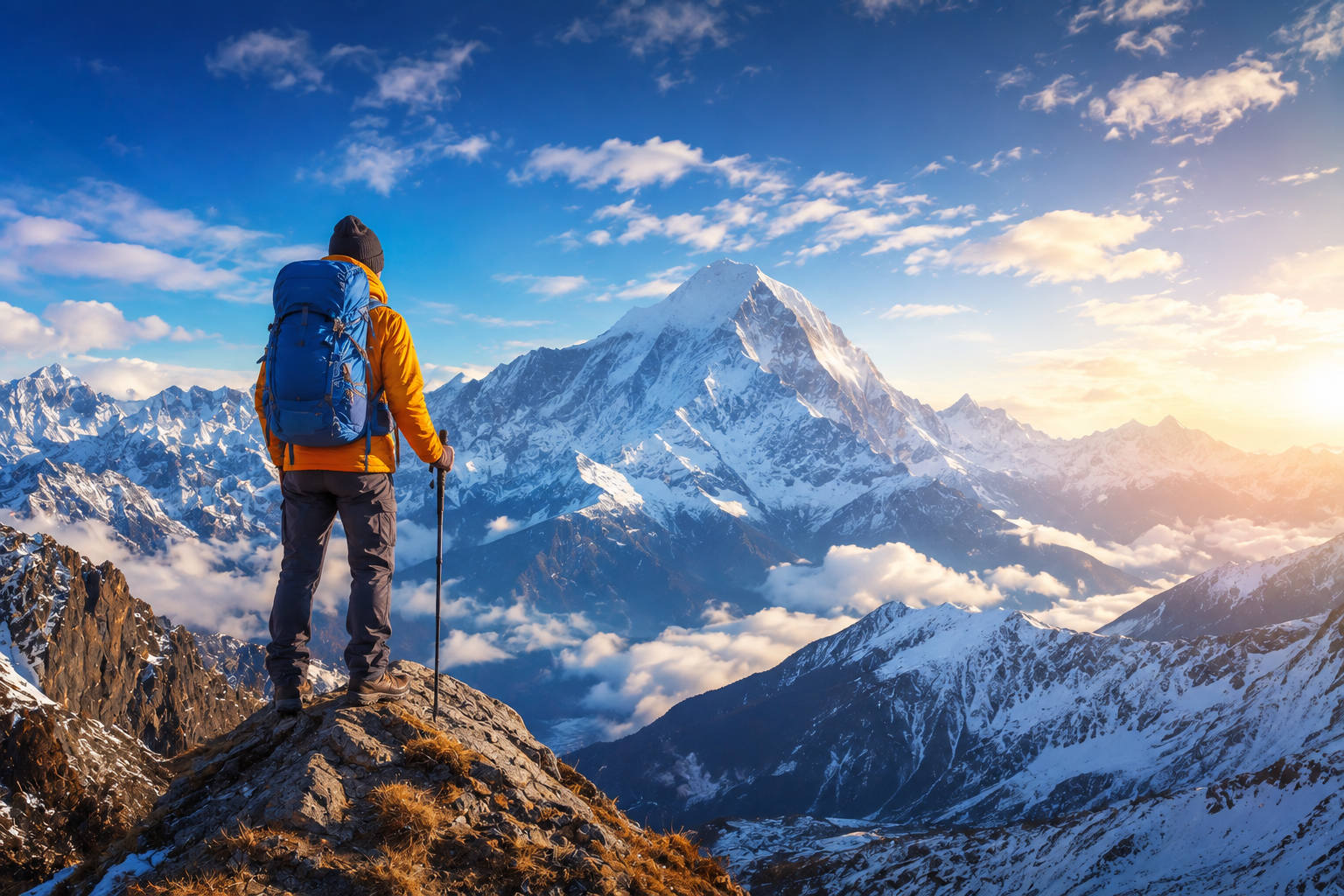
Small human figures can communicate the enormous size of the landscape.
But photography should not distract from safety.
Taking photographs near steep slopes, cliffs or exposed trails requires awareness.
No image is worth taking an unnecessary risk.
The same principle applies to social media.
The desire to capture an impressive image should never override weather warnings, local guidance or personal safety.
Slow Travel Makes Mountains Better
High-altitude destinations naturally encourage slower travel.
That should be embraced.
Adding additional days can provide:
- Better acclimatization
- More cultural interaction
- Flexibility for weather
- Time for photography
- Reduced physical pressure
- Opportunities to explore less crowded areas
The result is often a more memorable journey.
Rushing through mountains turns the itinerary into a checklist.
Moving slowly allows the landscape to become an experience.
When to Turn Around
One of the most important skills in mountain travel is knowing when not to continue.
Reaching a summit, pass or destination can feel psychologically important.
But mountains do not negotiate.
Weather can deteriorate.
A traveller may become exhausted.
Altitude symptoms can worsen.
Equipment can fail.
The safe decision may be to descend.
Turning around is not failure.
It is judgment.
Experienced mountain travellers understand that the objective is not simply to reach a point on the map.
The objective is to return safely with a journey worth remembering.
Why High Altitude Travel Leaves Such a Lasting Impression
Perhaps the greatest appeal of high altitude travel is that the environment changes the traveller’s sense of proportion.
At elevation, nature appears enormous.
Daily concerns can suddenly seem smaller.
Physical effort gives meaning to distance.
A sunrise becomes something earned by waking in darkness and walking through cold air.
A meal tastes different after hours on a trail.
A simple room can feel luxurious after crossing an exposed mountain pass.
These experiences create memories precisely because they are not effortless.
The difficulty becomes part of the beauty.
The Bigger Picture
High altitude travel offers some of the most awe-inspiring experiences available to travellers.
It can place you beneath Himalayan giants, across Andean plateaus, inside remote mountain villages or on alpine trails overlooking landscapes that seem almost unreal.
But altitude rewards humility.
Beautiful scenery does not remove physiological risk.
Fitness does not guarantee acclimatization.
Modern transportation can reach high elevation faster than the human body can comfortably adjust.
The smartest mountain journeys therefore balance ambition with patience.
Ascend gradually.
Understand the itinerary.
Watch for symptoms.
Prepare for changing weather.
Respect local communities.
Travel responsibly.
And allow enough time to experience the mountains rather than simply pass through them.
The greatest reward of scaling peaks is not always standing at the highest point.
Sometimes it is discovering how differently the world looks once you have taken the time to climb toward it.
Stay connected with Business Herald for the latest business news, insights, and updates.
Follow us on Facebook, Instagram, LinkedIn, and YouTube.
Join our growing community on WhatsApp and Telegram for real-time updates delivered directly to you.