


In Austin, an Uber customer can request a ride and, depending on availability and preference, be matched either with a conventional driver or a fully autonomous Waymo vehicle. The passenger is purchasing essentially the same outcome, transportation from one place to another, but the strategic logic behind the two forms of supply is markedly different.
Uber’s core marketplace has spent years improving liquidity, pricing, driver availability, and geographic coverage within a well-understood ride-hailing market, while Waymo has attacked a more fundamental assumption: that a commercial ride requires a human driver at all.
Uber and Waymo now cooperate in Austin and Atlanta, which makes the contrast even more revealing rather than less so, because two distinct strategic models can coexist inside the same customer journey.
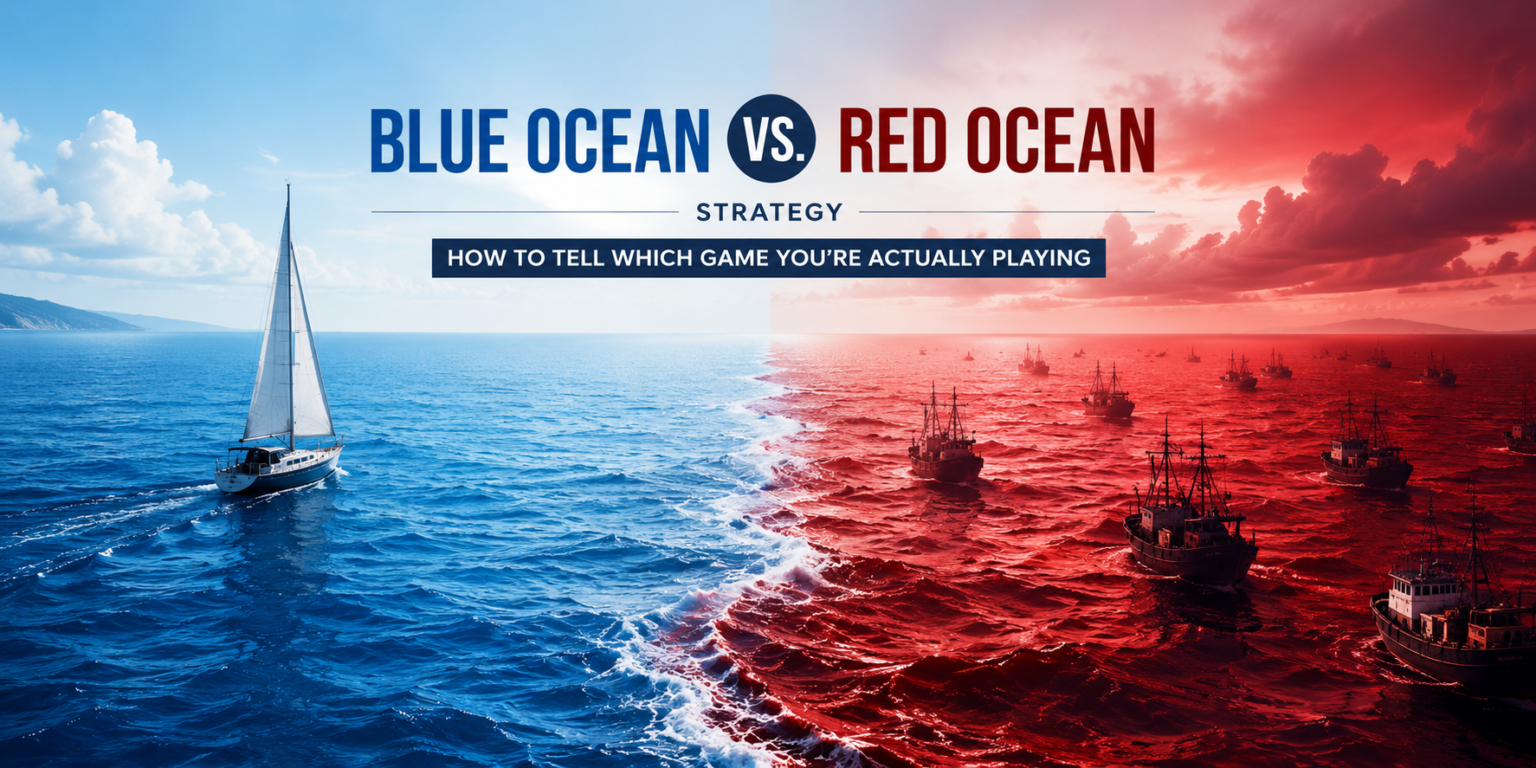
That is a more useful way to think about blue ocean vs red ocean strategy than the usual contrast between crowded markets and empty ones. The real question is whether your company is trying to outperform competitors inside an accepted definition of value, or changing that definition sufficiently to create demand that previously had nowhere obvious to go.
What Blue Ocean and Red Ocean Strategy Actually Mean
Red ocean strategy begins with an existing market whose boundaries are already legible. Customers understand the category, competitors can be named, pricing has reference points, and the basic dimensions of competition have usually settled into a familiar pattern.
The strategic challenge is therefore relative performance: can you offer the product more cheaply, distribute it more efficiently, build a stronger brand, acquire customers at a lower cost, or improve the attributes buyers already use to make comparisons?
Blue ocean strategy asks a different question. Instead of accepting those competitive variables as fixed, it examines whether some can be eliminated, reduced, or radically changed while new sources of customer value are created.
The point is not novelty for its own sake, but what W. Chan Kim and Renée Mauborgne called value innovation, a strategic move that changes the economics or utility of an offering sufficiently to create market space rather than merely redistribute existing demand.
Their Harvard Business Review article, published in 2004, argued that blue oceans can emerge as entirely new industries but are more commonly created when businesses redraw the boundaries of existing ones.
That distinction matters because conventional differentiation can happen entirely inside a red ocean. A premium bank, a faster delivery app, or an AI assistant with a superior interface may be genuinely differentiated without creating new demand.
A market differentiation strategy becomes blue-ocean-like only when it changes who can participate, what the buyer substitutes against, or which old industry trade-offs remain necessary.
| Dimension | Red Ocean | Blue Ocean |
|---|---|---|
| Competitive focus | Beat identifiable rivals | Alter the basis of competition |
| Demand | Capture existing demand | Create or unlock new demand |
| Pricing | Anchored by category benchmarks | Potentially less constrained initially |
| Primary risk | Margin pressure and imitation | Adoption and market-education risk |
| Strategic question | Why should buyers choose us? | Why should this new choice exist? |
The demarcation is therefore better treated as a competitive strategy framework than as a taxonomy of innovative versus conventional companies. A business can move between the two, and large companies often operate in both simultaneously.
Red Ocean Strategy in Practice
Red-ocean competition is frequently described as strategically inferior, yet that conclusion ignores one of its largest advantages: somebody else has already proved that customers want what you sell. The task is difficult because competitors can observe and respond to almost every move, but management is working with a demand that is visible rather than hypothetical.
Quick commerce: scale inside a known battlefield
India’s quick-commerce market offers one of the clearest contemporary red ocean strategy examples because Blinkit, Zepto and Swiggy Instamart are no longer persuading urban consumers that rapid grocery delivery is a category worth trying. They are increasingly competing over who serves that established demand more effectively.
Bain & Company and Flipkart estimated that quick commerce accounted for more than two-thirds of India’s online grocery orders in 2024, with the sector reaching roughly $6 billion to $7 billion in gross merchandise value. The attraction of that growth has encouraged broader competition, including initiatives from Amazon, Flipkart and other established retailers, while the principal quick-commerce platforms continue adding dark stores, categories and geographic coverage.
What makes the market strategically red is not simply the number of competitors. It is the convergence of the variables on which they compete. Delivery speed, assortment, availability, discounts, fulfilment density, private labels, fees and increasingly unit economics all provide visible points of comparison. In August 2026, Swiggy was preparing to move Instamart toward an inventory-led structure similar to Blinkit’s model, partly because greater inventory control could improve margins, purchasing economics and supply-chain efficiency.
That is classic red-ocean behaviour: a rival demonstrates an economically attractive operating mechanism, others study it, and the source of advantage gradually shifts from the idea itself toward execution. Yet entering such a market is not necessarily timid. Proven demand can justify heavy infrastructure spending because customer behaviour does not need to be invented from scratch.
Cursor: a fast-growing market can still be red
AI coding produces a similar pattern at a different stage of market development. Cursor has grown extraordinarily quickly, but by 2026 its competitive set was unmistakable: Anthropic’s Claude Code, OpenAI’s Codex, Replit and other agentic development tools were all fighting for developers and enterprises with increasingly comparable propositions.
OpenAI’s decision in May 2026 to expand Codex into the ChatGPT mobile application was explicitly framed against intensifying competition from tools such as Claude Code. Cursor, meanwhile, was reported to have passed $2 billion in annualised revenue by March 2026 and was pushing harder into enterprise customers, where purchasing decisions increasingly depend on model quality, security, integrations, pricing and reliability rather than whether AI-assisted development itself is useful.
Cursor shows why the most interesting red ocean strategy examples are often high-growth markets rather than declining ones. Fast growth attracts capital, lowers the perceived risk of entry, and gives competitors a strong incentive to reproduce successful product features. In that environment, competitive advantage does not disappear, but its half-life becomes shorter, forcing companies to improve faster than the category commoditises.
Blue Ocean Strategy in Practice
A blue-ocean move requires more than an impressive product. It must alter a meaningful industry assumption in a way that either brings noncustomers into the market or creates a sufficiently different value proposition that old comparisons become less useful.
Waymo: removing the driver from ride-hailing
Waymo provides one of the more credible current blue ocean strategy examples because its strategic move does not begin with making a conventional taxi slightly cheaper, cleaner, or easier to book. It removes the driver, one of the defining components of commercial passenger transport, and substitutes software, sensors, autonomous driving systems, and fleet operations.
The commercial evidence is now substantial enough that the case is no longer purely theoretical. Waymo said it delivered 15 million rides during 2025, while by March 2026 it was providing about 500,000 paid robotaxi rides each week across 10 US cities, up tenfold from roughly 50,000 weekly rides in May 2024.
Strategically, that matters because the company is attempting to reshape the cost structure and customer experience of urban transportation rather than win only through the traditional driver marketplace. The absence of a driver changes questions around labour availability, tipping, vehicle utilisation, service consistency, and potentially around the economics of operating a transportation network at scale. It also creates use cases and customer reactions that conventional taxi operators did not need to design around.
Yet Waymo simultaneously illustrates why a market differentiation strategy that creates new space carries risks red-ocean operators may avoid. Autonomous ride-hailing requires enormous engineering investment, regulatory approval, safety validation, specialised fleets and customer trust, while competitors such as Tesla are now pursuing their own robotaxi services. Tesla began a limited paid robotaxi rollout in Austin in 2025, showing that the new market Waymo helped establish is already attracting rivals.
The strategic lesson is not that Waymo has discovered permanent uncontested territory. It is that the company changed an important boundary of an existing market before competition around that new boundary became widespread.
When the Ocean Changes Color
Perhaps the most useful feature of the framework is also the one most simplified explanations omit: a blue ocean is temporary. Once a company demonstrates that new demand exists, the evidence that made its strategy powerful also gives competitors a reason to enter.
Lovable makes that transition unusually visible. The Swedish startup expanded the addressable market for software development by allowing users to build websites and applications largely through natural-language prompts. Although professional developers could use the product, its strategic significance came from making application development accessible to founders, marketers, designers, and other people who previously might have needed an engineering team before turning an idea into working software.
That proposition produced exceptional early traction. Lovable said it crossed $100 million in annual recurring revenue within eight months and had more than 2.3 million active users by July 2025. By February 2026, it said ARR had passed $400 million; by June, the company reported an annualised revenue run rate above $500 million and more than 50 million projects created on its platform, with its users described as primarily nontechnical.
Those numbers validated more than Lovable’s product. They validated demand for a broader category of software creation in which writing code was no longer the admission ticket.
Competitors responded accordingly. Replit, Cursor, Emergent, Bolt and newer entrants expanded adjacent capabilities, while OpenAI and Anthropic pushed increasingly powerful coding agents closer to the same customer problem. By March 2026, TechCrunch was describing Lovable as racing against Cursor, Replit, Bolt and the coding capabilities of the major AI laboratories themselves.
The strategic implication is important. Lovable can continue growing rapidly while simultaneously moving into a redder ocean. Growth rate and ocean colour measure different things. The former describes commercial momentum; the latter describes how contested the underlying source of value has become.
As imitation increases, Lovable’s challenge shifts. Creating applications through natural language is no longer enough by itself, so advantage increasingly has to come from enterprise adoption, product reliability, ecosystem depth, distribution, security, brand and the speed at which the platform evolves.
A successful blue ocean therefore contains the mechanism of its own destruction: once you prove the opportunity, you improve the business case for copying you.
Diagnosing Your Own Position
The practical value of blue ocean vs red ocean strategy lies in diagnosis rather than labelling. A founder who calls a company “blue ocean” because its pitch deck contains no identical competitor has learned very little; the more useful approach is to study what customers compare, what demand existed before the product, and where pricing power actually comes from.
Start with the alternatives customers mention without prompting. If prospects routinely compare you with the same three or four vendors, negotiate against their prices and ask for matching features, your market has developed a common competitive grammar. That does not make it unattractive, but your advantage must survive direct comparison.
Then examine where customers came from. Quick-commerce users moving between Blinkit, Zepto and Instamart represent demand being redistributed among alternatives. A nontechnical founder using Lovable to build a product that would otherwise never have been commissioned represents at least some genuinely incremental demand. The distinction between customer switching and customer creation is one of the most useful tests in this competitive strategy framework.
Pricing provides another signal. In red oceans, buyers often know what the category should cost and can discipline suppliers through comparison. In younger market spaces, pricing can initially be less anchored because buyers are comparing the product against a different expense entirely, perhaps an employee, an agency, an outsourced service or doing nothing.
You should also examine how much education precedes conversion. A company explaining why its version of an established product is better has a different sales problem from one explaining why a new category deserves a budget line. The latter may enjoy greater differentiation if it succeeds, but it also carries the expensive burden of teaching customers what to buy.
Finally, test the durability of your market differentiation strategy by imagining five well-funded replicas entering next year. If your advantage disappears immediately, you may have found an interesting product feature rather than defensible market space. If scale, proprietary data, regulation, network effects, distribution, or accumulated customer workflows strengthen your position as adoption grows, the strategic move is more substantial.
Where This Framework Gets Misapplied
The first mistake is treating “blue ocean” as a synonym for having few competitors. Sometimes a market has few suppliers because demand is weak rather than because somebody has discovered an overlooked opportunity. The absence of competition is evidence only after you understand why competitors are absent.
The second is confusing novelty with demand creation. A differentiated interface, unusual brand, or new AI feature may attract attention while leaving the buyer’s purchasing process fundamentally unchanged. Cursor can introduce technically impressive capabilities and still operate in an increasingly red market because customers can compare those capabilities with Claude Code, Codex, and other tools solving much the same problem.
The third is assuming blue ocean is strategically superior. Waymo has the possibility of restructuring parts of urban transport, but that possibility has required years of capital investment, specialised hardware, regulatory engagement and public safety scrutiny. Blinkit and Instamart operate in a far more directly contested market, yet they can observe customer demand every day and benchmark operating economics against competitors. The disciplined strategic choice depends on which risks your organisation is equipped to bear, not which colour looks more ambitious in a presentation.
The fourth mistake is treating the framework as a one-time decision. Lovable demonstrates why that is dangerous: the strategic environment around a company can change much faster than the company’s own positioning language. New categories acquire benchmarks, customers learn how to compare vendors, and competitors converge on successful features. A management team that still believes it occupies uncontested space after the market has learned to imitate it will underinvest in the capabilities required for direct competition.
This is also why blue and red are better understood as points on a spectrum. Uber can run a mature human-driver marketplace while simultaneously integrating autonomous vehicles. A company can create new demand in one product line while fighting aggressively for share in another. The framework becomes more accurate when applied to specific strategic moves rather than permanently attached to corporate identities.
The enduring usefulness of blue ocean vs red ocean strategy is that it forces leaders to ask where their growth is really coming from. Are customers choosing you instead of someone else, or are customers doing something they previously could not justify doing? Are your margins protected because the product is difficult to compare, or simply because competitors have not yet responded? And if your category succeeds, which part of your advantage will remain once everybody recognises the opportunity?
Those questions need to be asked repeatedly because market structure is not static. Blue oceans attract capital, competitors and imitation; red oceans can still produce exceptional companies when superior execution compounds for long enough. The objective is therefore not to claim the more flattering strategic label, but to understand what kind of competition your next investment will actually face.
The most valuable market is not automatically the one with the least competition; it is the one whose competitive rules give your particular advantage the greatest chance to compound.
Stay connected with Business Herald for the latest business news, insights, and updates.
Follow us on Facebook, Instagram, LinkedIn, and YouTube.
Join our growing community on WhatsApp and Telegram for real-time updates delivered directly to you.