

Unitree Robotics made an extraordinary entrance to public markets on August 19, with its shares rising as much as 629% above the IPO price during their first session on Shanghai’s STAR Market.
The Unitree Robotics IPO was priced at 150.80 yuan per share, but the stock opened at 1,100 yuan before easing toward 900 yuan in early trading.
The debut gives public-market investors a rare direct exposure to China’s fast-growing humanoid robotics sector. It also places a demanding valuation on a company that now has to prove its commercial growth can keep pace with market expectations.
Unitree Robotics IPO Delivers a Spectacular Market Debut
The scale of investor demand was visible well before trading began.
Unitree raised roughly 6.1 billion yuan, or about $900 million, by issuing approximately 40.45 million new shares. The offering represented around 10% of its enlarged share capital and initially valued the Hangzhou-based company at roughly 61 billion yuan.
Retail demand was especially intense.
The offering was oversubscribed more than 8,000 times, with nearly 10 million retail investors reportedly submitting bids. After allocation adjustments, the chance of an individual retail applicant receiving shares fell to roughly 0.018%.
That scarcity helped drive the first-day surge.
A move from the 150.80 yuan IPO price to 1,100 yuan represents an increase of about 629%. The stock later traded closer to 900 yuan, suggesting that the widely cited 629% gain refers to the intraday peak rather than the final closing return.
That distinction matters for investors. A spectacular opening session reflects demand and scarcity, but it does not establish a sustainable valuation.
Why the Unitree Robotics IPO Attracted Such Heavy Demand
Unitree occupies an unusual position in the global robotics industry.
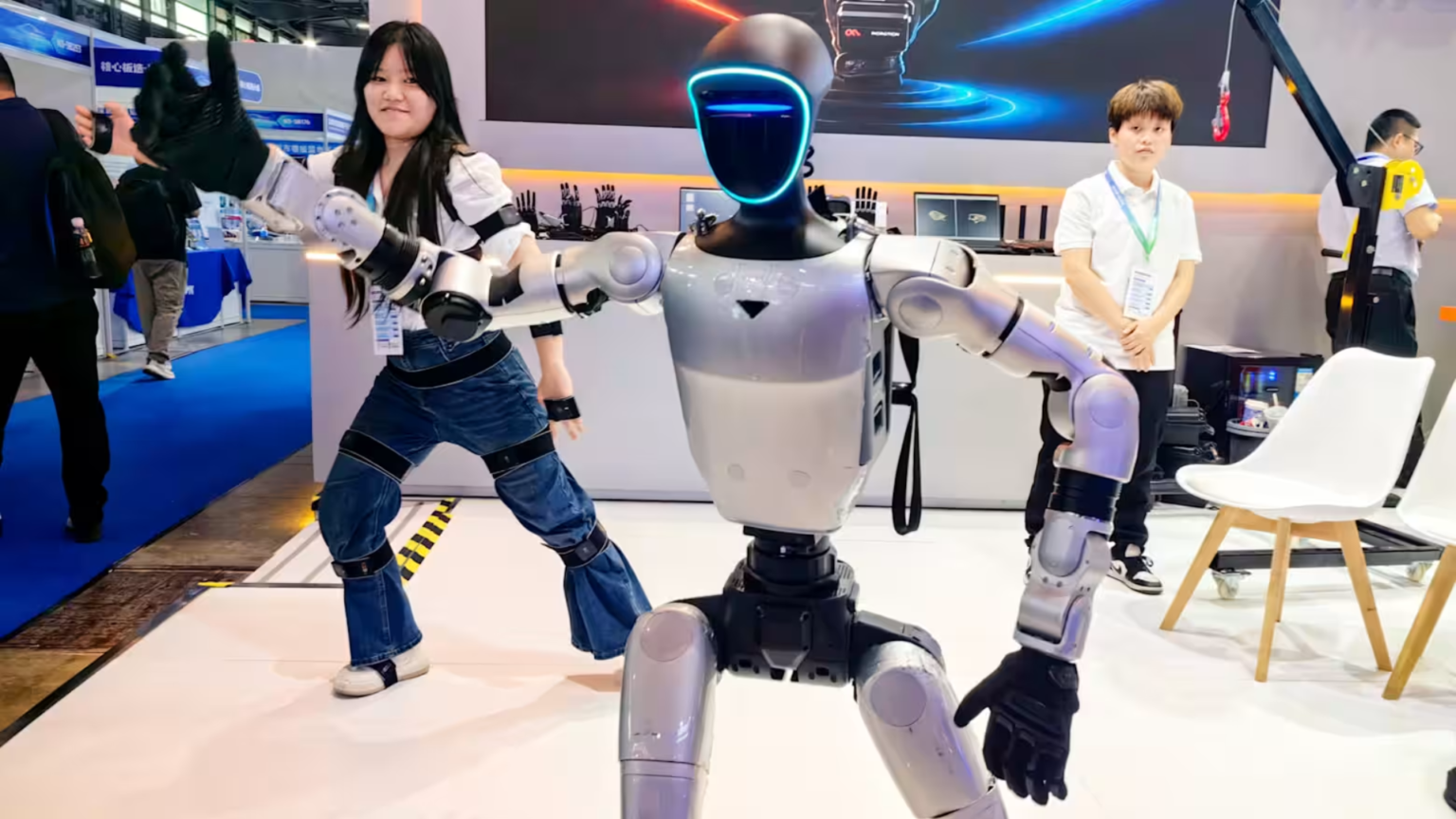
Many well-known humanoid robot programmes remain in pilot phases, research labs or internal testing. Unitree is already manufacturing and selling robots at scale, and unlike many early-stage robotics companies, it is profitable.
The company was founded in Hangzhou in 2016 by robotics engineer Wang Xingxing. It first gained international attention through its four-legged robotic platforms before expanding into humanoid machines such as the H1 and G1.
Unitree’s robots have become highly visible online because of demonstrations involving running, dancing and martial arts.
For investors, though, the more important point is commercial scale.
The company shipped more than 5,500 humanoid robots in 2025, according to its prospectus, giving it a leading position in the global market.
That makes the Unitree Robotics IPO more than a speculative bet on future technology. Investors are buying into a company that already has a meaningful manufacturing base and established customer demand.
Humanoid Robots Are Becoming Unitree’s Main Business
Unitree’s revenue mix has changed quickly, reaching about 1.7 billion yuan in 2025, representing a sharp increase from the previous year.
Humanoid robots accounted for more than half of Unitree’s main business revenue during the first nine months of 2025. Full-year humanoid robot sales reached approximately 867.8 million yuan, overtaking the company’s four-legged robot business. That shift is significant.
The market has spent years watching humanoid robots perform impressive demonstrations. Commercial adoption is a different test.
Customers eventually need robots that can perform useful work reliably, safely and at a cost that makes economic sense.
Unitree has started deploying humanoid robots in areas such as manufacturing, inspection, corporate reception, and guided-tour functions.
Those applications show that the market is moving beyond laboratory experiments. But broad industrial adoption remains at an early stage.
Unitree Robotics IPO Valuation Raises Tough Questions
The company entered the market at a demanding valuation even before its shares surged.
At the IPO price, Unitree was valued at roughly 219 times its 2025 earnings and around 36 times sales.
Those multiples are high for almost any public company, including a rapidly growing technology manufacturer.
The first-day rally pushed the implied valuation much higher.
That does not necessarily mean the market is irrational. Companies that establish leadership in new technology categories can trade at high multiples when investors expect a large future market.
But Unitree’s valuation now assumes several things go right at the same time.
The humanoid robotics market needs to grow rapidly.
Unitree needs to maintain a leading market share. Its margins need to remain healthy even as competition and research spending increase.
And the company has to convert interest in humanoid robots into repeatable commercial demand.
The gap between current earnings and market expectations is therefore substantial.
Growth Is Strong, but Costs Are Rising
Unitree’s recent financial performance shows both sides of the story.
First-quarter 2026 revenue rose about 68.5% year on year to 422.8 million yuan.
At the same time, profit excluding one-off items fell sharply as the company increased spending on research, product development and marketing. That pressure is understandable.
Robotics is capital intensive. Companies must spend heavily on artificial intelligence, sensors, hardware, manufacturing, testing, and software before achieving scale.
Unitree’s challenge will be to keep improving its products without allowing costs to rise faster than revenue.
For investors in the Unitree Robotics IPO, that balance will become increasingly important after the initial excitement fades.
China’s Robotics Ecosystem Gives Unitree an Advantage
China’s manufacturing base is one of Unitree’s strongest structural advantages.
The country already has deep supply chains across batteries, electric motors, electronics, sensors, and precision components.
Those industries were built partly to support sectors such as electric vehicles, consumer electronics and industrial manufacturing.
Robotics companies can now benefit from the same ecosystem.
This matters because lowering the cost of humanoid robots is one of the biggest challenges facing the industry.
A robot can be technically impressive and still fail commercially if it costs too much to manufacture, maintain, or operate.
Unitree’s ability to source components and manufacture at scale could help it bring prices down faster than competitors in markets with less integrated supply chains.
The Unitree Robotics IPO Reflects China’s Embodied AI Push
The listing also fits into China’s broader technology strategy.
Beijing has identified embodied intelligence as a priority area. The term refers to artificial intelligence systems that can perceive and interact with the physical world through machines such as robots.
That makes Unitree strategically interesting.
The company is not only developing hardware. It is investing in motion control, perception systems, AI models, and software that allow robots to operate with greater independence.
The IPO proceeds are expected to help strengthen manufacturing capacity and increase spending on core technologies.
DeepSeek Adds an AI Dimension to the Unitree Robotics IPO
Chinese AI company DeepSeek participated in Unitree’s strategic IPO placement, investing about 140.8 million yuan.
The two companies have also agreed to cooperate on AI models for humanoid robots.
The partnership highlights one of the most important technical questions facing the industry.
Robot hardware has improved quickly. Modern humanoids can walk, balance, recover from falls, and perform complex programmed movements. Autonomy is harder.
A commercially useful robot needs to understand instructions, interpret unfamiliar environments, and complete physical tasks reliably without constant human control.
Unitree brings expertise in robotics hardware, motion control, and real-world machine data.
DeepSeek brings expertise in artificial intelligence models.
If those capabilities can be combined effectively, Unitree could move from building sophisticated machines toward building increasingly autonomous systems.
Global Growth Brings Geopolitical Risk
Unitree is not purely a China-focused business.
Overseas markets have accounted for a meaningful share of its sales, while the United States has been one of its important international markets.
That creates a geopolitical risk investors cannot ignore.
Technology restrictions between the United States and China increasingly cover advanced semiconductors, AI, autonomous systems, drones, and robotics.
Unitree has already warned that future regulatory restrictions could affect new product approvals, imported components, and access to some overseas markets.
This matters because the valuation attached to the Unitree Robotics IPO partly assumes the company can become a global player.
Strong Chinese demand can support growth, but international expansion would give Unitree a much larger addressable market.
Competition in Humanoid Robotics Is Intensifying
Unitree is not alone in pursuing the humanoid robotics opportunity.
Chinese manufacturers, global technology groups and specialist startups are investing heavily in the sector.
Competition will likely intensify across several areas: price, software capability, reliability, battery life, dexterity, and industrial deployment.
The companies that win may not be the ones with the most impressive demonstrations.
They will be the ones who can produce robots that operate consistently and save customers money.
That commercial test is approaching quickly.
Factories and logistics companies are increasingly interested in automation, but they will judge humanoid robots using the same standards they apply to any other capital investment.
The machine has to deliver productivity.
What the Unitree Robotics IPO Means for Other Robotics Companies
Unitree’s successful listing could influence the wider sector.
A strong IPO gives private robotics companies a new valuation reference point and may encourage more Chinese humanoid robot developers to pursue public listings.
It also gives venture-capital investors another potential exit route.
That matters because humanoid robotics requires large amounts of long-term capital.
Hardware companies typically need more money than software startups because they must build factories, manufacture components, maintain inventories, and fund physical testing.
If public markets continue rewarding robotics companies, more capital could flow into the sector.
The risk is that valuations rise faster than commercial adoption.
That has happened before in emerging technology industries.
Unitree Still Has to Prove the Economics of Humanoid Robots
The first-day rally gives Unitree capital and visibility. It does not settle the core business question.
The company now has to prove that humanoid robots can move from demonstrations, research institutions, and limited deployments into large-scale commercial use.
Reliability will matter. So will maintenance costs, safety, operating life, and productivity.
A humanoid robot performing martial arts can generate millions of online views. A robot working thousands of hours inside a factory without interruption creates economic value.
Public investors have already priced in a substantial part of that second outcome.
The Next Test Comes After the Unitree Robotics IPO
Unitree has entered public markets with advantages that many robotics companies do not have.
It has meaningful revenue, profits, manufacturing scale, a recognised brand, and a leading position in humanoid robot shipments.
It also operates inside one of the world’s strongest advanced-manufacturing ecosystems.
Those strengths help explain why demand for the Unitree Robotics IPO was so intense.
But the first trading session has raised expectations dramatically. Unitree no longer needs to prove that investors are interested in humanoid robotics. The 629% intraday surge settled that point.
The company now needs to prove that the economics of humanoid robots can eventually justify what investors are willing to pay for them.
Stay connected with Business Herald for the latest business news, insights, and updates.
Follow us on Facebook, Instagram, LinkedIn, and YouTube.
Join our growing community on WhatsApp and Telegram for real-time updates delivered directly to you.