
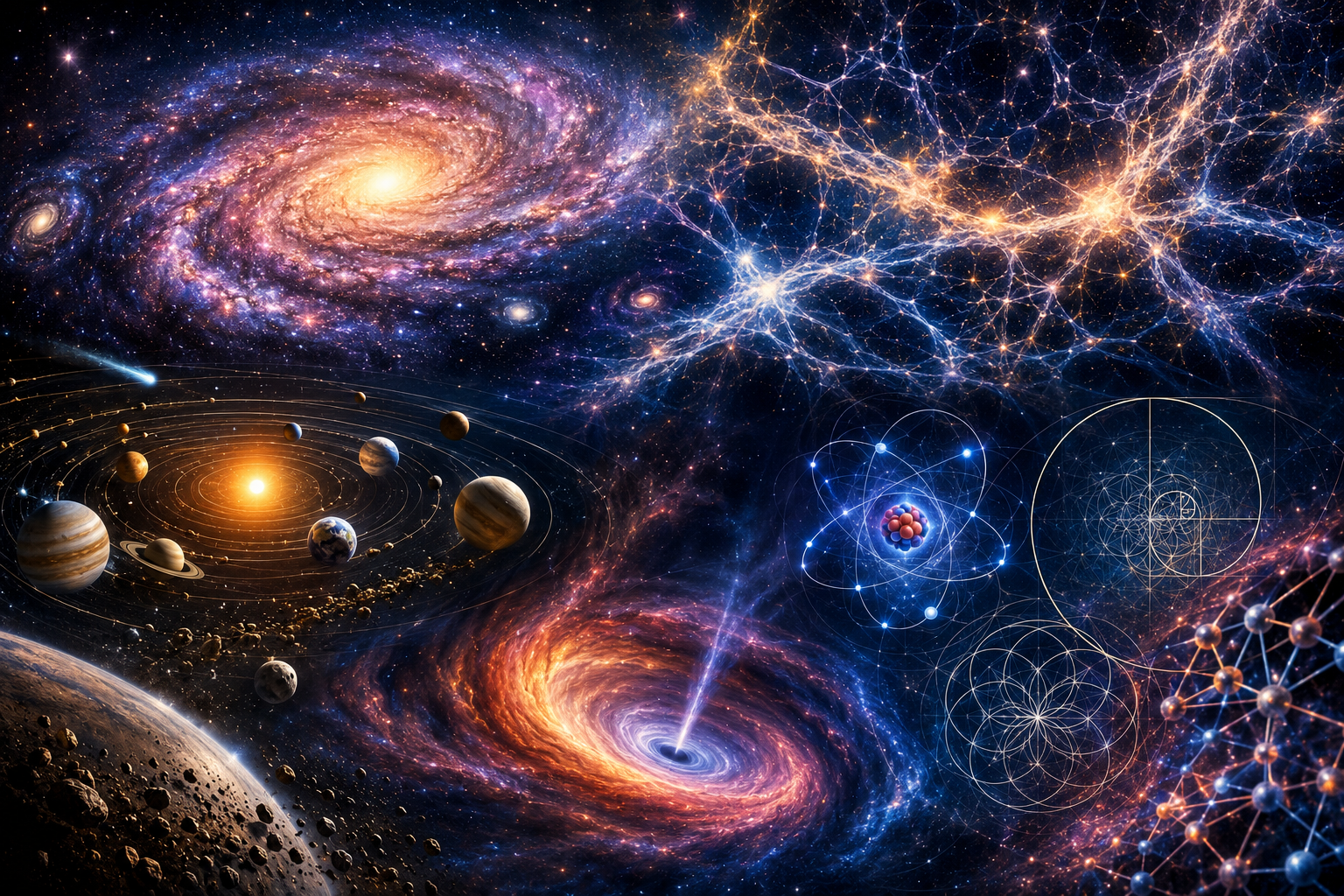

The patterns of the universe surround us on every scale. They appear in the rhythmic movement of planets, the spiral arms of galaxies, the behaviour of subatomic particles, and the enormous web of matter stretching across space.
At first glance, the universe can appear chaotic. Stars explode, galaxies collide, particles fluctuate, and cosmic structures evolve over billions of years. Yet beneath this apparent disorder lies a remarkable degree of organisation.
Mathematics allows scientists to identify that organisation. Numbers, equations and geometric models do not simply describe the universe’s size or age. They reveal relationships that connect events separated by extraordinary distances and timescales.
But the universe is not merely a giant calculation. Its patterns emerge from the interaction of physical laws, forces, energy, matter, probability, and time. Understanding them requires looking beyond numbers to explore what those numbers represent.
Mathematics as the Language of the Universe
Humanity has long used mathematics to explain natural phenomena. Planetary motion, gravitational attraction, electromagnetic waves, and quantum interactions can all be expressed through equations.
Johannes Kepler’s laws, for example, describe how planets travel around the Sun in elliptical orbits. They also connect the time a planet takes to complete an orbit with the size of that orbit. These relationships transformed astronomy by showing that celestial movement followed measurable principles rather than arbitrary paths.
Modern physics extends this mathematical approach to the smallest known components of matter. CERN’s Standard Model describes fundamental particles and three of the universe’s four known fundamental forces. It has successfully predicted and explained a wide range of experimental results, although it does not fully incorporate gravity or explain dark matter and dark energy.
Mathematics is therefore an exceptionally powerful model of reality. However, a model is not the same as reality itself. An equation may predict how an object behaves, but scientists must still use observations and experiments to determine whether the prediction is accurate.
Symmetry: The Hidden Architecture of Physical Laws
Symmetry is one of the most important patterns in physics.
In everyday life, symmetry may describe an object that remains visually balanced when reflected or rotated. In physics, it has a deeper meaning. A law is considered symmetrical when it remains valid after a particular change or transformation.
For example, the laws governing an experiment should not suddenly change because a laboratory is facing a different direction. Similar principles help physicists organise particles, forces and interactions into coherent theories.
CERN explains that these symmetries “form the basis and define the structure of the theory.”
Yet perfect symmetry does not explain everything. Some of the universe’s most important features emerge when symmetry is broken.
The Higgs mechanism offers one example. The equations of particle physics may contain an underlying symmetry, but the physical system settles into a particular state. CERN compares this with a pencil balanced vertically on its tip. The position is initially symmetrical, but when the pencil falls, it selects one direction.
This process of spontaneous symmetry breaking helps explain how fundamental particles acquire mass. It also demonstrates an important principle: the universe’s structure may depend as much on broken patterns as on perfect ones.
The Cosmic Web: A Pattern Across Billions of Light-Years
One of the most striking patterns of the universe appears at the largest observable scales.
Galaxies are not distributed uniformly or independently. They gather into groups and clusters, while clusters form part of larger superstructures. These structures are connected through vast filaments of matter separated by enormous cosmic voids.
Together, they create what astronomers call the cosmic web.
NASA describes this arrangement as a network of twisting, threadlike structures formed as gravity draws matter together. Where filaments intersect, they create denser structures such as galaxy clusters and walls. Some galactic walls extend hundreds of millions of light-years, while the Sloan Great Wall spans approximately 1.4 billion light-years.
Dark matter appears to provide much of the invisible scaffolding behind this network.
In January 2026, researchers using the James Webb Space Telescope released one of the most detailed dark-matter maps produced to date. The map used observations covering nearly 800,000 galaxies and revealed how concentrations of dark matter overlap with visible matter. According to NASA’s Jet Propulsion Laboratory, the Webb map was twice as sharp as previous dark-matter maps of the region.
Lead researcher Diana Scognamiglio said scientists were seeing “the invisible scaffolding of the universe in stunning detail.”
The discovery reinforces the idea that visible galaxies trace a much larger underlying structure. What appears to be empty space is part of an interconnected system shaped by gravity and the distribution of matter.
Spirals That Move Without Remaining Still
Spiral galaxies are among the most recognisable structures in space. Their sweeping arms create the impression of a fixed cosmic design.
However, these arms are not necessarily permanent arrangements containing the same stars.
NASA explains that spiral arms can behave like density waves moving through a galaxy. Gas, dust and stars pass through denser regions, much like vehicles entering and leaving a traffic jam. As material becomes compressed within these regions, conditions can support the formation of new stars.
This distinction matters because it shows that a pattern does not have to be physically static.
A wave moving through water maintains a recognisable form even though individual water molecules do not travel with it over long distances. Similarly, a galaxy’s spiral structure can persist while its individual components continue moving.
Spiral patterns also appear in planetary rings and other rotating systems. They often emerge from the combined effects of gravity, rotation, density and resonance rather than from a single universal geometric formula.
This is why popular claims that every cosmic spiral follows the golden ratio should be treated cautiously. Nature frequently produces spirals, but similar appearances do not automatically indicate identical mathematical origins.
Orbital Resonance and the Rhythm of Planets
Some cosmic patterns are best understood as rhythms.
Orbital resonance occurs when two or more celestial bodies complete their orbits in repeating numerical relationships. Their gravitational interactions create a stable or recurring pattern over time.
The Kepler-223 planetary system offers a powerful example. Its four known planets move in a 3:4:6:8 orbital-period relationship. As one planet completes a specific number of orbits, the others repeatedly return to corresponding positions.
Astronomers have found other resonant systems in which planets appear to move in synchronised sequences. These arrangements can provide evidence about how planetary systems formed, migrated and remained stable over billions of years.
Resonance demonstrates how gravity can produce order without requiring a central designer. Repeated interactions gradually shape a system into a recognisable pattern.
The result resembles a cosmic rhythm, created not by sound but by motion, time and gravitational influence.
Ancient Light Carries the Universe’s Earliest Pattern
The universe’s oldest observable light is known as the cosmic microwave background, or CMB.
This radiation became free to travel approximately 380,000 years after the Big Bang, when the universe had cooled enough for atomic nuclei to capture electrons. The cosmos became transparent, allowing light to move across vast distances.
The CMB is not completely uniform. It contains tiny temperature differences representing variations in the density of the early universe.
NASA’s Cosmic Background Explorer detected fluctuations of roughly one part in 100,000. Although extraordinarily small, these variations became the seeds from which galaxies and larger cosmic structures eventually developed.
This means the cosmic web observed today can be traced back to subtle irregularities in ancient light.
The pattern was neither perfectly smooth nor completely random. Small differences were amplified over billions of years as gravity drew matter into increasingly dense regions.
The galaxies, stars, and planets visible today emerged partly because the early universe was imperfect.
Matter, Antimatter and the Importance of Asymmetry
The existence of matter presents one of modern physics’ biggest unresolved questions.
Scientists believe the early universe should have produced matter and antimatter in closely related quantities. When matter meets antimatter, the two can annihilate each other. Yet the observable universe is overwhelmingly dominated by matter.
The explanation may involve violations of charge-parity, or CP, symmetry.
In 2025, CERN’s LHCb experiment reported the first observation of CP violation in the decay of a baryon. Researchers analysed more than 80,000 particle decays and measured an asymmetry of approximately 2.45%, with a statistical significance above the threshold physicists use to claim an observation.
The finding is important, but it does not fully explain why matter prevailed. CERN notes that the CP violation predicted by the Standard Model remains far too small to account for the matter-antimatter imbalance observed in the universe.
Once again, broken symmetry appears to be essential. Without some imbalance between matter and antimatter, galaxies, planets and human life might never have formed.
Are the Patterns of the Universe Evidence of Design?
The presence of order naturally raises philosophical questions.
Do cosmic patterns suggest design, or can they emerge through physical processes alone?
Science can demonstrate how many patterns arise. Gravity forms clusters and filaments. Rotation and density waves help generate spirals. Resonance produces repeating orbital relationships. Quantum fields and symmetry govern particle interactions.
These explanations show that complexity can emerge from relatively consistent rules operating over long periods.
However, science does not currently provide a final answer to every philosophical question about existence, meaning or ultimate causation. It examines observable evidence, builds testable models and revises those models when better evidence becomes available.
The patterns themselves can support different philosophical interpretations. What science contributes is a method for determining how reliably each pattern can be measured and explained.
Why Cosmic Patterns Matter Beyond Astronomy
Studying cosmic patterns does more than satisfy human curiosity.
Pattern recognition allows researchers to transform enormous datasets into useful scientific knowledge. Astronomers identify planets by measuring repeated changes in starlight. Physicists reconstruct particle interactions from detector data. Cosmologists map invisible matter by studying how gravity bends light.
The same intellectual process also influences developments in computing, artificial intelligence, imaging, engineering, and advanced materials. In each case, progress depends on finding meaningful relationships inside complex information.
For business and technology leaders, the broader lesson is significant. Innovation often begins when an apparent collection of unrelated events is recognised as part of a larger system.
The competitive advantage does not always come from collecting more numbers. It comes from identifying the pattern that those numbers reveal.
Beyond Numbers: What the Universe Teaches Us
The patterns of the universe show that nature is neither perfectly ordered nor entirely chaotic.
Symmetry provides stability, while broken symmetry creates difference. Gravity builds immense structures from tiny fluctuations. Resonance generates rhythm, while density waves create forms that appear permanent despite constant movement.
Mathematics helps humanity recognise these relationships. But the real insight lies in understanding the physical processes behind the equations.
Numbers tell us how frequently a pattern occurs, how large it is, and how accurately it can be predicted. Exploration tells us why that pattern matters.
The universe is therefore more than a collection of measurable objects. It is an evolving network of relationships in which simplicity and complexity, regularity and randomness, order and disruption continuously interact.
To look beyond numbers is not to reject mathematics. It is to see mathematics for what it truly offers: a window into the deeper structure of reality.
Frequently Asked Questions
What are the patterns of the universe?
The patterns of the universe include repeating or organised structures such as spiral galaxies, orbital resonances, particle symmetries, cosmic microwave background fluctuations and the filament-like cosmic web connecting galaxies and clusters.
Is the universe made of mathematics?
Mathematics provides highly accurate models for describing physical laws and predicting natural behaviour. However, whether the universe is literally made of mathematics is a philosophical question rather than an established scientific conclusion.
Why do spiral patterns appear in galaxies?
Spiral arms can emerge from density waves moving through a rotating galactic disk. Gas, dust, and stars pass through denser regions, where compression can support new star formation.
What is the cosmic web?
The cosmic web is the large-scale arrangement of galaxies, clusters, filaments, and voids across the universe. Gravity and dark matter play central roles in shaping this interconnected structure.
Is the entire universe a fractal?
Some natural and cosmic structures may display limited forms of self-similarity, but scientists have not established that the entire universe is a perfect fractal. Similar-looking patterns can also arise through different physical processes.
Why is symmetry important in physics?
Symmetry helps physicists identify properties that remain unchanged under particular transformations. It forms a foundation for major physical theories, while symmetry breaking helps explain phenomena such as particle mass and matter-antimatter differences.
Travis Kalanick’s new industrial-robotics venture, Atoms, closed a $1.7 billion funding round in July 2026, led by Andreessen Horowitz. The company secured one of the biggest investments in robotics and industrial AI this year. But what caught everyone’s attention wasn’t the company’s valuation or who led the funding round; it was one unexpected name on the investor list—Uber.
Contents
Background: A Founder Defined by Growth and ControversyThe Silent RebuildThe Rebrand: From CloudKitchens to AtomsThe Ultimate Plot Twist
Nine years after its board pushed Kalanick out of the CEO role, Uber is now an investor in the startup he built next. What began with a high-profile executive exit has now turned into one of the year’s biggest funding stories. It’s a reminder that in Silicon Valley, today’s setback can become tomorrow’s comeback if the opportunity is big enough.
Background: A Founder Defined by Growth and Controversy
Kalanick co-founded Uber with Garrett Camp in 2009. He ran it for eight years, turning a niche ride-hailing app into one of the most highly valued private companies in the world. During this period, he was considered one of the industry’s most polarizing executives, known for an aggressive management style and a willingness to clash publicly with regulators, competitors, and, eventually, his own board.
The company was growing fast, but so were the problems. In 2017, the company’s success and its controversies collided, leading to a major turning point. The chain of events that ended Kalanick’s tenure began in February 2017, when former Uber engineer Susan Fowler published an account of workplace harassment and the company’s failure to act on her complaints.
The essay prompted Uber’s board to commission an internal culture review led by former U.S. Attorney General Eric Holder.
Holder’s investigation found the company lacked basic protections against workplace harassment, and more than 20 employees, including several managers, were subsequently terminated.
The pressure became immense in the following months. Footage surfaced of Kalanick berating an Uber driver over a fare dispute, bolstering the narrative of a toxic leadership culture. By June 2017, five of Uber’s largest investors had drafted a letter, titled “Moving Uber Forward,” calling for his immediate resignation. The letter was hand-delivered to Kalanick at a hotel in Chicago.
He resigned as chief executive on June 21, 2017, retaining his board seat and an ownership stake of roughly 10 percent. He said, “I love Uber more than anything in the world,” in a statement at the time. He added that he had accepted the investors’ request “so that Uber can go back to building rather than be distracted by another fight.” The resignation came weeks after the death of his mother in a boating accident, in which his father was also seriously injured. At 40, Kalanick had built and lost control of what was then the world’s most highly valued startup after a single boardroom decision.
The Silent Rebuild
Instead of trying to fix his public image, Kalanick chose to stay away from the spotlight and rebuild silently. A year after leaving Uber, in 2018, he became the CEO of a new company called City Storage Systems. The name didn’t reveal much about what the company actually did. He kept things that way on purpose. For nearly eight years, employees were reportedly not allowed to mention the company on LinkedIn. Kalanick later described this approach as operating in “full underground, full stealth.”
Behind the scenes, the company was building CloudKitchens—a network of delivery-only kitchens that allowed restaurants to prepare food for online orders without opening a physical storefront. While most people weren’t paying attention, the business kept growing. Its reported valuation climbed from around $5 billion in 2019 to $15 billion by 2022, attracting investors including Saudi Arabia’s sovereign wealth fund.
By the time Kalanick stepped back into the public eye, he had quietly built another multibillion-dollar company, this time without the constant headlines that had followed him at Uber.
The Rebrand: From CloudKitchens to Atoms
In March 2026, Kalanick broke 8 years of silence and unveiled a new name for his company, Atoms. But this wasn’t just a rebrand. It was with a much bigger vision than the delivery-only kitchens the company had become famous for.
Kalanick said Atoms would focus on using AI and automation to solve problems in industries like mining, construction, transportation, and food production. The company was divided into three parts: Atoms Food, which continued the CloudKitchens business, Atoms Mining, and Atoms Transport.
As part of this new chapter, Atoms also acquired Pronto, a startup that develops self-driving technology for heavy industrial vehicles. The company was founded by Anthony Levandowski, a former engineer at both Uber and Google. Levandowski is well known in the tech industry because of a legal battle between Uber and Google over self-driving technology. In 2020, he received a presidential pardon related to that case.
With Atoms, Kalanick made it clear that he wasn’t just building another startup. He was aiming to bring AI and automation into some of the world’s biggest industries.
The Ultimate Plot Twist
On July 22, 2026, Atoms raised $1.7 billion in fresh funding. The investment was led by Andreessen Horowitz and the firm’s co-founder, Ben Horowitz. They joined Atoms’ board as part of the deal. Several other investors also backed the company, including Bain Capital, Fifth Wall, Chemistry, K5 Global, SV Angel, and Alpha Square Group.
But the biggest surprise wasn’t the amount of money raised or the list of investors. It was Uber. Nine years after removing Travis Kalanick as CEO, Uber had invested in his new company. The company did not explain why it decided to invest, and it did not reveal how much money it contributed.
Uber’s name on the list quickly became the biggest talking point. It was a reminder of how much things had changed since 2017. A company that had once pushed Kalanick out is now backing his next venture.
Stay connected with Business Herald for the latest business news, insights, and updates.
Follow us on Facebook, Instagram, LinkedIn, and YouTube.
Join our growing community on WhatsApp and Telegram for real-time updates delivered directly to you.