
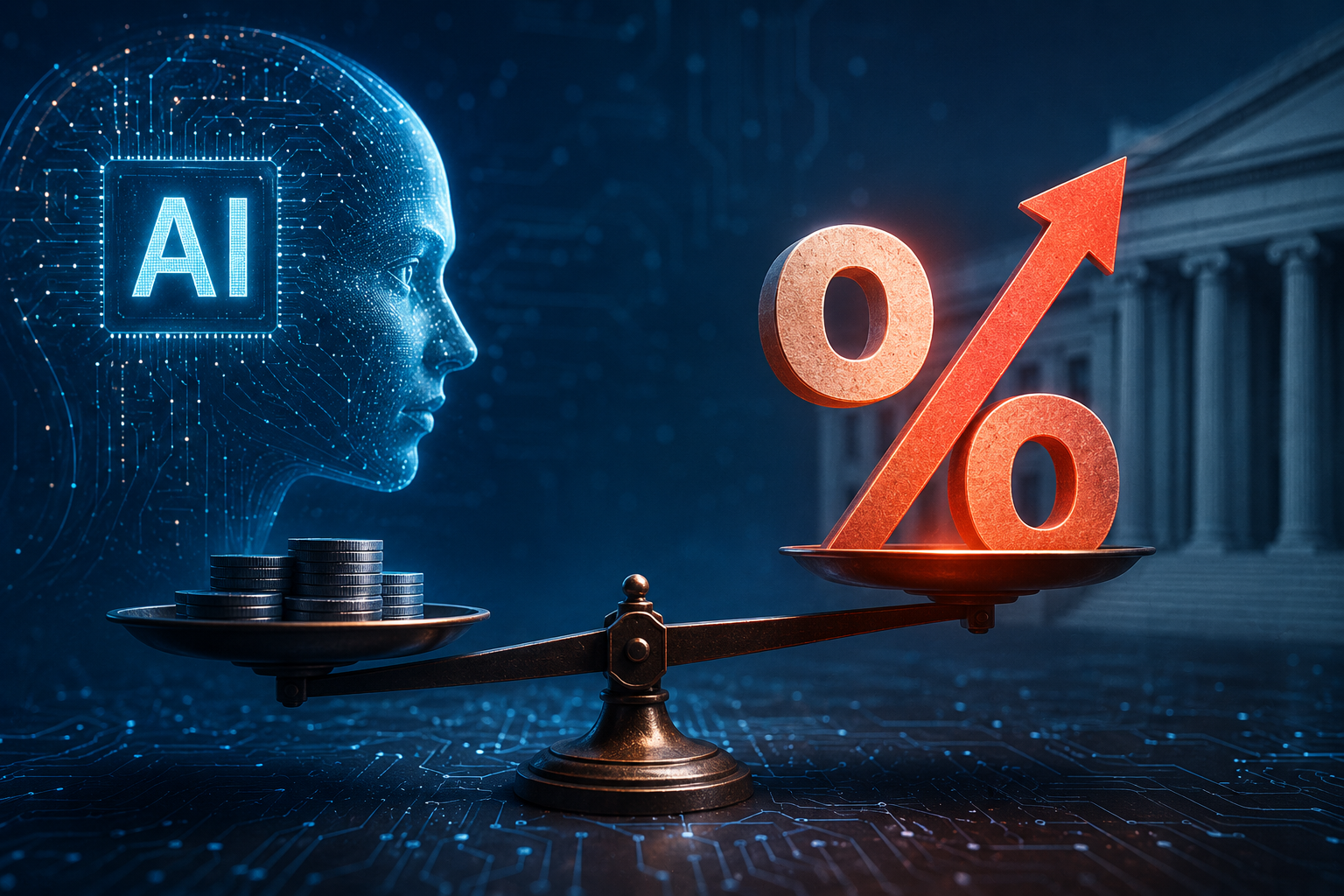

Artificial intelligence is usually sold as a technology that will make businesses faster, workers more productive, and goods and services cheaper. That sounds like a recipe for lower inflation and eventually lower interest rates.
But something very different is happening while the AI economy is being built.
Technology companies are spending hundreds of billions of dollars on data centres, chips, servers, electricity networks, and other infrastructure. Some are increasingly turning to bond markets to finance that expansion. Governments, meanwhile, are also borrowing heavily.
The result is growing competition for capital.
On August 14, inflation-adjusted long-term borrowing costs were near multi-year or multi-decade highs across several major economies. Reuters reported that the US 30-year real yield was around 3%, close to an 18-year high, while British and German 10-year real yields were near their highest levels in more than a decade.
AI is not solely responsible for that rise. Government deficits, resilient economic growth, expectations for monetary policy, and reduced central-bank bond buying are all important.
But the AI investment boom is becoming large enough that economists and central bankers are asking a once-unlikely question: What if artificial intelligence ultimately makes the economy more productive, but keeps interest rates higher along the way?
“Interest Rates” Does Not Mean Just One Thing
Understanding the relationship between AI and interest rates requires separating two concepts.
The first is the policy rate set by a central bank, such as the US Federal Reserve’s federal funds rate.
The Fed kept its target range at 3.50% to 3.75% at its July 28-29, 2026 meeting.
The second is the interest rate determined in financial markets, particularly government and corporate bond yields.
These two can move differently.
A central bank might keep short-term rates unchanged or even eventually cut them, while longer-term bond yields stay high because investors demand greater returns to absorb heavy borrowing.
That distinction is increasingly important in the AI investment cycle.
1. AI Has Become an Enormous Investment Shock
The simplest explanation starts with spending.
Building generative AI requires far more physical infrastructure than traditional software businesses did.
Companies need:
- advanced semiconductors
- servers and networking equipment
- hyperscale data centres
- cooling systems
- electricity generation
- transmission infrastructure
- land
- construction labour
- long-term energy contracts
The spending numbers have become extraordinary.
Reuters estimated in July that consensus forecasts for capital expenditure by Microsoft, Alphabet, Amazon, Meta, and Oracle had risen from roughly $485 billion at the beginning of 2026 to around $730 billion by July.
That spending is not entirely AI-related, because technology companies do not consistently separate AI capital expenditure from wider cloud infrastructure. But company executives have repeatedly identified AI demand as a major driver of data-centre, server, and networking investment.
The crucial economic point is what happens when hundreds of billions of dollars suddenly chase limited resources.
Demand increases for capital, labour, land, chips, and energy.
And when investment demand rises faster than available savings, the price of capital can rise too.
That price is the interest rate.
2. The AI Boom Is Creating a Bond Supply Boom
Big Tech traditionally enjoyed an enviable business model.
Software, search, and advertising companies could generate enormous amounts of cash without constantly investing comparable amounts in factories and physical infrastructure.
AI is changing that.
Reuters found that the five major hyperscalers could collectively spend more on capital expenditure than they generate in free cash flow by 2027 if current trajectories persist. Their annual operating cash flow is expected to increase by about $340 billion between 2025 and 2027, while capital expenditure could rise by roughly $534 billion.
That gap matters.
As internal cash becomes less sufficient to fund AI expansion, companies have stronger incentives to access debt markets.
Alphabet, Amazon, and Meta had issued almost $220 billion of bonds in 2026 by August 14, more than double the roughly $108 billion issued during all of 2025, according to LSEG data cited by Reuters.
More bonds mean investors are being asked to supply more capital.
If demand from bond buyers does not increase just as quickly, issuers need to offer higher yields to attract them.
That can raise borrowing costs across the market.
AI, in other words, may not push rates higher because central bankers dislike artificial intelligence.
It can push rates higher because building AI requires an extraordinary amount of money.
3. Big Tech Is Competing With Governments for the Same Capital
The timing makes the situation more complicated.
Technology companies are borrowing heavily at the same time that major governments continue to run large fiscal deficits.
Reuters estimated the US budget deficit at roughly 6% of GDP, or $1.9 trillion, in 2026, while France and Britain were also running substantial deficits.
Government bonds and investment-grade corporate bonds compete for investor capital.
When both governments and companies issue huge volumes of debt simultaneously, investors gain choice.
Issuers may consequently need to offer better yields.
BlackRock Investment Institute’s Vivek Paul described the environment to Reuters as an unusually intense competition for capital, with the AI build-out contributing to increasing capital scarcity.
This is one reason the AI story is no longer only about technology stocks.
It is increasingly becoming a global capital-markets story.
4. AI Could Raise the Economy’s “Neutral” Interest Rate
There is another, deeper mechanism.
Economists often discuss a theoretical interest rate known as r-star, or r*.
It represents the inflation-adjusted interest rate consistent with an economy operating around its full potential without either stimulating or restricting activity.
It cannot be observed directly.
But it matters enormously to central banks.
If AI permanently increases productivity, companies may discover more profitable investment opportunities. They may therefore want to borrow and invest more.
At the same time, households expecting stronger future income growth could decide they need to save less today.
More demand for investment combined with less willingness to save can push the equilibrium interest rate higher.
Federal Reserve Vice Chair Philip Jefferson highlighted this possibility precisely in July 2026. He said that if AI creates persistently stronger productivity growth, businesses could increase their demand for investment funding while households save less because they expect higher future incomes. Under such conditions, the neutral rate would likely increase.
Fed Governor Lisa Cook made a related point earlier in 2026.
She noted that AI-related investment in chips and data centres was already contributing to strong aggregate demand despite borrowing costs being relatively elevated, creating the possibility that the current neutral rate is higher than it was before the pandemic.
The IMF has reached a similar conclusion.
Its January 2026 global economic analysis warned that a sustained technology boom could push real neutral interest rates higher, similar to the dynamics seen during the dot-com investment boom, potentially requiring tighter monetary policy.
That is a crucial shift in the AI debate.
Higher productivity does not automatically mean lower interest rates.
If productivity creates an investment boom powerful enough to increase demand for capital, equilibrium borrowing costs can actually rise.
5. AI Is Also Creating Physical Bottlenecks
Artificial intelligence may feel digital.
Its infrastructure is anything but.
A data centre requires concrete, steel, semiconductors, transformers, cooling equipment, electricity, and specialised workers.
Those resources cannot always expand as quickly as software demands.
In a May 2026 speech, Fed Governor Cook noted that companies had announced more than $1.5 trillion in data-centre plans, with only a relatively small portion realised so far. She pointed to significant price increases in chips, high-tech equipment, and software, along with stronger wages in specialised construction trades.
This creates another channel through which AI can create near-term price pressure.
If hundreds of billions of dollars chase a constrained supply of GPUs, electricians, transformers, or electricity capacity, prices can increase.
Central banks care about those pressures because inflation is ultimately influenced by the relationship between demand and the economy’s ability to supply goods and services.
6. Electricity May Become One of AI’s Most Important Economic Constraints
The power requirements are particularly significant.
The International Energy Agency expects worldwide electricity consumption by data centres to reach around 945 terawatt-hours by 2030, roughly double current levels.
Between 2024 and 2030, the IEA expects data-centre electricity consumption to increase around 15% annually, more than four times faster than electricity consumption from other sectors combined.
The IEA also stresses that data centres would still represent less than 3% of global electricity demand in its base case.
So it would be misleading to claim that AI alone is about to overwhelm the entire global energy system.
The real issue is location.
Data centres tend to cluster in particular regions.
That can create severe local grid constraints even when their share of global electricity consumption remains relatively modest.
The United States provides an early example.
PJM Interconnection, the country’s largest grid operator, has been developing new rules to deal with surging data-centre demand as capacity becomes increasingly constrained.
The economic chain is straightforward:
AI demand → data centres → electricity demand → generation and grid investment → greater demand for capital
That final step leads back to interest rates.
7. Higher Real Yields Matter Even If Inflation Falls
This is where the current bond-market signal becomes particularly important.
Bond yields can rise for two very different reasons.
One is that investors expect higher inflation.
The other is that real yields rise, meaning investors demand higher returns even after adjusting for expected inflation.
The recent move has been notable because inflation expectations have remained comparatively stable while real yields increased.
Reuters reported that the US 30-year real yield was around 3%, while comparable long-term real borrowing costs in Britain and Germany were around decade-plus highs.
The US Treasury also paid 5.22% at a 30-year bond auction on August 13, the highest borrowing cost for such an auction since 2001.
That matters because real yields influence the economy even when inflation is under control.
Higher real borrowing costs can make:
- Mortgages more expensive
- Corporate borrowing more costly
- Infrastructure projects less attractive
- Private-equity financing harder
- Government debt more expensive to service
- High-valuation stocks less attractive relative to bonds
This means AI could simultaneously contribute to stronger productivity and tougher financial conditions.
8. Why Rising Bond Yields Could Eventually Hurt AI Itself
There is an irony in this cycle.
AI investment can help push yields higher.
Those higher yields can eventually make AI investment harder to finance.
As Reuters noted, elevated inflation-adjusted borrowing costs can eventually cause businesses and households to reduce investment and spending.
For technology companies, the vulnerability grows as free cash flow comes under pressure.
Microsoft, for example, reported $35.8 billion of operating cash flow against $37.5 billion of capital expenditure, including finance leases, in one recent fiscal quarter. Amazon’s trailing 12-month operating cash flow increased strongly, yet its free cash flow fell sharply as investment accelerated. Oracle has also increasingly relied on external financing for cloud infrastructure expansion.
If AI companies continue borrowing aggressively while yields keep rising, financing costs begin eating into the economics of the infrastructure they are trying to build.
Eventually, the market could impose discipline.
Projects offering weak expected returns may be delayed or cancelled.
But AI Could Still Push Rates Lower Eventually
The higher-rates argument is only half the story.
AI could ultimately be highly disinflationary.
If companies can produce significantly more goods and services with the same amount of labour and capital, unit production costs could decline.
A worker using AI might complete tasks faster.
A manufacturer could reduce waste.
A logistics company could optimise routes.
A bank could automate routine processes.
Software companies could deliver services at lower marginal cost.
Higher productivity allows economies to produce more without necessarily generating equivalent inflation pressure.
Federal Reserve officials have repeatedly acknowledged this possibility.
Fed Governor Michael Barr has cited research suggesting AI could add roughly 0.3 to 0.9 percentage points to annual total factor productivity growth over the next decade, although estimates remain highly uncertain.
If those productivity gains become widespread, AI could eventually ease supply constraints and reduce inflationary pressure.
That could give central banks greater room to lower policy rates.
Which Force Wins?
That is the multi-trillion-dollar question.
There are effectively two phases of the AI economic cycle.
Phase One: Build Everything
Companies race to construct:
data centres, power plants, semiconductor fabs, networks and AI infrastructure.
This phase requires enormous capital.
It can increase investment demand, create physical bottlenecks, boost borrowing, and put upward pressure on real interest rates.
Phase Two: Use Everything
Businesses deploy AI throughout the economy.
Productivity rises.
Production becomes more efficient.
Some costs fall.
Economic capacity expands.
This phase could reduce inflation pressure and potentially create conditions for lower policy rates.
The problem is that nobody knows exactly when the second phase becomes powerful enough to outweigh the first.
It Would Be Wrong to Blame AI for All Higher Rates
There is an important caveat.
AI is only one factor affecting global borrowing costs.
Reuters identified several other major drivers of today’s higher real yields:
Large government deficits. Governments continue issuing substantial amounts of debt.
Stronger-than-expected economic growth. Robust growth can naturally support higher real interest rates.
Expectations of central bank policy. Markets periodically reprice the probability of rate increases or cuts.
Reduced central-bank bond buying. Central banks are no longer providing the same degree of demand for government securities that helped suppress yields during earlier periods.
Europe also has its own structural spending requirements.
Defence, energy security and infrastructure investment can be more important drivers of European borrowing costs than AI itself.
The correct conclusion is therefore not: “AI is making interest rates rise.”
It is: “The scale of the AI investment boom is becoming one meaningful force that could keep real borrowing costs higher than markets previously expected.”
That distinction matters.
What Investors Should Watch
For investors trying to understand where AI and interest rates go next, five indicators deserve particular attention.
1. Big Tech Bond Issuance
If hyperscalers continue moving from cash-funded investment toward bond-funded expansion, capital-market pressure could intensify.
2. AI Capital Expenditure
The question is no longer simply how much technology companies spend.
Investors increasingly need to ask how much revenue and cash flow each additional dollar of AI infrastructure generates.
3. Long-Term Real Yields
Nominal Treasury yields can be distorted by changing inflation expectations.
Real yields provide a clearer indication of the underlying cost of capital.
4. Electricity and Infrastructure Costs
Power availability, grid congestion, chip shortages and specialised construction costs will determine how expensive the next stage of AI expansion becomes.
5. Productivity Data
Ultimately, AI needs to deliver economy-wide productivity gains.
If productivity accelerates meaningfully, the enormous investment could be justified.
If it does not, the financing structure around AI becomes much harder to sustain.
What It Means for Global Markets
The consequences extend well beyond Silicon Valley.
Stocks
Higher real yields increase the discount rate applied to future corporate earnings.
That can be especially challenging for high-growth companies whose valuations depend heavily on profits expected many years into the future.
Bonds
Heavy government and corporate issuance can keep upward pressure on long-term yields even if central banks eventually become more dovish.
Real Estate
Higher long-term rates can keep mortgage and commercial-property financing costs elevated.
Private Equity
Leveraged acquisitions become more difficult when debt remains expensive.
Governments
Higher real yields increase debt-servicing costs, potentially reducing fiscal room for infrastructure, defence and social spending.
Emerging Markets
Higher developed-market yields can attract capital toward US and European bonds, creating additional competition for capital globally.
AI is therefore becoming relevant to almost every major asset class.
A New Kind of Technology Cycle
The internet boom of the 1990s gave investors one important historical precedent.
Technology investment accelerated sharply.
Productivity eventually improved.
But the boom also supported strong demand and helped keep monetary policy tighter than it might otherwise have been.
The IMF has explicitly drawn a comparison between today’s AI-driven technology investment cycle and the dot-com era when discussing the possibility of higher neutral interest rates.
There is, however, an important difference.
Artificial intelligence is extraordinarily capital-intensive.
The companies building today’s AI economy are not merely writing code.
They are constructing some of the world’s largest computing facilities and securing decades of electricity, semiconductor, and infrastructure capacity.
That makes this technology cycle unusually connected to the physical economy.
And therefore unusually connected to interest rates.
Final Take: AI May Change the Meaning of “High Rates”
For more than a decade after the global financial crisis, investors became accustomed to a world where digital technology seemed inherently deflationary.
Software scaled cheaply.
Platforms required relatively little physical capital.
Interest rates remained historically low.
AI is challenging that model.
The technology may ultimately deliver substantial productivity gains and lower costs.
But building the infrastructure required to achieve those gains involves an enormous upfront demand for capital.
Big Tech is borrowing more.
Governments are borrowing heavily at the same time.
Power grids need investment.
Data centres need financing.
Semiconductor capacity needs expansion.
And investors are increasingly demanding higher real returns to provide that capital.
That does not mean central banks are destined to keep raising policy rates.
Nor does it mean AI will permanently increase inflation.
The more interesting possibility is subtler:
AI could be disinflationary in what it eventually produces, while being interest-rate intensive in what it takes to build.
For global investors, that may become one of the most important economic contradictions of the AI era.
Stay connected with Business Herald for the latest business news, insights, and updates.
Follow us on Facebook, Instagram, LinkedIn, and YouTube.
Join our growing community on WhatsApp and Telegram for real-time updates delivered directly to you.