

Rank Math SEO Details
For thousands of years, humanity has looked towards the night sky and wondered what lies beyond the visible horizon. Every star, planet, and galaxy appears to offer a clue, yet the more scientists discover, the more complex the cosmos becomes.
The mysteries of the universe extend far beyond unexplored regions of space. They include questions about how the cosmos began, what most of it is made of, why its expansion is accelerating, how black holes influence galaxies, and whether life exists elsewhere.
Modern astronomy has transformed these questions from philosophical speculation into scientific investigation. Space telescopes now observe galaxies formed near the beginning of cosmic history. Gravitational-wave observatories detect collisions between black holes and neutron stars. Planet-hunting missions examine thousands of worlds beyond our solar system.
Despite these advances, much of the universe remains invisible, unexplained, or inaccessible. Navigating the cosmos is therefore not simply a journey across distance. It is an attempt to understand the fundamental structure of reality.
Table of Contents
- Understanding the Scale of the Cosmos
- Reconstructing the Origin of the Universe
- Dark Matter and the Invisible Cosmic Framework
- Dark Energy and the Accelerating Universe
- Black Holes and the Limits of Physics
- The Matter-Antimatter Mystery
- Searching for Life Beyond Earth
- Reading the Universe Through Gravitational Waves
- The Telescopes Transforming Cosmic Exploration
- Why Exploring the Universe Matters
- Frequently Asked Questions
Understanding the Scale of the Cosmos
The universe is approximately 13.8 billion years old, but its observable dimensions are much larger than 13.8 billion light-years. This is because space itself has expanded while light has travelled towards Earth.
Within the observable universe are billions of galaxies, each potentially containing billions or even trillions of stars. These galaxies are not distributed randomly. They form groups, clusters, walls and enormous filaments separated by vast regions known as cosmic voids.
Together, these structures create the cosmic web, one of the largest known patterns in nature.
The scale involved is difficult to visualise. Light from the Sun takes approximately eight minutes to reach Earth. Light from the nearest star system takes more than four years. Light from distant galaxies can travel for billions of years before reaching a telescope.
Astronomy is therefore also a form of cosmic archaeology. Looking deeper into space means looking further back in time.
Reconstructing the Origin of the Universe
One of the greatest mysteries of the universe concerns its beginning.
The Big Bang model describes an early period when the universe was extremely hot, dense and rapidly expanding. It does not describe an explosion occurring at one location in pre-existing space. Instead, it describes the expansion of space itself.
During the universe’s first minutes, protons and neutrons combined to create the earliest atomic nuclei, mainly hydrogen and helium. Hundreds of thousands of years later, the universe cooled sufficiently for electrons and nuclei to form neutral atoms.
Light could then travel more freely across space.
That ancient radiation remains detectable today as the cosmic microwave background, the oldest light scientists can directly observe. Tiny temperature differences within it represent variations in the density of the young universe. Over billions of years, gravity amplified those variations into stars, galaxies and larger cosmic structures.
However, major questions remain unanswered. Scientists still do not know what caused the earliest period of expansion, what preceded it or whether asking what came “before” is physically meaningful if time itself emerged with the universe.
Dark Matter and the Invisible Cosmic Framework
Everything humans can directly see, including stars, planets, gas, dust and living organisms, represents only a small fraction of the cosmos.
Current cosmological models estimate that ordinary matter accounts for approximately 5% of the universe. Dark matter contributes about 27%, while dark energy makes up the remaining 68%.
Dark matter does not emit, reflect or absorb light, making it invisible to conventional telescopes. Scientists infer its presence through its gravitational influence.
Galaxies rotate in ways that visible matter alone cannot fully explain. Gravitational lensing also reveals hidden concentrations of mass by showing how light from distant objects bends as it travels through space.
Dark matter appears to act as an invisible framework around which galaxies and galaxy clusters form. NASA describes it as the invisible “glue” helping hold the universe together. Yet scientists have not conclusively identified the particles or physical substance responsible for it.
Solving the dark matter mystery could require physics beyond the Standard Model, the framework currently used to describe known fundamental particles and most of their interactions.
Dark Energy and the Accelerating Universe
For much of the 20th century, astronomers expected gravity to gradually slow cosmic expansion.
Observations of distant supernovae instead revealed that the universe’s expansion is accelerating. Scientists use the term dark energy to describe the unknown phenomenon driving this acceleration.
NASA estimates that the acceleration began several billion years after the universe formed. However, dark energy’s true nature remains unknown. It could be an inherent property of space, a dynamic field or evidence that the scientific understanding of gravity is incomplete.
This is not a minor gap in cosmology. Dark energy appears to represent most of the universe’s total energy content.
The European Space Agency’s Euclid mission is mapping the shapes, positions and distances of billions of galaxies across more than one-third of the sky. Its observations are designed to show how cosmic structures evolved and how expansion changed over time, offering new evidence about dark matter, dark energy and gravity.
Euclid released its first survey data in March 2025, providing an early view of large-scale galaxy organisation and deep-field observations.
Black Holes and the Limits of Physics
Black holes are among the most fascinating cosmic objects because they expose the limits of current physical theories.
A black hole forms when matter becomes concentrated within an extraordinarily small region. Its gravitational influence is so intense that, beyond a boundary called the event horizon, nothing can escape, including light.
Stellar-mass black holes can form after massive stars collapse. Supermassive black holes, containing millions or billions of times the Sun’s mass, occupy the centres of most large galaxies.
Scientists still do not fully understand how the earliest supermassive black holes grew so rapidly. Some appear to have reached enormous sizes when the universe was comparatively young.
Black holes also create a conflict between general relativity and quantum mechanics.
General relativity describes gravity and large-scale cosmic structures with remarkable accuracy. Quantum mechanics explains particles and interactions at microscopic scales. Inside a black hole, however, both theories become essential, and scientists do not yet possess a complete theory combining them.
Questions about black-hole interiors, singularities and the fate of information falling through an event horizon remain central to theoretical physics.
The Matter-Antimatter Mystery
The observable universe is overwhelmingly composed of matter, but the laws of physics suggest the early universe should have created matter and antimatter in closely related quantities.
Matter particles have corresponding antiparticles with the same mass but opposite electrical charge. When matter and antimatter meet, they annihilate and convert their mass into energy.
Had the early universe contained exactly equal quantities of both, they might have annihilated almost completely. Stars, planets and life would not exist in their present form.
Something created a slight imbalance favouring matter.
One possible part of the explanation is charge-parity, or CP, violation, through which matter and antimatter behave differently under certain interactions. In 2025, CERN’s LHCb experiment reported the first observation of CP violation in baryon decays, adding an important piece to the investigation. However, the known amount of CP violation remains insufficient to fully explain the cosmic imbalance.
Understanding why matter survived is therefore inseparable from understanding why the universe contains galaxies, planets and people.
Searching for Life Beyond Earth
Few mysteries of the universe capture public imagination as powerfully as the question of extraterrestrial life.
For centuries, humanity knew only the planets orbiting the Sun. Astronomers have now confirmed more than 6,200 exoplanets, with thousands of additional candidates awaiting verification.
These discoveries reveal an extraordinary range of planetary systems. Some worlds orbit two stars. Others complete an orbit in only a few days. There are planets hotter than many stars, gas giants larger than Jupiter and rocky worlds orbiting within their stars’ potentially habitable zones.
A habitable-zone location does not prove that a planet supports life. Scientists must also consider atmospheric composition, temperature, radiation, geological activity, water availability and long-term climate stability.
The next stage of exoplanet research involves examining planetary atmospheres for potential biosignatures. These could include combinations of gases or chemical processes that are difficult to explain without biological activity.
Any potential signal would require extensive verification. Geological, atmospheric and photochemical processes can sometimes imitate signs associated with life.
The search is therefore not simply for another Earth. It is an investigation into how planets form, how frequently habitable conditions emerge and whether biology is a common cosmic phenomenon or an exceptional event.
Reading the Universe Through Gravitational Waves
For most of astronomical history, scientists studied the universe through electromagnetic radiation, including visible light, radio waves, infrared radiation, ultraviolet light, X-rays and gamma rays.
Gravitational-wave astronomy has opened an entirely new observational channel.
Gravitational waves are distortions in spacetime generated by accelerating massive objects. Collisions between black holes and neutron stars can produce waves strong enough to travel across the universe and reach detectors on Earth.
The LIGO, Virgo and KAGRA observatories use extremely sensitive instruments to measure these minute distortions. Their observations allow scientists to study objects that may produce little or no conventional light.
The GWTC-5.0 catalogue, released following the second part of the fourth LIGO-Virgo-KAGRA observing run, expanded the collection of gravitational-wave detections available for studying black holes, neutron stars, gravity and cosmic expansion. The collaboration reported 236 detections usable for large-scale cosmological analysis.
Gravitational waves could eventually help researchers measure the universe’s expansion independently, test general relativity more precisely and investigate physics that conventional telescopes cannot reveal.
The Telescopes Transforming Cosmic Exploration
Modern astronomy advances by combining instruments that observe different wavelengths, scales and cosmic periods.
James Webb Space Telescope
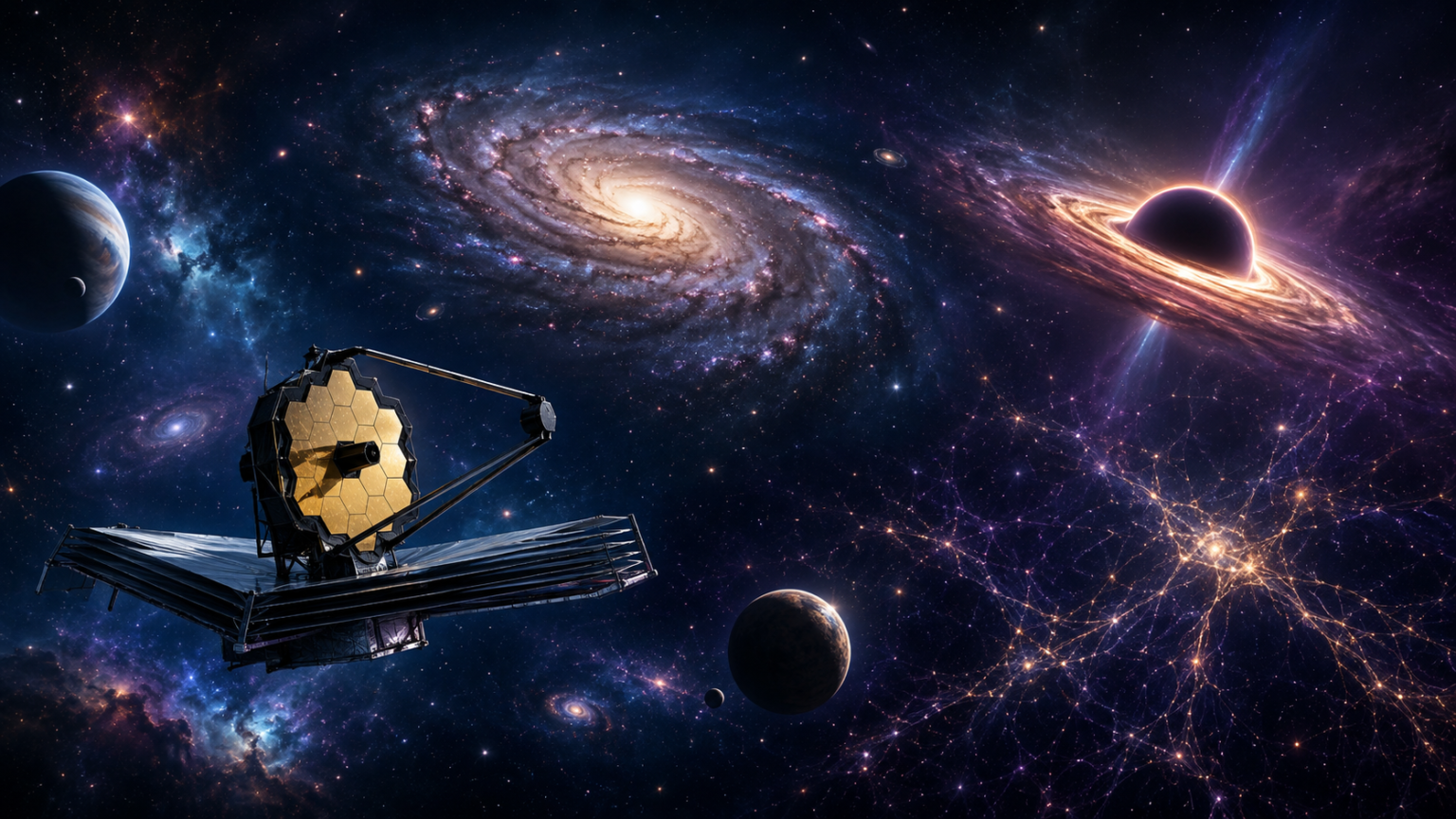
The James Webb Space Telescope observes primarily in infrared wavelengths. This allows it to examine distant galaxies whose light has been stretched by cosmic expansion and to see through clouds of dust surrounding newly forming stars.
Webb is studying the first luminous objects, the evolution of galaxies, star and planet formation, and exoplanet atmospheres.
In January 2026, NASA reported observations of the galaxy MoM-z14 as it appeared approximately 280 million years after the Big Bang, pushing astronomical observations closer to the beginning of galaxy formation.
Euclid Space Telescope
Euclid is designed to survey enormous areas rather than focus mainly on individual objects. Its mission is to map large-scale cosmic structures and investigate how dark matter and dark energy influenced the universe’s development.
Nancy Grace Roman Space Telescope
NASA’s Nancy Grace Roman Space Telescope will combine wide-field infrared surveys with detailed observations of galaxies, dark matter, dark energy and exoplanets.
As of August 3, 2026, NASA is targeting August 30, 2026, for Roman’s launch aboard a SpaceX Falcon Heavy rocket. The observatory is expected to survey vast areas of the sky far more efficiently than telescopes designed around narrower fields of view.
Together, these observatories demonstrate why no single telescope can solve every cosmic mystery. Progress depends on combining multiple forms of evidence.
Could There Be Dimensions Beyond What We Observe?
Human experience is structured around three spatial dimensions and one dimension of time. However, some theoretical models propose that additional spatial dimensions may exist but remain hidden at extremely small scales.
String theory, for example, generally requires more dimensions than those directly observed. Other theories propose that gravity may behave differently because it extends into dimensions inaccessible to ordinary matter.
These ideas remain theoretical. Scientists have not obtained conclusive experimental evidence for additional dimensions.
Nevertheless, investigating them could help explain why gravity is much weaker than the other fundamental forces and how quantum mechanics might be reconciled with general relativity.
The possibility demonstrates how navigating the cosmos increasingly involves exploring conceptual frontiers, not only travelling greater physical distances.
Is the Universe Infinite?
Scientists do not yet know whether the entire universe is infinite.
Measurements indicate that the observable universe is geometrically close to flat on large scales. A flat geometry is consistent with an infinite universe, but it does not prove infinity. The whole cosmos could be vastly larger than the observable region while still having a finite topology.
Observation is limited because light has travelled for a finite period and cosmic expansion prevents certain regions from ever communicating with Earth.
The observable universe is therefore not necessarily the entire universe. It is the portion from which information has had time to reach us.
This distinction leaves open profound questions about what may exist beyond the cosmic horizon.
How Will the Universe End?
The universe’s ultimate fate depends largely on dark energy and the long-term behaviour of cosmic expansion.
Under the most widely discussed scenario, expansion continues indefinitely. Galaxies outside gravitationally bound groups move increasingly far apart. Star formation gradually declines as available gas is consumed, stars burn out and the cosmos moves towards a colder, darker state often called the Big Freeze or heat death.
Alternative possibilities include a future contraction, sometimes called the Big Crunch, or an increasingly violent expansion capable of separating galaxies, stars and eventually atoms in a theoretical Big Rip.
Current evidence favours continuing accelerated expansion, but the conclusion depends on whether dark energy remains constant over time. Because its nature is unknown, the universe’s final chapter has not yet been written.
Why Exploring the Universe Matters
Cosmic research may appear distant from everyday economic and social priorities, but its practical influence is substantial.
Space science requires advanced sensors, precision engineering, high-performance computing, robotics, communications systems and sophisticated data analysis. Technologies developed for difficult astronomical problems can contribute to imaging, navigation, materials research and digital infrastructure.
The scale of modern astronomical datasets is also accelerating the use of artificial intelligence. Automated systems help scientists classify galaxies, identify unusual signals, process telescope imagery and detect patterns that would take human researchers far longer to examine manually.
Space exploration also strengthens international scientific collaboration. Major observatories frequently involve government agencies, universities, research laboratories and industrial partners across multiple countries.
Most importantly, astronomy changes humanity’s understanding of its place in nature. It connects the atoms within living organisms to stars that existed billions of years before Earth formed.
Navigating the Next Frontier
The mysteries of the universe are not signs that science has failed. They are evidence that discovery is still in progress.
Dark matter reveals gravitational effects without exposing its identity. Dark energy accelerates cosmic expansion without explaining its source. Black holes challenge the compatibility of our strongest theories. Exoplanets expand the possibilities for life while reminding us how difficult life is to detect.
Every new instrument answers some questions and exposes others.
The future of cosmic exploration will depend on combining space telescopes, ground-based observatories, particle accelerators, gravitational-wave detectors, artificial intelligence and increasingly precise theoretical models.
Navigating the cosmos ultimately means navigating uncertainty. It requires researchers to distinguish evidence from assumption, revise established ideas and remain open to discoveries that may transform humanity’s understanding of space, time, matter and existence.
The universe may never surrender all its secrets. Yet every observation brings its hidden architecture into sharper focus.
Suggested Article Schema
Primary Schema: Article
Additional Schema: FAQPage
Optional Schema: BreadcrumbList
Suggested Internal Links
Add internal links using anchor text such as:
- latest space exploration news
- artificial intelligence in scientific research
- future of the global space economy
- breakthrough technologies transforming astronomy
- science and innovation news
Suggested External Links
Link naturally to authoritative pages from:
- NASA Science
- European Space Agency
- CERN
- LIGO Scientific Collaboration
Rank Math Publishing Checklist
- Add the focus keyword to the SEO title.
- Keep the focus keyword in the URL slug.
- Place the keyword within the first 10% of the article.
- Include it naturally in at least one H2 heading.
- Use the keyword in the meta description.
- Add the focus keyword to the featured-image alt text.
- Retain a minimum article length of 1,500 words.
- Add a clickable table of contents.
- Include three to five relevant internal links.
- Include authoritative external references.
- Compress the featured image and convert it to WebP.
- Use Article and FAQ schema.
- Add the author’s name, publication date and updated date.
- Keep paragraphs short for mobile readability.
- Avoid placing the focus keyword unnaturally in every section.
- Test the URL, title and meta description before indexing.
Stay connected with Business Herald for the latest business news, insights, and updates.
Follow us on Facebook, Instagram, LinkedIn, and YouTube.
Join our growing community on WhatsApp and Telegram for real-time updates delivered directly to you.