
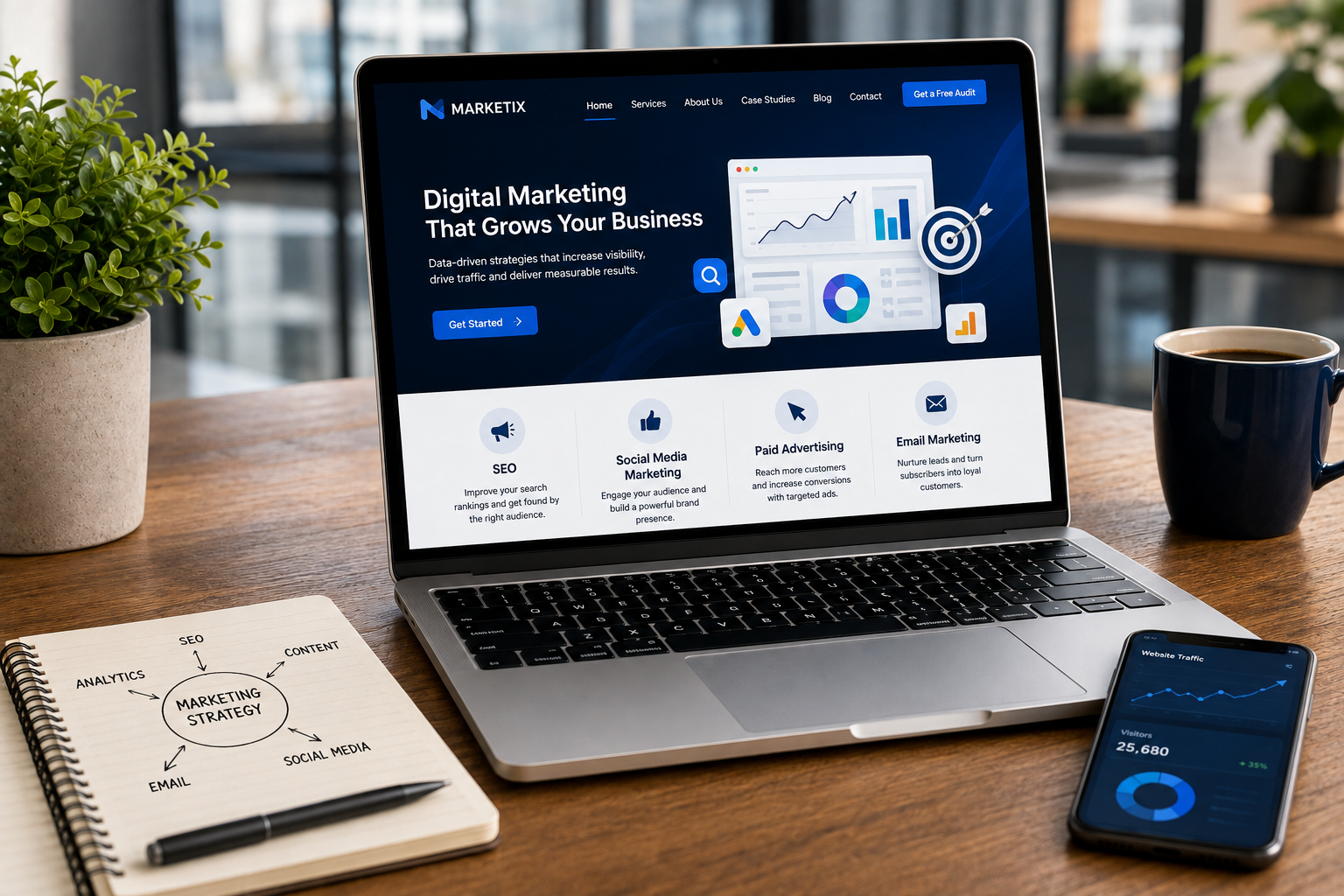

A digital marketing website is more than an online business card. For a service provider, it can become the foundation of your brand, the place where potential clients understand your expertise, and one of the most important channels for generating new business.
Whether you are a freelancer, consultant, marketing professional, creative agency, or specialist offering a particular service, a well-planned website can help turn online attention into real conversations and paying clients.
But simply launching a website is not enough.
Your website needs to answer a few important questions quickly:
What do you offer? Who do you help? Why should someone trust you? And how can they get started?
When these answers are clear, your website becomes a business-development tool rather than just another digital presence.
Here is how to build one strategically.
Start With a Clear Digital Marketing Service
Before purchasing a domain or choosing a website template, define exactly what you are selling.
“Digital marketing” is a broad category.
It can include:
- Search engine optimization
- Social media marketing
- Content marketing
- Paid advertising
- Email marketing
- Website development
- Brand strategy
- Influencer marketing
- Lead generation
- Marketing automation
- Online reputation management
- Conversion optimization
Trying to sell everything from the beginning can make your business difficult to understand.
Instead, identify the service where you can create the strongest value.
For example, instead of saying:
“We provide digital marketing services.”
You could position your business as:
“We help B2B companies generate qualified leads through SEO and content marketing.”
The second statement immediately tells a potential customer what you do and who you serve.
Choose a Specific Target Audience
Your digital marketing website should be designed around the people you want to attract.
You could target:
- Startups
- Local businesses
- E-commerce companies
- Professional service firms
- Technology companies
- Restaurants and hospitality brands
- Real estate businesses
- Healthcare organizations
- Coaches and consultants
- Established enterprises
A focused audience makes everything easier, including your website copy, service packages, content strategy, advertising, and sales process.
The more clearly you understand your ideal customer, the easier it becomes to communicate your value.
Choose a Strong Domain Name
Your domain name is one of the first things people will associate with your business.
Ideally, choose something that is:
- Easy to remember
- Easy to spell
- Professional
- Relevant to your brand
- Short enough to say and type easily
- Flexible enough to support future growth
Avoid overly complicated domain names, unnecessary numbers, or combinations that are difficult to pronounce.
If you are building a long-term agency or consulting brand, a brand-based domain can often provide more flexibility than a domain that focuses on one specific service.
Your website may begin with SEO services, for example, but eventually expand into content, advertising, social media, or broader marketing strategy.
Build a brand that can grow with you.
Build a Professional Digital Marketing Website
Once your service and domain are established, it is time to build the website.
You do not necessarily need dozens of pages.
You need the right pages.
A strong service-based website should typically include:
Homepage
Your homepage should immediately communicate what you do, who you help, and what makes your service valuable.
Avoid filling the first screen with complicated explanations.
A strong homepage structure can include:
Headline → Value proposition → Services → Proof → Benefits → Call to action
The visitor should understand your business within seconds.
About Page
People buy services from people and organizations they trust.
Your About page should explain your experience, philosophy, expertise, and approach.
Do not turn it into a long corporate biography.
Instead, connect your experience to the customer’s needs.
Explain why your background makes you qualified to solve their problems.
Services Page
Your services page should clearly explain what you offer.
Instead of listing services without context, explain:
- What the service includes
- Who it is for
- What problem it solves
- What the process looks like
- What outcomes clients can expect
- How customers can get started
If you offer multiple services, consider creating a dedicated page for each major service.
This can also create additional opportunities to target relevant search terms.
Case Studies
Case studies can be among the most powerful sections of a service website.
Rather than simply saying:
“We deliver great results.”
Show what happened.
A strong case study can explain:
Client challenge → Strategy → Execution → Results
Where possible, include measurable outcomes.
Numbers can make your claims more credible and give prospective customers a clearer understanding of your capabilities.
Contact Page
Do not make potential clients search for a way to contact you.
Your website should have a clear path from interest to action.
Depending on your business, that could mean:
- Book a consultation
- Request a proposal
- Schedule a discovery call
- Send an inquiry
- Request a free audit
- Get a quote
The call to action should match the buying journey of your target audience.
Make Your Digital Marketing Website Search-Friendly
Building a website is only half the job.
People need to be able to discover it.
This is where search engine optimization becomes important.
Your website should be structured around the terms your potential customers actually search for.
For example, if you offer SEO services to small businesses, relevant search terms might include:
- SEO services for small businesses
- small business SEO agency
- local SEO services
- affordable SEO services
- SEO consultant for small business
Do not force keywords into every sentence.
Instead, use them naturally in strategic locations such as:
- Page titles
- Headings
- Introduction paragraphs
- Service descriptions
- Image alt text
- Meta descriptions
- URLs
- Internal links
Search engines increasingly evaluate the overall usefulness and relevance of content, so writing for humans should remain the priority.
Create Dedicated Service Pages
One common mistake is putting every service on one page.
Imagine an agency offering SEO, social media management, paid advertising, content marketing, and email marketing.
A single page containing a few sentences about each service may not provide enough information for visitors—or enough topical depth for search engines.
Instead, create dedicated pages such as:
/seo-services/
/social-media-marketing/
/paid-advertising/
/content-marketing/
/email-marketing/
Each page can address the specific problem, audience, process, benefits, and frequently asked questions associated with that service.
This creates a stronger website architecture and gives each service a clearer opportunity to attract relevant search traffic.
Use Content Marketing to Attract Potential Clients
Your digital marketing website should not remain static.
Publishing useful content can help you attract people who are researching problems your business can solve.
For example, an SEO agency could publish articles about:
- How to improve local search rankings
- Common SEO mistakes businesses make
- How long SEO takes to produce results
- SEO strategies for startups
- How to conduct keyword research
- How to improve website conversions
The goal is not simply to publish as many articles as possible.
The goal is to publish content that answers questions your potential customers are already asking.
Over time, this can help build search visibility, demonstrate expertise, and introduce your services to people earlier in their buying journey.
Build Trust Before Asking for the Sale
A visitor who discovers your website for the first time may not be ready to hire you immediately.
That is normal.
Your website should therefore provide multiple trust signals.
These can include:
- Client testimonials
- Case studies
- Portfolio examples
- Industry experience
- Certifications
- Media mentions
- Reviews
- Client logos, where permission has been granted
- Data-backed results
- Educational content
Trust becomes particularly important for professional services because customers are not simply buying a product.
They are buying expertise.
Your website needs to communicate that expertise clearly.
Create a Strong Call to Action
A website without a clear next step can lose potential customers.
Every important page should guide visitors toward an appropriate action.
For example:
“Book a Strategy Call”
“Request a Proposal”
“Get Your Free Website Audit”
“Talk to Our Marketing Team”
Keep calls to action specific.
“Submit” is functional, but “Request Your Free Consultation” tells the visitor exactly what happens next.
You can also use different calls to action depending on where the visitor is in the buying journey.
Someone reading a beginner’s guide may prefer to download a resource.
Someone reviewing your pricing page may be ready to schedule a call.
Make the Website Fast and Mobile-Friendly
A beautiful website is not useful if it is difficult to use.
Your digital marketing website should work smoothly across smartphones, tablets, and desktop computers.
Pay particular attention to:
- Page loading speed
- Mobile navigation
- Font readability
- Button size
- Image optimization
- Website security
- Form functionality
- Broken links
- Overall user experience
A significant portion of online visitors use mobile devices, so mobile optimization should be treated as a core requirement rather than an optional feature.
Connect Your Website With Analytics
You cannot improve what you do not measure.
Connect your website to appropriate analytics and search performance tools so you can understand how visitors discover and interact with your business.
Track metrics such as:
- Website traffic
- Organic search traffic
- Top-performing pages
- Search queries
- Conversion rates
- Contact form submissions
- Consultation bookings
- Traffic sources
- Engagement patterns
The objective is not to collect numbers simply for the sake of reporting.
Use the information to make better decisions.
If one service page attracts significant organic traffic but generates few inquiries, for example, its messaging or call to action may need improvement.
Turn Your Website Into a Lead Generation System
The best digital marketing website is not simply informative.
It creates opportunities.
Think of your website as a journey:
Discovery → Education → Trust → Interest → Action
Someone discovers your article through search.
They explore your services.
They read a case study.
They see evidence of your expertise.
Then they book a consultation.
That is how a website can become part of your sales process.
You can strengthen this journey by connecting your website with tools such as customer relationship management systems, email marketing platforms, scheduling software, analytics platforms, and marketing automation.
Common Mistakes to Avoid
Building a service website can be exciting, but several mistakes can reduce its effectiveness.
Making the Website About You
Your experience matters, but customers ultimately want to know what you can do for them.
Lead with their problems and desired outcomes.
Using Too Much Marketing Jargon
Terms such as “360-degree solutions,” “synergistic growth,” and “digital transformation ecosystem” may sound impressive but often communicate very little.
Use simple language.
Explain what you actually do.
Hiding Your Services
Visitors should not have to navigate through several pages to understand what you offer.
Make your services easy to find.
Using Weak Calls to Action
Do not assume visitors will know what to do next.
Tell them.
Ignoring SEO
A visually impressive website with no search strategy can remain invisible to potential customers.
Build SEO into the website from the beginning.
Focusing Only on Traffic
Traffic is useful, but traffic alone does not build a business.
Pay attention to qualified visitors, inquiries, consultations, and customers.
A Simple Launch Checklist
Before launching your digital marketing website, review the following:
- Your target audience is clearly defined.
- Your core service is easy to understand.
- Your homepage communicates your value proposition.
- Your services have dedicated sections or pages.
- Your contact information is easy to find.
- Your website works on mobile devices.
- Your important pages have SEO titles and meta descriptions.
- Your URLs are simple and descriptive.
- Your images are optimized and have relevant alt text.
- Your website has clear calls to action.
- Your testimonials and case studies are easy to find.
- Analytics and conversion tracking are configured.
- Your website has a clear content strategy.
- Your forms and booking links have been tested.
- Your website uses HTTPS and follows appropriate security practices.
The Bigger Picture
Starting a digital marketing website is not simply a technology project.
It is a business positioning exercise.
Your website tells prospective customers what you stand for, what you specialize in, and why they should consider working with you.
The strongest service websites do not try to impress visitors with complexity.
They make the buying decision easier.
They communicate a clear problem, present a credible solution, demonstrate expertise, provide evidence, and make the next step obvious.
Start with a focused service.
Understand your audience.
Build a professional digital presence.
Create useful content.
Optimize your website for search.
Show evidence of your work.
Then continuously improve the experience using real customer and performance data.
Your website does not need to be perfect on day one.
It needs to be useful, credible, discoverable, and built to grow.
Stay connected with Business Herald for the latest business news, insights, and updates.
Follow us on Facebook, Instagram, LinkedIn, and YouTube.
Join our growing community on WhatsApp and Telegram for real-time updates delivered directly to you.