

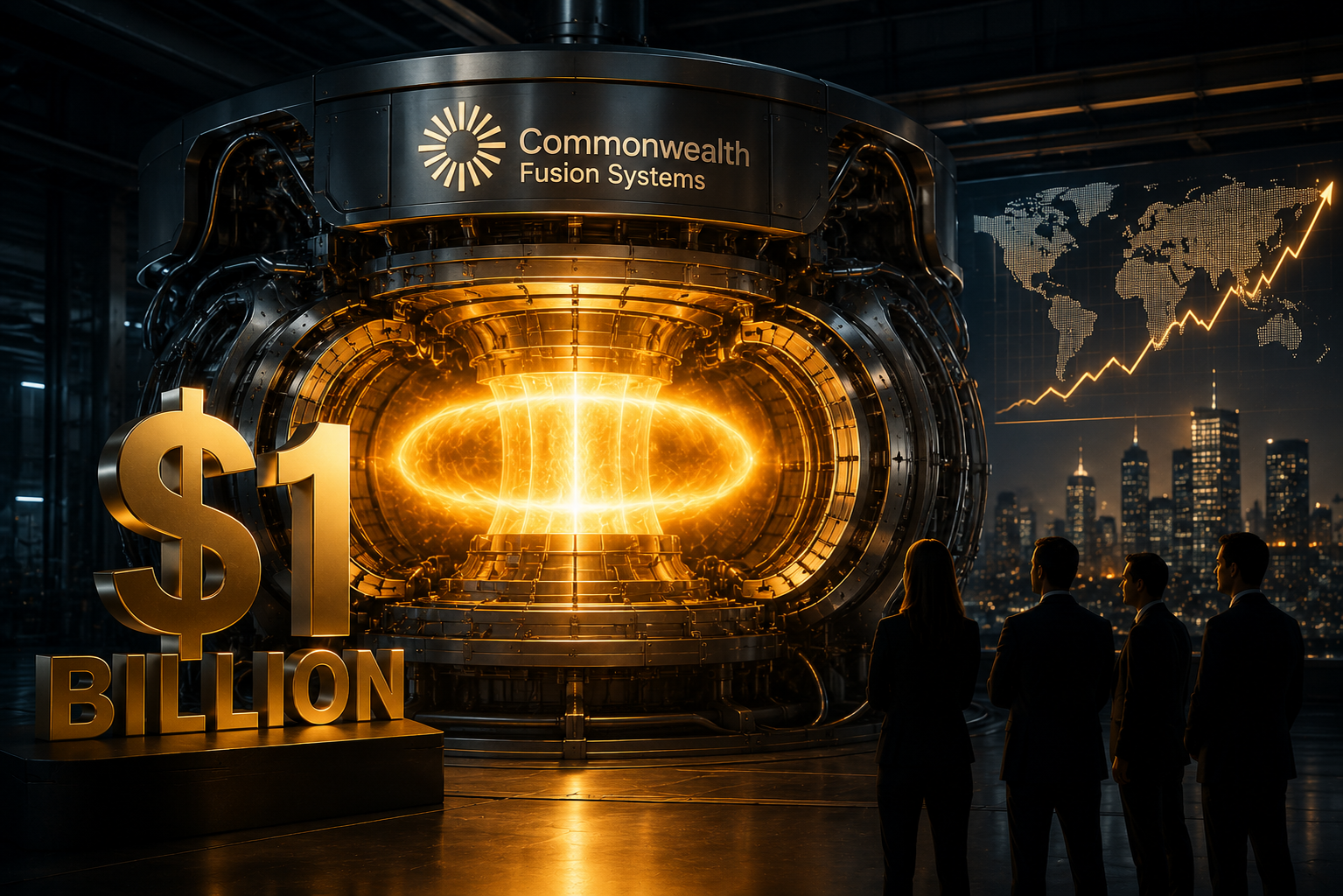

Commonwealth Fusion Systems has secured $1 billion in additional equity financing, taking its total capital raised to $4 billion as it moves from building a fusion demonstration machine towards developing a commercial power plant in Virginia.
Fusion energy funding has entered a new phase.
Commonwealth Fusion Systems, a US company developing technology designed to generate electricity through nuclear fusion, announced on July 30, 2026, that it had raised $1 billion in additional equity financing.
The capital came from institutional and strategic investor categories that included pension funds, sovereign wealth funds, infrastructure investors, and industrial corporate partners. CFS did not identify the individual investors, disclose a company valuation, or assign the transaction a numbered Series designation.
The company said the money would accelerate its progress towards commercialisation. Reuters reported that the funds are intended to advance ARC, CFS’s proposed commercial fusion power plant in Virginia, rather than finance its SPARC demonstration machine in Massachusetts.
The financing takes the total investment in CFS to $4 billion. It also strengthens the company’s position as the best-funded private participant in the global race to turn fusion from a laboratory achievement into a commercially viable source of electricity.
Table of contents
- What Commonwealth Fusion Systems announced
- What the company does
- How the $1 billion will be used
- Why institutional investment matters
- The wider fusion funding race
- AI, data centres and electricity demand
- Commercial agreements with Google and Eni
- Energy security and government policy
- The technical and regulatory reality check
- What the investment means for business
Commonwealth Fusion Systems Funding: What Was Announced?
The latest Commonwealth Fusion Systems funding announcement covers $1 billion in additional equity capital.
CFS described it as the largest single financing by a fusion energy company since its own $1.8 billion Series B round in 2021. The company had previously raised $863 million in a Series B2 round announced in August 2025.
The latest investment brings CFS’s cumulative funding to $4 billion. Reuters calculated that this represents more than 28% of the approximately $14.2 billion reported across the global private fusion industry since 2021.
The investor profile is particularly significant.
CFS said the new capital came from pension funds, sovereign wealth funds, infrastructure investors, and industrial companies. These investor categories generally operate with longer investment horizons than conventional venture capital funds, although their participation does not mean fusion has acquired the risk profile of established infrastructure.
No named investors were confirmed for this specific transaction. The company also did not publicly confirm a post-money valuation, ownership structure, or detailed allocation of the proceeds.
Those omissions matter. They prevent reliable conclusions about CFS’s valuation, dilution, individual investor exposure, or the financial terms attached to the equity.
What Does Commonwealth Fusion Systems Do?
Commonwealth Fusion Systems is developing machines intended to generate energy through nuclear fusion, the physical process that powers the sun and other stars.
Fusion occurs when light atomic nuclei combine under extreme conditions and release energy. Commercial developers are attempting to control that process on Earth and use the resulting heat to generate electricity.
CFS’s approach is based on a tokamak, a doughnut-shaped magnetic confinement device designed to contain extremely hot plasma. The company uses high-temperature superconducting magnets to create the strong magnetic fields required to control that plasma.
Its commercial strategy has two principal stages: SPARC and ARC.
SPARC is the demonstration machine being assembled at the company’s headquarters in Devens, Massachusetts. CFS intends SPARC to achieve net fusion energy, also described as Q greater than one, by producing more fusion energy than the energy delivered directly to heat the plasma.
That remains a future company target. SPARC has not yet demonstrated net fusion energy.
ARC is the proposed commercial successor. CFS plans to build its first ARC facility at the Fall Line Fusion Power Station in Chesterfield County, Virginia.
The company says ARC is being designed to deliver approximately 400 megawatts of net electricity to the grid. It is targeting the early 2030s for power production, but this is a company projection rather than a demonstrated operating date.
How Will the $1 Billion Be Used?
CFS said the financing would accelerate its progress towards commercial fusion energy.
Its official announcement stated that the company would continue completing SPARC while advancing ARC in parallel. Reuters added an important financial distinction: Chief Executive Bob Mumgaard said the $1 billion would not be used for the Massachusetts demonstration facility and would instead allow the company to progress towards ARC.
This changes the business interpretation of the round.
Capital invested in SPARC primarily supports scientific and engineering validation. Capital directed towards ARC begins addressing a wider commercial challenge that includes detailed plant design, licensing, site development, procurement, construction planning, grid connection, and project financing.
ARC will also require infrastructure beyond the fusion machine itself. A commercial power station must convert fusion heat into usable electricity, manage maintenance and fuel systems, meet safety standards, and deliver power reliably into an electricity market.
CFS has already submitted an interconnection application to PJM, the wholesale electricity market serving Virginia and several other US regions. The application begins a long technical assessment of whether and how the planned plant could connect to the grid.
It is an important development step, but it is not regulatory approval or permission to construct the plant.
Why Fusion Energy Funding From Institutional Investors Matters
The size of the funding is important, but the composition of the capital may be even more consequential.
Fusion companies have traditionally relied on governments, scientific institutions, specialist venture funds, energy companies, and technology billionaires. These sources can tolerate the technical uncertainty and long development cycles associated with experimental energy systems.
Pension funds, sovereign wealth funds, and infrastructure investors usually evaluate opportunities differently.
They tend to focus on long-term asset value, commercial demand, policy stability, construction risk, operating performance, and the potential for contracted cash flows.
Their participation does not prove that fusion is commercially viable. It does indicate that the industry is beginning to attract investors whose mandates extend beyond speculative science and early-stage technology.
For CFS, this broader capital base may be useful as the company approaches a more expensive stage of development.
A fusion demonstration machine can be financed largely as a technology project. A grid-scale power station requires a much more complex capital structure that could eventually combine corporate equity, customer agreements, strategic investment, government support, and infrastructure financing.
This is why the latest fusion energy funding round matters beyond its headline value. It suggests that some investors are beginning to evaluate fusion as a prospective industrial and infrastructure category.
Global Fusion Energy Funding Reaches a Record
The CFS announcement follows a record year for private fusion investment.
The Fusion Industry Association reported that 56 fusion companies raised $4.48 billion during the 12 months leading to July 2026. That was 69% higher than the comparable 2025 total and the highest annual figure recorded since the association began its survey in 2021.
Cumulative funding reported by the industry since 2021 reached $14.24 billion. The association also estimated that the sector employed more than 16,000 people globally.
These figures should be interpreted with context.
The Fusion Industry Association’s data is based on voluntary responses from private companies, and many of those companies are association members. The organisation states that it aims to treat members and non-members equally, but the survey remains industry-reported data rather than a regulatory filing or independently audited global census.
Even with that qualification, the investment trend is clear.
Fusion energy funding is increasing, more companies are entering the market, and commercial agreements are becoming more common. The association reported that six companies had secured siting agreements, while five had a power purchase agreement, offtake arrangement, or similar commercial commitment.
The industry is also attracting different forms of financing. Some developers remain privately held, while others are pursuing public-market transactions or strategic combinations.
That expansion increases access to capital, but it also introduces greater scrutiny over valuations, timelines, scientific claims, and commercial assumptions.
AI and Data Centres Strengthen the Energy Investment Case
The investment case for fusion is increasingly connected to the rapid expansion of artificial intelligence infrastructure.
AI models require large computing clusters housed in data centres. These facilities need substantial and continuous electricity for servers, cooling equipment, and supporting infrastructure.
The International Energy Agency estimated that data centres consumed about 415 terawatt-hours of electricity globally in 2024, equivalent to roughly 1.5% of worldwide electricity use. Its base case projects demand will more than double to approximately 945 terawatt-hours by 2030.
The IEA expects data-centre electricity consumption to grow by approximately 15% annually between 2024 and 2030, more than four times faster than electricity demand from other sectors combined. Accelerated servers, largely associated with AI adoption, are expected to account for almost half of the increase.
The global share remains relatively limited, but the local effect can be significant.
Data centres are concentrated in particular regions. This can produce large increases in electricity demand around specific grid connections, substations, and generation markets.
Virginia is one of the most important data-centre markets in the United States. CFS’s decision to locate ARC in Chesterfield County therefore connects the project directly with a region where technology infrastructure and electricity demand are expanding.
Fusion’s commercial proposition is based partly on its potential to provide firm power, meaning electricity that can be available regardless of weather conditions.
However, this remains a prospective benefit. CFS must first demonstrate that its technology can produce electricity reliably at commercial scale and at a price acceptable to customers.
Google and Eni Provide Early Commercial Validation
CFS has already secured power agreements with Google and Eni for its proposed ARC plant.
Google signed an offtake agreement in June 2025 covering 200 megawatts of electricity from the planned Virginia facility. It also increased its investment in CFS and received an option to purchase electricity from future ARC plants. Financial terms of Google’s additional investment were not disclosed.
The 200-megawatt commitment represents half of ARC’s planned 400-megawatt net output.
In September 2025, Italian energy company Eni signed an agreement worth more than $1 billion to purchase power from the same plant. Eni has been a CFS shareholder since 2018 and has also increased its investment during the company’s earlier Series B2 financing.
CFS says the Google and Eni agreements together cover more than half of the electricity the first ARC plant is expected to produce.
These commitments provide evidence of future customer demand. They may also help CFS demonstrate revenue visibility when it begins arranging project financing.
They should not, however, be treated as proof of technical success.
Power purchase agreements can reduce market risk by identifying buyers. They do not eliminate scientific, engineering, construction, regulatory, scheduling, or cost risk.
The value of these agreements will ultimately depend on whether ARC is built, connected, and able to supply electricity under commercially acceptable terms.
Fusion Energy Funding Becomes an Energy-Security Issue
Governments are increasingly treating fusion as more than a climate technology.
A commercially viable fusion sector could potentially support domestic electricity production, reduce dependence on imported fuels, and create new industrial capabilities in advanced magnets, materials, robotics, power electronics, precision manufacturing, and engineering.
The US Department of Energy released a finalised Fusion Science and Technology Roadmap in June 2026. It aims to coordinate public research, private-sector development, infrastructure, workforce programmes, and supply-chain investment around fusion pilot plants and commercial power in the mid-2030s.
The roadmap was developed with input from more than 800 scientists and engineers, more than 15 companies, over 10 national laboratories, and more than 70 universities.
It identifies three broad priorities: building critical infrastructure, accelerating innovation, and expanding the wider fusion ecosystem through partnerships, workforce development, and commercial pathways.
The Department of Energy also states that implementation depends on future public-private partnerships and congressional appropriations. The roadmap does not commit the government to specific funding levels.
That qualification is important for investors. Policy support can reduce risk, but roadmaps do not guarantee budgets, project approvals, or commercial outcomes.
The Technical and Regulatory Reality Check
Fusion remains experimentally advanced but commercially unproven.
CFS and its competitors must still demonstrate sustained plasma performance, reliable plant operation, efficient conversion of fusion energy into electricity, and components capable of surviving demanding reactor conditions.
Reuters identified two major challenges: developing materials that can withstand continuous neutron exposure and improving the efficiency of fusion reactions.
The fuel cycle is another issue.
Many proposed fusion systems plan to use deuterium and tritium. Deuterium is relatively accessible, but tritium is scarce and radioactive. A commercial plant will need to manage, recover, and potentially breed tritium safely and efficiently.
CFS says ARC will use a molten-salt blanket to capture neutron energy and produce tritium for reuse within the plant. That is part of the proposed design and has not yet been demonstrated in an operating commercial ARC facility.
Regulation is also evolving.
The US Nuclear Regulatory Commission has been developing a framework to regulate fusion machines under its byproduct-material rules. In January 2026, the agency published a strategy supporting the development of that licensing framework, while subsequent documents described a proposed rulemaking process.
CFS must therefore manage several different forms of risk simultaneously:
Scientific performance must be proven. Plant components must survive operational conditions. The fuel cycle must function. Regulators must approve the relevant activities. The project must secure construction capital, connect to the grid, and operate at a competitive cost.
A successful SPARC result would be significant, but it would not answer every commercial question facing ARC.
What the $1 Billion Means for Investors and Industry
For venture investors, the latest fusion energy funding round supports a technology platform with potentially large intellectual-property and market opportunities.
For infrastructure investors, the longer-term opportunity is different. It lies in financing operating power plants that could generate contracted electricity revenue over several decades.
For energy companies, early involvement may create access to technical knowledge, future electricity supplies, and positions within a new industrial value chain.
For technology companies, fusion could eventually become part of a diversified strategy for securing firm, low-carbon electricity for data centres and AI infrastructure.
For governments, the strategic calculation combines energy security, climate policy, industrial capacity, scientific leadership, and high-value employment.
For utilities and electricity customers, the decisive question is more practical: can fusion provide dependable power at a competitive price?
The $1 billion raise does not answer that question.
It provides CFS with more capital to pursue the scientific, engineering, and commercial milestones that could eventually produce an answer.
Is Fusion Becoming a Commercially Investable Industry?
Fusion has not yet become a conventional investable infrastructure sector.
There is no operating commercial fusion plant supplying electricity to a public grid. Cost structures remain uncertain, licensing frameworks are still developing, and several crucial engineering questions remain unresolved.
Yet the financing environment is changing.
CFS has raised $4 billion, attracted institutional investors, secured future power commitments from Google and Eni, selected a commercial site, and entered the grid-interconnection process.
The broader sector has also reported record annual investment and a growing number of siting and customer agreements.
These developments indicate that fusion is moving beyond pure scientific research and entering the early stages of industrial development.
The next decisive milestone will not be another large funding announcement.
It will be evidence that capital can translate into net energy, an approved plant, reliable grid electricity, and economics that customers can support.
Until then, fusion energy funding should be viewed as a long-duration investment in a potentially transformative technology, accompanied by unusually high scientific, construction, and commercial risk.
Stay connected with Business Herald for the latest business news, insights, and updates.
Follow us on Facebook, Instagram, LinkedIn, and YouTube.
Join our growing community on WhatsApp and Telegram for real-time updates delivered directly to you.