

The global economy is entering a period in which technological capability, energy access, supply-chain control and workforce readiness are becoming inseparable.
Artificial intelligence is moving from experimental chatbots into business operations. Robots and autonomous systems are advancing beyond repetitive factory work. Data centres are attracting vast amounts of capital, while their electricity requirements are exposing constraints in grids and energy infrastructure.
At the same time, geopolitics is changing trade relationships, cybersecurity is becoming a board-level financial risk, and companies are redesigning supply chains around resilience rather than cost alone.
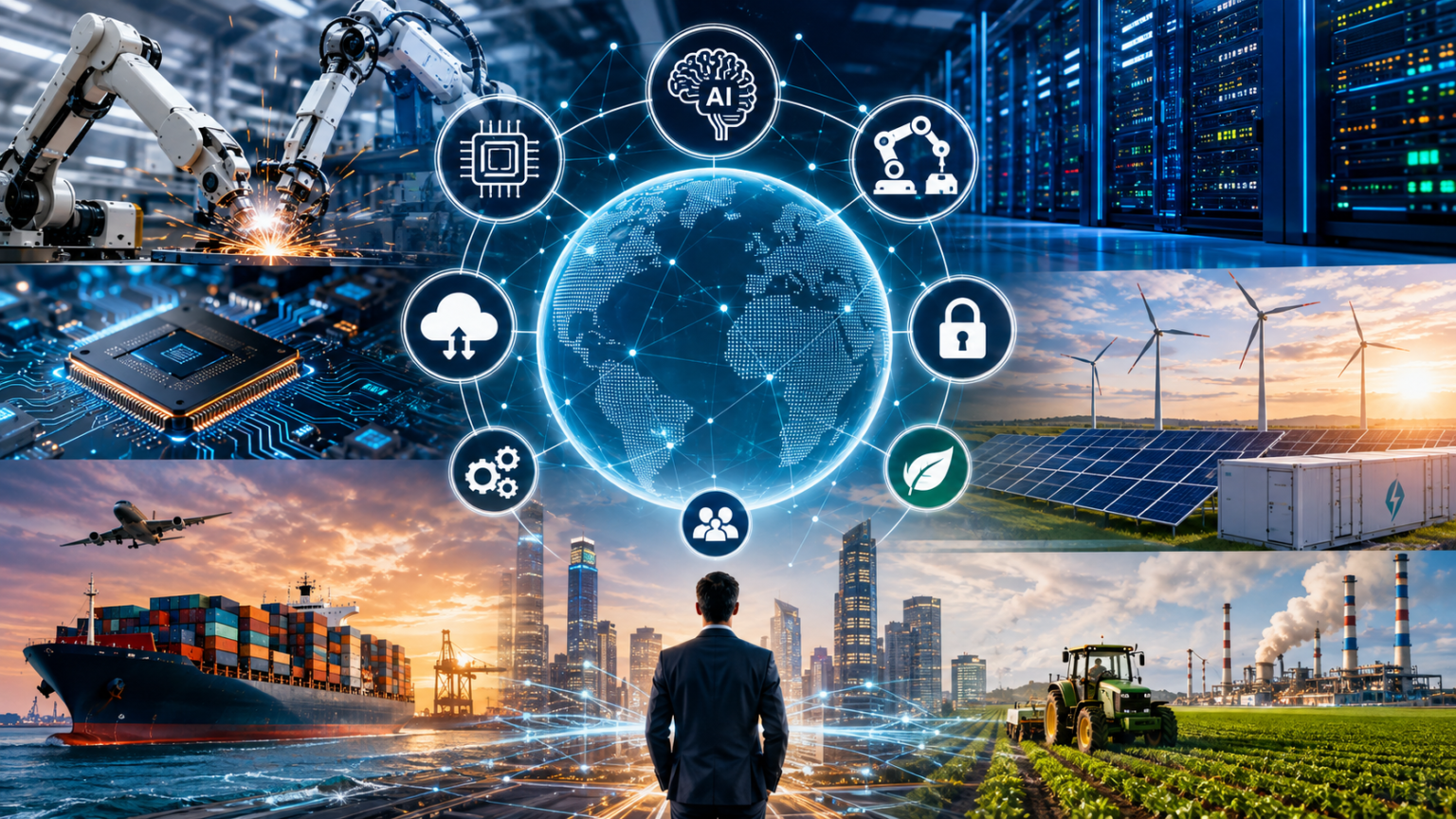
These industry trends shaping the future are not developing independently. Artificial intelligence requires semiconductors, data centres, electricity, skilled workers and secure digital networks. Electric vehicles depend on batteries, critical minerals, charging systems and policy support. Advanced manufacturing requires automation alongside reliable supply chains and industrial research.
For business leaders and investors, the central question is no longer which individual technology will win. It is which companies can combine technology, physical infrastructure, talent and execution into a defensible operating model.
Table of Contents
- AI Is Becoming an Operating Layer
- Robotics Is Moving into the Physical Economy
- Data Centres and Semiconductors Attract Strategic Capital
- Energy Security Becomes Industrial Strategy
- Supply Chains Shift from Efficiency to Resilience
- Cybersecurity Becomes a Business-Critical Function
- Healthcare and Biotechnology Enter a Platform Era
- The Workforce Faces a Skills Reset
- Investment Becomes More Concentrated
- India’s Opportunity in the Next Industrial Cycle
- What Business Leaders Should Prioritise
- Risks That Could Slow Industry Transformation
- Frequently Asked Questions
1. Artificial Intelligence Is Becoming an Operating Layer
The first stage of generative AI adoption focused heavily on producing text, images and software code. The next stage is moving towards systems that can complete multistep workflows.
Agentic AI combines foundation models with the ability to plan, use software tools, retrieve information and execute actions. Potential applications include procurement, customer service, software testing, financial reporting, logistics and internal research.
McKinsey identifies agentic AI as one of the fastest-growing technology trends, describing the emergence of “virtual coworkers” capable of planning and executing complex workflows. The firm also expects AI to accelerate developments across robotics, bioengineering and energy systems.
However, adoption does not automatically produce value.
AI systems need access to reliable data, clear permissions and well-designed business processes. A poorly structured workflow does not become efficient simply because an AI model is added to it.
The competitive shift in 2026 is therefore moving from AI access to AI integration.
Companies are beginning to ask more demanding questions:
- Can the technology reduce operating costs?
- Can it shorten product-development cycles?
- Does it improve customer retention or revenue?
- Can its decisions be audited?
- What happens when the model produces an incorrect result?
- Can the system operate securely at scale?
The strongest AI investments are likely to be those attached to measurable outcomes rather than general promises of transformation.
What This Means for Investors
AI companies with proprietary data, strong distribution and deep industry integration may be better positioned than providers offering easily replicated interfaces.
The value could increasingly move towards specialised applications in finance, healthcare, manufacturing, logistics and professional services, where domain expertise and regulatory knowledge create meaningful barriers to entry.
2. Robotics Is Moving into the Physical Economy
Software-based AI can analyse and recommend. Robotics allows intelligence to act in the physical world.
Manufacturers are adopting computer vision, autonomous mobile robots, digital twins and AI-enabled equipment to inspect products, predict machine failures and optimise production.
The World Economic Forum found that 58% of employers expect robotics and automation to transform their businesses by 2030. McKinsey similarly reports that physical robots and digital agents are moving from pilots towards practical deployment in logistics, industrial operations and dynamic environments.
The major change is flexibility.
Traditional industrial robots excel at repetitive tasks in controlled environments. Newer systems can use cameras, sensors and machine learning to adjust when objects, people or operating conditions change.
This is expanding the addressable market for automation.
Areas Likely to See Strong Adoption
Manufacturing: Inspection, assembly, welding, packaging and predictive maintenance.
Logistics: Inventory movement, order fulfilment, sorting and warehouse management.
Healthcare: Surgical assistance, rehabilitation and hospital logistics.
Agriculture: Crop monitoring, precision spraying and automated harvesting.
Energy and mining: Inspection and maintenance in dangerous environments.
Humanoid robots have attracted attention because existing workplaces are already designed around the human body. However, commercial success will depend on reliability, energy consumption, maintenance costs and productivity rather than appearance.
The future of robotics will be determined on factory floors, warehouses and worksites, not only through controlled demonstrations.
3. Data Centres and Semiconductors Are Attracting Strategic Capital
Artificial intelligence depends on physical infrastructure.
Training and operating advanced models requires specialised chips, high-speed networks, cooling systems, cloud platforms and large quantities of electricity. This has transformed semiconductors and data centres into strategic assets.
UN Trade and Development reported that global foreign direct investment rose to approximately $1.6 trillion in 2025, but the recovery was heavily concentrated. Data-centre projects accounted for more than one-fifth of announced global greenfield investment value, exceeding $270 billion, while semiconductor project values increased by 35%.
The investment surge reflects several connected forces:
- rapid growth in AI workloads;
- demand for sovereign computing capacity;
- national-security concerns;
- the localisation of semiconductor supply chains;
- and competition for cloud and digital infrastructure.
McKinsey notes that higher demand for computing, memory and networking has accelerated innovation in application-specific semiconductors. These chips are being designed to manage AI performance, cost, heat and power consumption more efficiently.
The Infrastructure Bottleneck
The AI industry cannot expand solely through better software.
Data-centre projects face limitations involving electricity connections, land, cooling water, permitting and specialised equipment. Grid capacity and access to dependable power could become as important as processor performance.
This creates opportunities beyond technology companies. Utilities, engineering firms, cooling specialists, network providers and industrial real-estate developers may all participate in the AI infrastructure cycle.
4. Energy Security Is Becoming Industrial Strategy
Energy is no longer only a utility-sector issue. It is becoming a determinant of industrial competitiveness.
The International Energy Agency expects global energy investment to reach approximately $3.4 trillion in 2026. The agency says geopolitical disruption and energy-security concerns are pushing countries and companies to diversify supply sources, technologies and trade routes.
Electricity demand is also being reshaped by data centres, electric vehicles, industrial electrification and cooling requirements.
The IEA estimates that more than 2,500 gigawatts of renewable-energy, storage and large electricity-demand projects are stalled in grid-connection queues worldwide. Annual grid investment may need to rise by approximately 50% from the current level of about $400 billion by 2030.
This changes the commercial meaning of the energy transition.
The opportunity is no longer limited to building solar panels or wind farms. It includes:
- transmission and distribution networks;
- battery storage;
- grid-management software;
- flexible electricity demand;
- nuclear and geothermal systems;
- clean industrial fuels;
- and energy-efficient cooling.
Energy as a Competitive Advantage
Industries such as semiconductors, metals, chemicals and data centres require large quantities of reliable electricity.
Regions that can provide affordable, stable and increasingly low-carbon power may attract a greater share of industrial investment. Regions with slow permitting, congested grids or high energy prices risk losing projects even when they possess strong technology talent.
The future of industry may therefore be shaped as much by transformers, transmission lines and storage capacity as by AI models.
5. Supply Chains Are Shifting from Efficiency to Resilience
For decades, global supply chains were optimised primarily for speed and cost.
Repeated geopolitical, health, climate and shipping disruptions have forced companies to reconsider that model. Businesses are diversifying suppliers, increasing inventory for critical inputs and reassessing where products are manufactured.
This does not necessarily mean the end of globalisation.
The OECD argues that global value chains are evolving rather than disappearing. Companies are reorganising specific activities, diversifying suppliers and managing risk without abandoning international production.
The new supply-chain model combines several priorities:
- cost efficiency;
- supplier diversification;
- geopolitical risk management;
- cybersecurity;
- environmental traceability;
- and visibility across multiple tiers of suppliers.
The OECD’s 2026 supply-chain report identifies AI and environmental market-access requirements as two systemic forces transforming trade. It argues that paperless systems, standardised data and interoperable digital infrastructure are becoming essential for efficient and resilient supply chains.
Traceability Becomes Commercial Infrastructure
Companies increasingly need to demonstrate where materials originated, how goods were produced and whether environmental or labour requirements were met.
This creates demand for:
- supply-chain analytics;
- digital customs systems;
- product passports;
- verification platforms;
- enterprise risk software;
- and machine-readable compliance records.
Smaller companies may face greater pressure because they possess fewer resources to implement complex digital reporting systems.
For large businesses, supporting suppliers with technology and data standards could become essential to maintaining market access.
6. Cybersecurity Is Becoming a Business-Critical Function
Every major industry trend increases digital exposure.
AI systems create new attack surfaces. Smart factories connect operational technology to corporate networks. Digital supply chains exchange sensitive commercial data, while cloud systems centralise critical workloads.
The World Economic Forum’s Global Cybersecurity Outlook 2026 found that 94% of respondents expect AI to be the most significant driver of cybersecurity change. The proportion of organisations assessing AI-tool security nearly doubled from 37% in 2025 to 64% in 2026.
At the same time, 87% of respondents identified AI-related vulnerabilities as the fastest-growing cyber risk during 2025. Almost two-thirds of organisations were accounting for geopolitically motivated cyberattacks in their risk strategies.
Cybersecurity is therefore moving beyond the information-technology department.
It now affects:
- operational continuity;
- executive liability;
- customer trust;
- intellectual property;
- supply-chain reliability;
- regulatory compliance;
- and national infrastructure.
The Shift from Prevention to Resilience
It is unrealistic to assume that every cyberattack can be prevented.
Companies must also prepare to limit damage, continue essential operations and recover quickly. This requires incident planning, employee training, secure backups, supplier assessments and clear executive accountability.
Cybersecurity spending should increasingly be evaluated as protection for revenue and operational capacity rather than an administrative cost.
7. Healthcare and Biotechnology Are Entering a Platform Era
Healthcare is being reshaped by the convergence of AI, diagnostics, genomics, connected devices and biomanufacturing.
AI can support medical imaging, clinical documentation, disease surveillance and drug research. Biotechnology platforms are expanding the ability to develop targeted medicines, vaccines and biological products.
The OECD’s 2026 biotechnology analysis highlights the role of innovative small and medium-sized companies, investment and cross-border partnerships in building competitive biotechnology value chains.
India also launched its Strategic Framework for AI in Health in February 2026. The framework prioritises data quality, interoperability, secure digital infrastructure, workforce readiness and ethical governance. WHO described India as the first country in its South-East Asia region to adopt a comprehensive national AI strategy for health.
The Next Healthcare Opportunity
The next phase is unlikely to be dominated by one application.
Value could emerge from connected ecosystems combining:
- digital patient records;
- diagnostic algorithms;
- remote monitoring;
- drug-discovery platforms;
- precision medicine;
- and local biomanufacturing.
However, healthcare adoption requires a higher standard of evidence than many consumer applications. A system that appears accurate in a demonstration may not perform consistently across hospitals, populations or clinical settings.
Regulation, patient privacy and reimbursement will determine which innovations move beyond pilots.
8. The Global Workforce Is Facing a Skills Reset
Technology is not only changing jobs. It is changing the skills required inside existing jobs.
The World Economic Forum estimates that structural labour-market changes could create 170 million roles and displace 92 million by 2030, producing a net increase of approximately 78 million jobs.
The distribution will be uneven.
Technology roles, including AI specialists, big-data professionals, fintech engineers and software developers, are expected to grow rapidly. Demand is also increasing for renewable-energy engineers, care professionals, educators and construction workers.
Meanwhile, many clerical, administrative and data-entry roles face pressure from automation.
The report estimates that 39% of workers’ current skill sets could change or become outdated by 2030. If the global workforce were represented by 100 people, 59 would require training.
Skills That Will Matter
Technical skills remain important, particularly:
- AI and data literacy;
- cybersecurity;
- software and automation;
- and technological fluency.
However, employers also place significant value on analytical thinking, adaptability, creativity, leadership and lifelong learning.
This suggests that the future workforce will not be divided simply between technical and non-technical workers.
The most valuable professionals may be those who combine industry expertise with the ability to use, evaluate and supervise intelligent systems.
9. Investment Is Becoming More Concentrated
Capital is returning to global markets, but it is not being distributed evenly.
UNCTAD reported that global FDI increased by 6% to $1.6 trillion in 2025. However, the world’s top 20 destination economies attracted more than 80% of total flows. Much of the increase came from a relatively small number of megaprojects, particularly in AI-related infrastructure.
Strategic sectors accounted for 44% of global greenfield investment in 2025, compared with 16% in 2020. AI infrastructure was the largest segment, supported by data centres, cloud systems and associated digital networks.
This concentration has several implications.
Countries without dependable infrastructure, skilled workforces or clear investment policies may struggle to attract projects even when capital is available globally.
Companies operating in favoured sectors may enjoy easier financing, while businesses outside strategic investment themes could face more demanding capital markets.
Investor Focus Is Narrowing
Investment is increasingly directed towards industries connected to:
- artificial intelligence;
- semiconductors;
- energy security;
- critical minerals;
- defence;
- healthcare;
- and advanced manufacturing.
The presence of strong demand does not eliminate valuation risk. Large capital inflows can lead to overbuilding, unrealistic growth expectations and poor returns when infrastructure develops faster than customer revenue.
Investors must separate structural demand from speculative enthusiasm.
10. India’s Opportunity in the Next Industrial Cycle
India enters this period with strong domestic demand, a large technical workforce and ambitions in manufacturing, digital services, clean energy and advanced technology.
The Economic Survey 2025-26 estimated real GDP growth of 7.4% for the year and projected growth of between 6.8% and 7.2% in 2026-27. Services remained a major driver, while manufacturing growth recovered and foreign direct investment reached $81 billion in 2025.
The Survey also identified data centres, specialised tourism, space services and ocean-related industries as emerging service opportunities. It argued that India’s industrial strategy must increasingly focus on scale, innovation, competitiveness and deeper participation in global value chains.
Application-Led AI
India’s strongest near-term opportunity may not be competing exclusively to build the largest frontier AI models.
The Economic Survey argues that India’s comparative advantage lies in application-led innovation and human-capital depth. It recommends sector-specific AI models, shared infrastructure, open systems and stronger education and skilling.
This could support AI products designed for:
- Indian languages;
- agriculture;
- healthcare;
- financial inclusion;
- manufacturing;
- logistics;
- education;
- and public administration.
Advanced Manufacturing
India can benefit from the diversification of global supply chains, but success will require more than incentives.
Manufacturers need reliable power, efficient logistics, skilled labour, local suppliers and consistent regulation. Increasing private-sector research and development will also be critical. India’s national R&D expenditure remains approximately 0.64% of GDP, with businesses contributing a smaller share than in several competing economies.
For readers following Business News India, the opportunity lies in the intersection of domestic scale and global competitiveness.
India does not need to dominate every emerging industry. It needs to develop defensible positions in selected parts of the value chain where talent, demand and policy support reinforce one another.
What Business Leaders Should Prioritise
Understanding trends is useful only when it changes decision-making.
Build Around Business Outcomes
Companies should avoid investing in technology solely because competitors are doing so. Every programme should have a measurable operational or financial objective.
Treat Data as Infrastructure
AI, automation and supply-chain visibility depend on accurate, accessible and secure information. Fragmented data systems can prevent promising technology from scaling.
Link Technology with Energy Planning
Businesses developing factories, data centres or electric fleets must evaluate electricity availability, grid timelines and energy costs early in the investment process.
Diversify Critical Dependencies
Companies should map not only direct suppliers but also upstream dependencies involving semiconductors, cloud platforms, minerals, logistics routes and specialist equipment.
Make Cybersecurity Part of Strategy
AI governance, supplier security and operational resilience should be discussed at board level.
Invest in Workforce Transition
Technology adoption without employee training can produce resistance, errors and underused systems. Reskilling must begin before roles are significantly redesigned.
Preserve Financial Discipline
High-growth markets can still destroy capital. Leaders must evaluate deployment costs, customer willingness to pay and the time required to generate returns.
Risks That Could Slow Industry Transformation
The direction of change appears clear, but the pace is uncertain.
Infrastructure Constraints
Power grids, data centres, ports, transport networks and semiconductor capacity may fail to expand quickly enough.
Geopolitical Fragmentation
Trade restrictions and strategic competition could raise costs and limit access to technology or critical materials.
Weak Economics
Some AI, robotics and clean-technology projects may remain technically impressive but commercially unviable.
Regulatory Uncertainty
Different rules governing AI, data, trade and environmental reporting can make international deployment more complex.
Talent Shortages
Skills gaps remain one of the largest barriers to business transformation. The World Economic Forum found that 63% of surveyed employers viewed them as a major obstacle.
Cybersecurity Failures
A serious incident can interrupt physical operations, compromise intellectual property and undermine public trust.
Unequal Access to Capital
The concentration of investment may leave smaller companies and developing markets without the infrastructure required to participate fully in emerging industries.
Industries of the Future Will Be Built Through Convergence
The most important industry trends shaping the future are converging.
Artificial intelligence needs semiconductors, electricity and secure data. Robotics requires AI, sensors and advanced manufacturing. Clean energy depends on grids, storage and critical minerals. Resilient supply chains need interoperable data, logistics infrastructure and trusted suppliers.
The winning businesses will not necessarily be those that adopt every emerging technology first.
They will be the companies that combine technology with operational discipline, sector expertise and financial sustainability.
For investors, the next industrial cycle offers substantial opportunities, but it also demands selectivity. Capital-intensive trends may take longer to generate returns, while software advantages can disappear quickly when competitors gain access to similar models.
For policymakers, the challenge is to create the infrastructure, skills and regulatory certainty needed to attract long-term investment rather than short-lived speculation.
The future of industry will be shaped by more than innovation. It will be shaped by the ability to scale innovation securely, affordably and productively across the real economy.
Frequently Asked Questions
What are the leading industry trends shaping the future?
The most significant trends include artificial intelligence, robotics, digital infrastructure, energy-system investment, cybersecurity, biotechnology, resilient supply chains and workforce reskilling.
How is AI changing industries?
AI is being used to automate workflows, analyse data, improve forecasting, assist product development and manage operational decisions. Agentic systems may increasingly complete multistep tasks with limited human intervention.
Which industries are expected to grow fastest?
AI infrastructure, semiconductors, cybersecurity, robotics, clean energy, healthcare technology and advanced manufacturing are attracting significant strategic investment.
Why are data centres becoming important?
Data centres provide the computing power needed for cloud services and artificial intelligence. Their expansion is also increasing demand for electricity, cooling, networking and grid connections.
How will automation affect employment?
Automation will displace some tasks and roles while creating demand in technology, care, education, construction and green-energy occupations. The World Economic Forum projects net global job growth through 2030, although major reskilling will be required.
Why is cybersecurity a major industry trend?
Companies are becoming more digitally connected, increasing exposure to fraud, data theft and operational disruption. AI is strengthening cybersecurity tools while also enabling more advanced attacks.
How are global supply chains changing?
Businesses are diversifying suppliers, improving visibility and using digital tools to balance cost efficiency with resilience, security and environmental compliance.
What role will clean energy play in future industries?
Affordable and reliable electricity will be critical for data centres, transport, manufacturing and industrial electrification. Investment is expanding beyond renewable generation into grids, storage and flexibility.
What opportunities does India have?
India has opportunities in application-focused AI, digital services, manufacturing, healthcare technology, clean energy, data centres and global business services. Success will depend on skills, infrastructure, research and stronger supplier ecosystems.
What should investors examine before investing in an emerging industry?
Investors should assess market demand, competitive barriers, capital requirements, regulation, customer economics, infrastructure dependencies and the company’s path to sustainable cash flow.
Stay connected with Business Herald for the latest business news, insights, and updates.
Follow us on Facebook, Instagram, LinkedIn, and YouTube.
Join our growing community on WhatsApp and Telegram for real-time updates delivered directly to you.