

Artificial intelligence is moving into a part of banking that receives far less public attention than chatbots but handles enormous amounts of money.
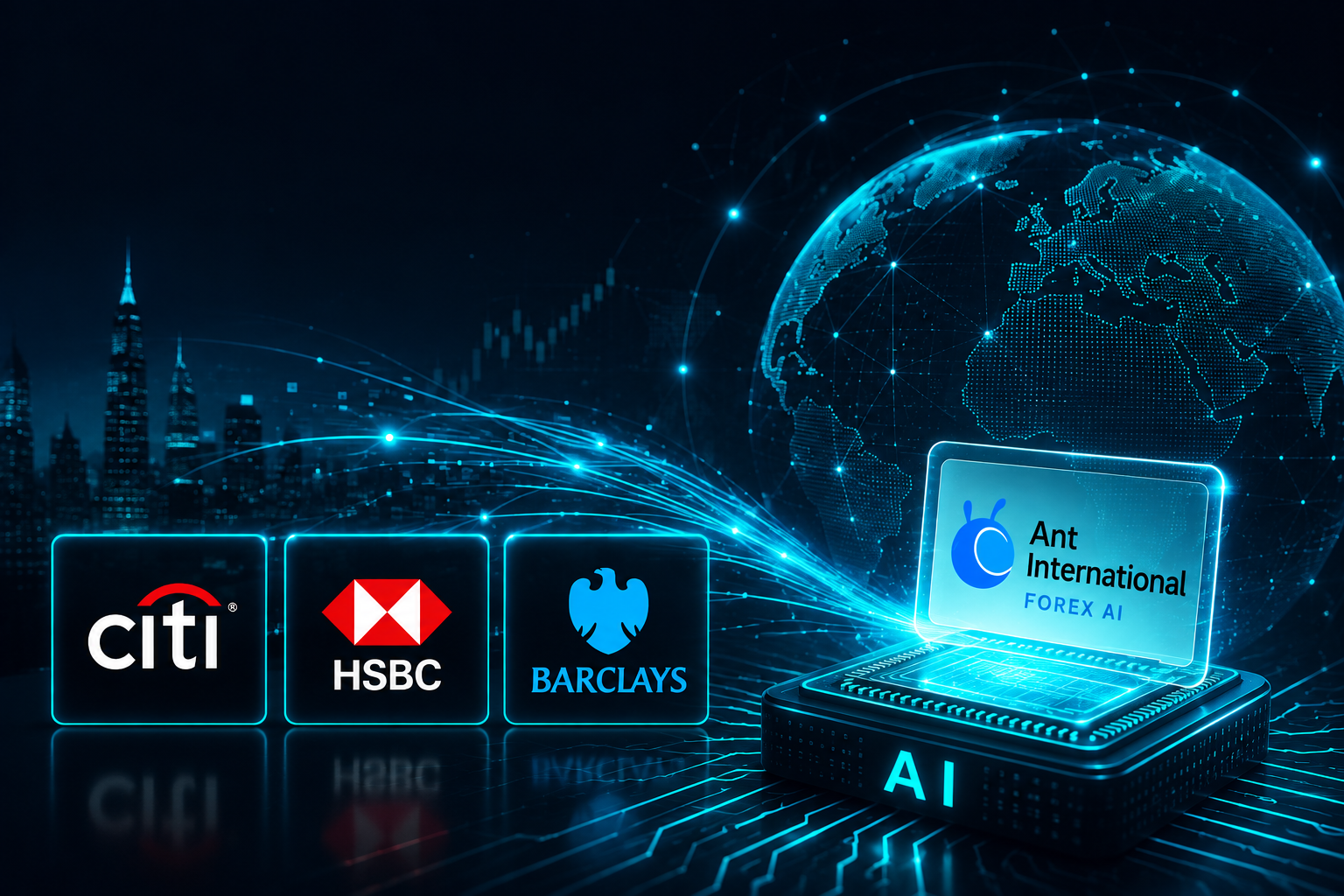
Ant International has launched an upgraded version of its Falcon Time-Series Transformer model and is working with major banks as financial institutions look for better ways to forecast cash flows and manage foreign-exchange risk. The participating banks include Citi, HSBC, Deutsche Bank, Standard Chartered, and Barclays.
The development gives the Ant International forex AI model a serious test inside mainstream financial infrastructure. This is not generative AI writing reports or answering customer questions. It is being applied to a narrower problem: estimating how much money businesses are likely to receive or need in different currencies, and helping banks hedge that exposure more efficiently.
That distinction is important because specialist financial models may prove more useful in banking than general-purpose AI systems for tasks where precision matters more than conversation.
What Ant International Forex AI Actually Does
Companies operating across multiple countries constantly receive and make payments in different currencies.
An airline, for example, may sell tickets in euros, dollars, yen, and dozens of other currencies while paying many of its costs elsewhere. Exchange rates can move between the moment a sale is made and the moment money is converted.
Businesses protect themselves through hedging. In simple terms, they use financial contracts to reduce the risk that currency movements will hurt their margins.
The problem is that a company first needs a reliable estimate of how much foreign currency it will actually receive.
Ant International’s Falcon model studies historical transaction patterns and other time-based data to forecast future cash flows and foreign-exchange exposure. Better forecasts can allow companies and banks to hedge closer to the amount genuinely needed rather than buying more protection than necessary.
Ant says its AI-powered FX systems can achieve forecast accuracy above 90% in its own applications. The company also says precise forecasting can reduce some foreign-exchange hedging and allocation costs by more than 60%. Those figures are Ant’s claims and should not be treated as an industry-wide result.
Why Citi, HSBC and Other Banks Are Working With Specialist AI
The banking industry’s AI push is beginning to split into different categories.
General-purpose models are useful for summarising documents, assisting employees, analysing text, and handling some customer interactions. Financial forecasting presents a different problem.
Treasury departments work with streams of numerical data that change by hour, day, currency, and market. A model designed specifically to identify patterns in that data can be more useful than a system built primarily to understand and generate language.
Kelvin Li, general manager of platform technology at Ant International, told Reuters that specialist models have an advantage in financial scenarios, while general-purpose large models have yet to achieve what he described as a universal breakthrough in finance.
That is a useful way to view the Ant International forex AI strategy.
The financial sector may not end up relying on a single giant AI model. Banks are more likely to use different models for different jobs: one for fraud, another for credit risk, another for compliance, and another for forecasting liquidity or currency exposure.
For institutions handling large sums of money, being narrower can be an advantage.
Ant International Forex AI Has Already Been Tested With Citi and Barclays
The latest announcement builds on work that began before Falcon 2.0.
Citi and Ant International announced a pilot in July 2025 that combined Falcon with Citi’s fixed foreign-exchange rate service for corporate customers. The initial focus was airlines, where large numbers of online transactions create complex currency exposures.
Ant said the pilot helped one airline reduce hedging costs by about 30% in initial live transactions. Citi’s fixed FX service supports more than 70 currencies.
Barclays had also begun integrating an earlier version of Falcon into its BARX NetFX platform. The bank said the model improved its ability to forecast Ant International’s currency exposure and helped make the hedging process more precise.
Capital A, the parent group associated with AirAsia, later used Falcon across its multi-currency treasury operations. Ant said the project achieved forecast accuracy of about 90% and reduced some hedging costs by up to 40%.
These cases remain limited compared with the scale of the global foreign-exchange market. They are nevertheless useful because they move the technology beyond laboratory testing.
[LINK: related Business Herald article on how AI is changing global banking]
The Business Case Is About Better Forecasts, Not Predicting Currency Prices
The phrase “forex AI” can easily create the wrong impression.
Falcon is not being marketed primarily as a machine that tells traders whether the dollar, euro or yen will rise tomorrow.
Its more practical role is forecasting the financial flows a company expects to handle. Consider a business that expects to receive €100 million next month.
If its forecast is inaccurate and it actually receives only €75 million, it may have paid to hedge currency exposure that never materialised. If it receives €125 million, part of its exposure may remain unprotected.
A better cash-flow forecast allows the hedge to match the underlying business more closely.
For large multinationals processing payments across many countries, even small improvements can affect working capital and transaction costs.
That makes the Ant International forex AI model less glamorous than an AI trading system, but potentially more useful.
AI Could Change How Corporate Treasury Teams Work
Treasury departments have traditionally relied on historical data, company forecasts, banking systems and human judgement to estimate future liquidity.
AI gives them another layer of analysis.
A forecasting system can continuously process transaction behaviour and adjust predictions when spending or payment patterns change. That could allow treasury teams to move away from relatively static forecasts toward more frequent updates. There is also a wider strategic shift underway.
Banks once developed most of their critical financial technology internally or bought it from established financial software suppliers. The Ant partnerships show that large institutions are increasingly willing to integrate specialised technology from fintech companies when it solves a specific problem.
That creates an opening for financial AI providers that can demonstrate measurable cost savings rather than simply offering another general-purpose assistant.
Ant International is pushing hard into that market. The Singapore-headquartered fintech company is an international affiliate of Ant Group, which raised $1.2 billion in equity funding in July as it expands its global operations.
The Risks Become More Serious as AI Moves Closer to Financial Decisions
Better forecasts do not remove risk. A model trained on historical patterns can struggle when markets behave in ways that history does not capture well. Wars, sudden tariffs, financial crises, or abrupt regulatory changes can disrupt normal payment flows and currency relationships.
Data quality matters a lot because if a company feeds incomplete or distorted information into a forecasting model, a highly sophisticated system can still produce a poor estimate.
Banks also need to understand how much authority these tools receive.
An AI system suggesting a hedge is very different from an AI system automatically executing large financial transactions. The closer models move toward decision-making, the more important human oversight, testing, and limits become.
Regulators will pay attention as adoption grows. Financial institutions need to be able to explain how critical systems are monitored, where accountability sits, and what happens when a model fails. This is where the enthusiasm around AI in banking meets the less exciting work of governance.
Specialist AI May Become the More Important Banking Story
Much of the public discussion around financial AI has focused on customer service, productivity assistants, and automated research.
The Ant International forex AI rollout points to a quieter development. AI is starting to enter the operational machinery of finance: forecasting cash, allocating liquidity, managing currency exposure, and supporting treasury decisions.
These applications may attract fewer headlines than consumer chatbots, but the economic value can be clearer because banks can measure the effect in costs, accuracy, and capital usage.
Ant still has to show that Falcon 2.0 can deliver consistent results across different banks, industries, and market conditions. Its strongest efficiency numbers are company-reported, and success in selected pilots does not guarantee the same outcome everywhere.
But the participation of Citi, HSBC, Deutsche Bank, Standard Chartered, and Barclays shows that large financial institutions are willing to test the proposition.
The next phase of AI in banking may therefore look less like a universal financial super-intelligence and more like a collection of highly specialised systems doing narrow jobs very well.
For treasury management, that transition has already started.
Stay connected with Business Herald for the latest business news, insights, and updates.
Follow us on Facebook, Instagram, LinkedIn, and YouTube.
Join our growing community on WhatsApp and Telegram for real-time updates delivered directly to you.