

Technology used to evolve in relatively distinct waves.
First came personal computing. Then the internet. Smartphones followed, cloud computing scaled behind them, and social platforms created an entirely new digital economy.
What is happening in 2026 feels different.
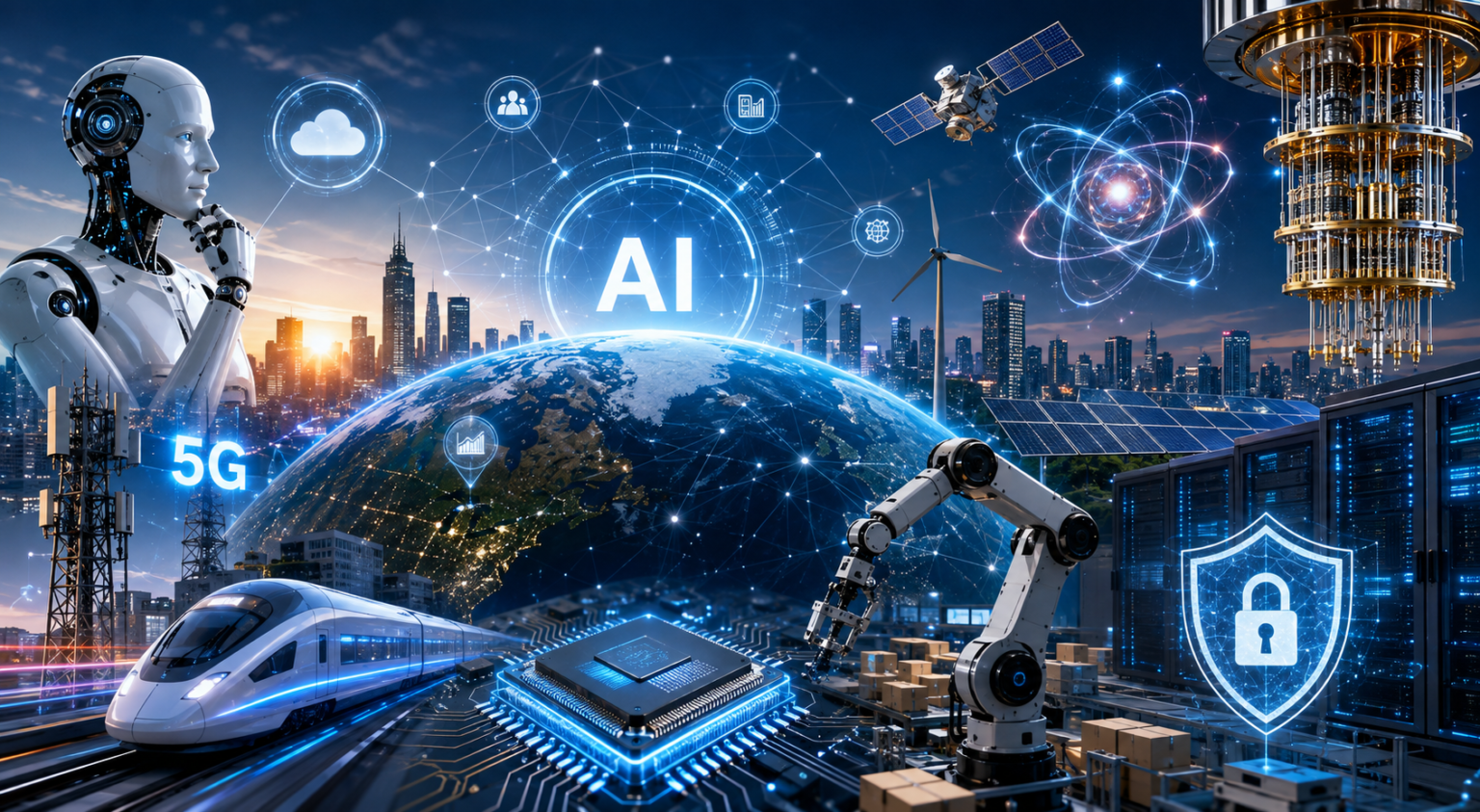
Artificial intelligence, semiconductors, energy, cloud infrastructure, robotics, cybersecurity and geopolitics are no longer developing as separate industries. They are increasingly interconnected pieces of what might best be described as the global technosphere: the enormous network of hardware, software, electricity, data, factories, algorithms and people supporting the modern digital economy.
The numbers reveal the scale of the transition.
Gartner’s April 2026 forecast puts worldwide IT spending at approximately $6.32 trillion this year, up 13.5% from 2025. Data-centre systems are expected to grow 55.8%, considerably faster than most traditional technology categories.
Artificial intelligence sits at the centre of that acceleration. Gartner’s latest forecast expects global AI spending to reach $2.59 trillion in 2026, up 47% year over year, with AI infrastructure accounting for the majority.
But the real story is not simply that technology spending is rising.
It is where the money is going and why.
Here are eight major global technology trends in 2026 reshaping businesses, investment markets and the digital economy.
1. AI Is Transforming From Software Feature Into Economic Infrastructure
For the past three years, the artificial-intelligence conversation has largely revolved around what models can do.
Write an email.
Generate an image.
Create software.
Analyse documents.
Produce video.
That phase is evolving rapidly.
Businesses are now asking a more economically important question: How do we industrialise AI?
Stanford University’s 2026 AI Index found AI adoption among surveyed organisations had climbed to 88% in 2025, while 70% were using generative AI in at least one business function. At the same time, corporate AI investment more than doubled during 2025, with private investment rising 127.5%.
This marks a transition from experimentation to infrastructure.
Instead of simply purchasing an AI chatbot, companies increasingly need:
- GPUs
- high-speed networking
- cloud computing
- vector databases
- cybersecurity
- enterprise data infrastructure
- AI governance systems
- inference capacity
- specialised software platforms
That explains why infrastructure is absorbing such an enormous portion of AI expenditure.
Gartner expects approximately $1.43 trillion of worldwide AI spending in 2026 to go towards AI infrastructure, compared with roughly $453 billion for AI software.
The implication for investors is significant.
The AI opportunity extends far beyond companies developing foundation models.
Some of the biggest beneficiaries could sit underneath them.
Think chips, memory, networking equipment, data centres, cooling systems, cloud platforms and electricity infrastructure.
AI is increasingly being financed less like a conventional software trend and more like an industrial build-out.
2. The AI Model Race Is Becoming More Competitive
Another major change is occurring at the top of the AI market.
The performance gaps between the most advanced models are narrowing.
Stanford’s 2026 AI Index shows leading models from Anthropic, xAI, Google and OpenAI clustered within a relatively narrow range on comparative Arena rankings as of March 2026. Stanford also concluded that the performance gap between leading American and Chinese models had effectively closed.
This could fundamentally alter competition.
When one model is dramatically better than everything else, capability becomes the primary differentiator.
When several models become powerful enough for similar tasks, businesses begin evaluating other factors:
How much does inference cost?
How reliable is the model?
Can it integrate securely with proprietary company data?
How quickly can it respond?
Can it operate within industry regulations?
Can it be customised for a particular domain?
This moves AI competition beyond benchmark scores.
The long-term winners may not simply build the smartest model.
They may build the most commercially useful AI ecosystem.
There is another important wrinkle.
Stanford found that industry produced more than 90% of notable AI models in 2025, highlighting how frontier AI development is becoming increasingly concentrated among organisations capable of funding enormous computing requirements.
That concentration makes infrastructure economics even more important.
3. Semiconductors Are Becoming the Strategic Commodity of the Digital Age
Every artificial-intelligence model ultimately depends on something physical.
Chips.
That makes semiconductors one of the most consequential global technology trends of 2026.
World Semiconductor Trade Statistics now forecasts the global semiconductor market to reach approximately $1.51 trillion in 2026, driven by extraordinary growth in memory, high-bandwidth memory and accelerated-computing demand.
The memory market alone is projected to exceed $800 billion.
That is an extraordinary shift for an industry that spent decades being viewed mainly as a cyclical electronics supplier.
Advanced chips now influence:
- AI development
- defence systems
- telecommunications
- cloud computing
- electric vehicles
- smartphones
- industrial automation
- scientific computing
The semiconductor supply chain consequently occupies the intersection of technology, industrial policy and geopolitics.
And it is much larger than chip designers alone.
The value chain includes:
Chip architecture → fabrication → semiconductor equipment → materials → advanced packaging → high-bandwidth memory → networking → cooling → power
AI demand is pulling investment through virtually every layer.
For investors trying to understand the technology boom, following only consumer-facing AI companies risks missing much of the underlying economic activity.
4. India Is Trying to Move Deeper Into the Semiconductor Value Chain
The semiconductor shift has particular relevance for Business News India.
India has long supplied global chip companies with engineering and design talent but historically captured a relatively small portion of semiconductor manufacturing.
That is changing.
On July 15, 2026, India’s Union Cabinet approved Semicon 2.0 with an outlay of ₹1,27,500 crore.
The programme expands the country’s semiconductor strategy across six areas including chip design, fabrication, equipment, materials, packaging and research. The government said 105 startups were already developing chips under the broader design ecosystem.
The opportunity is substantial.
But semiconductor manufacturing is also among the world’s most capital-intensive and technically complex industries.
India will therefore have to compete on more than incentives.
It needs reliable power, water, specialised talent, chemical supply chains, precision manufacturing capabilities and strong logistics.
If those pieces come together, India’s position in the global technology supply chain could look dramatically different a decade from now.
5. Data Centres Are Becoming an Energy Industry
The term “cloud computing” creates a misleading mental picture.
There is nothing weightless about the cloud.
Modern AI runs inside enormous physical facilities filled with servers, networking equipment, cooling infrastructure and processors operating continuously.
Those systems consume electricity.
A lot of it.
The International Energy Agency projects global data-centre electricity consumption will more than double to around 945 terawatt-hours by 2030, equivalent to just under 3% of worldwide electricity demand.
Between 2024 and 2030, data-centre electricity use is projected to grow roughly 15% annually, while electricity consumed by accelerated servers associated primarily with AI could increase around 30% each year.
The scale becomes easier to understand when translated into physical infrastructure.
The IEA notes that traditional data centres may require between 10 and 25 megawatts, while hyperscale AI facilities can exceed 100 MW. Some planned facilities are vastly larger.
This means AI companies increasingly need something technology businesses historically did not spend much time worrying about:
power generation.
The AI economy is consequently becoming entangled with:
- electricity grids
- renewable energy
- natural gas
- nuclear power
- battery storage
- geothermal energy
- cooling technology
- water infrastructure
- land and real estate
The next constraint on AI growth might not be the intelligence of the model.
It could simply be whether enough reliable electricity exists to run it.
6. Digital Sovereignty Is Fragmenting the Global Cloud
For years, the internet economy moved towards centralisation.
A relatively small number of hyperscale companies provided cloud computing infrastructure to businesses around the world.
Geopolitics is beginning to challenge that model.
Governments increasingly want strategically important data and computing infrastructure located within jurisdictions they control.
This is producing the rise of sovereign cloud infrastructure.
Gartner forecasts worldwide sovereign-cloud infrastructure-as-a-service spending will reach $80 billion in 2026, up 35.6% year over year.
“As geopolitical tensions rise, organizations outside the U.S. and China are investing more in sovereign cloud IaaS,” Gartner analyst Rene Buest said.
This is not merely a government technology trend.
Banks, telecommunications companies, energy businesses, defence contractors and other highly regulated industries also care about where data is stored and which laws apply to it.
The result could be a more geographically fragmented technology stack.
Instead of one universally distributed global cloud, the future may involve multiple interconnected but jurisdictionally distinct digital infrastructures.
7. Regulation Is Becoming Part of the AI Competitive Landscape
For most technology companies, regulation once arrived after markets were already mature.
Artificial intelligence is developing differently.
Governments are attempting to construct rules while the technology itself is still changing rapidly.
Europe’s AI Act represents the most consequential example.
Obligations covering providers of general-purpose AI models began applying in August 2025. From August 2, 2026, the European Commission can enforce full compliance with those obligations, including through fines.
That changes AI economics.
Model developers increasingly need to invest not only in computing and research, but also in:
- documentation
- risk management
- copyright compliance
- cybersecurity
- testing
- governance
- transparency systems
This could produce an interesting competitive tension.
Larger technology companies may face greater regulatory scrutiny, but they also have more resources to finance compliance.
Smaller firms may innovate faster but could find complex compliance requirements disproportionately expensive.
The next stage of AI competition will therefore involve three simultaneous races:
capability, economics and compliance.
8. Robotics Is Bringing AI Into the Physical Economy
Generative AI initially changed what machines could create on screens.
Robotics asks a bigger question:
What happens when intelligent software can act in the physical world?
Industrial automation is already operating at enormous scale.
According to the International Federation of Robotics, 542,000 industrial robots were installed globally in 2024, more than double the number installed ten years earlier.
Asia accounted for 74% of new installations, with China alone representing 54% of global deployments.
The next stage involves combining this mechanical capability with increasingly sophisticated AI.
Traditional industrial robots are excellent at repeating predefined movements inside carefully controlled environments.
AI-enabled robots could become more capable of perceiving objects, interpreting changing surroundings and performing variable tasks.
That opens opportunities across:
manufacturing, warehouses, agriculture, construction, logistics, healthcare and eventually consumer services.
Humanoid robots attract considerable attention, but their near-term economic success is far from guaranteed.
The more important trend is broader.
AI is beginning to leave the computer screen and enter machines that interact with the physical economy.
9. Quantum Computing Is Entering a More Serious Commercial Phase
Quantum computing has lived in the future tense for years.
That is gradually changing.
IBM’s updated roadmap targets the first examples of quantum advantage during 2026, using quantum computers alongside high-performance classical systems. The company is aiming for its first large-scale fault-tolerant quantum computer in 2029.
In June 2026, IBM also announced plans to invest more than $10 billion in quantum computing over five years, spanning research, manufacturing, acquisitions and ecosystem development.
None of this means quantum computers are about to replace ordinary computers.
They are not.
The potential lies in solving specific categories of highly complex problems where quantum approaches may eventually outperform conventional systems.
Possible applications include:
- molecular simulation
- materials science
- drug discovery
- optimisation
- chemistry
- financial modelling
For investors, caution remains essential.
Roadmaps should not be confused with proven commercial advantage.
Yet the scale of investment shows quantum computing is moving from an academic curiosity towards a genuine strategic technology race.
10. Cybersecurity Is Preparing for the Quantum Era Before It Arrives
Quantum computing is also creating a peculiar cybersecurity problem.
Businesses may need to protect themselves against machines that do not yet exist at the required scale.
Powerful future quantum computers could potentially undermine several cryptographic methods currently used to secure digital communications.
That has accelerated development of post-quantum cryptography.
NIST is already working with governments and industry to migrate systems towards cryptographic standards designed to resist both conventional and future quantum attacks.
In June 2026, NIST released additional working drafts supporting post-quantum cryptography in US Personal Identity Verification systems, while its migration programme is urging organisations using public-key cryptography to begin preparing for quantum-resistant systems.
The important business takeaway is not that tomorrow’s encryption will suddenly fail.
It is that large organisations take years to replace cryptographic systems.
Migration therefore needs to start before the threat becomes immediate.
Cybersecurity strategy is becoming increasingly forward-looking rather than reactive.
India’s Technology Economy Is Entering the Infrastructure Phase
India provides a useful example of how these global trends are converging.
The country’s technology story was traditionally associated with software services, outsourcing and digital consumer platforms.
The next phase is increasingly physical.
Under the IndiaAI Mission, backed by an outlay of ₹10,372 crore, more than 38,000 GPUs had been onboarded for shared AI computing infrastructure by March 2026.
Meanwhile, public-cloud spending in India is expected to climb 28.1% to approximately $17.5 billion in 2026, according to Gartner. Infrastructure-as-a-service spending alone is forecast to rise 40%.
Add semiconductor manufacturing, new data centres and domestic AI models, and a broader transformation becomes visible.
India is trying to move from being primarily a user and developer of global technology towards owning a larger share of the infrastructure underneath it.
For Indian founders, investors and policymakers, that distinction matters.
What Businesses and Investors Should Watch Now
The global technology story of 2026 can be reduced to several questions.
Does AI generate measurable productivity?
The next phase will increasingly be judged on returns rather than demonstrations.
Who controls compute?
GPUs, cloud infrastructure and semiconductor capacity are becoming strategic assets.
Where does the electricity come from?
AI growth increasingly depends on energy infrastructure.
Can companies secure their technology stack?
AI agents, distributed cloud systems and quantum-era threats are expanding cybersecurity requirements.
How fragmented will technology become?
Digital-sovereignty policies could reshape the global cloud market.
Can robotics deliver commercial economics?
The transition from digital AI to physical automation could become one of the decade’s largest opportunities.
When does quantum become economically useful?
Technical milestones matter, but commercial advantage remains the real test.
The Bigger Shift: Technology Is Becoming Industrial Again
Perhaps the most important insight from the global technology trends of 2026 is that technology is becoming unexpectedly physical.
The dominant companies of the previous internet era could often scale software with relatively modest additional capital.
The AI era looks different.
It requires processors.
Processors require semiconductor fabs.
Fabs require specialised equipment and materials.
Data centres require enormous buildings.
Servers require electricity.
Electricity requires power plants and grids.
Robotics requires factories.
And every layer requires security.
Technology has not stopped being digital.
But the infrastructure required to produce digital intelligence is becoming profoundly industrial.
That could reshape where profits accumulate.
The next technology winners may include not only model developers and software companies but also chip manufacturers, electricity providers, data-centre operators, cooling specialists, cybersecurity companies and industrial automation firms.
Conclusion
The global technosphere is entering one of its most consequential periods of restructuring since the rise of the internet.
Artificial intelligence has moved from novelty to infrastructure. Semiconductor demand is accelerating dramatically. Data centres are becoming significant electricity consumers. Robots are moving deeper into the physical economy. Quantum computing is advancing towards important technical milestones, while governments are constructing new systems for digital sovereignty and AI regulation.
The common thread is clear.
Technology is no longer evolving inside a vacuum.
AI depends on chips. Chips depend on factories. Data centres depend on electricity. Digital economies depend on cybersecurity. Cloud infrastructure increasingly depends on geopolitics.
Understanding the next era of technology therefore requires looking beyond individual products.
The real opportunity lies in understanding the entire stack.
For businesses and investors following global technology trends in 2026, that may be the most important shift of all: the future of technology is increasingly being determined not just by who creates the smartest software, but by who controls the infrastructure that allows intelligence to scale.
Stay connected with Business Herald for the latest business news, insights, and updates.
Follow us on Facebook, Instagram, LinkedIn, and YouTube.
Join our growing community on WhatsApp and Telegram for real-time updates delivered directly to you.