

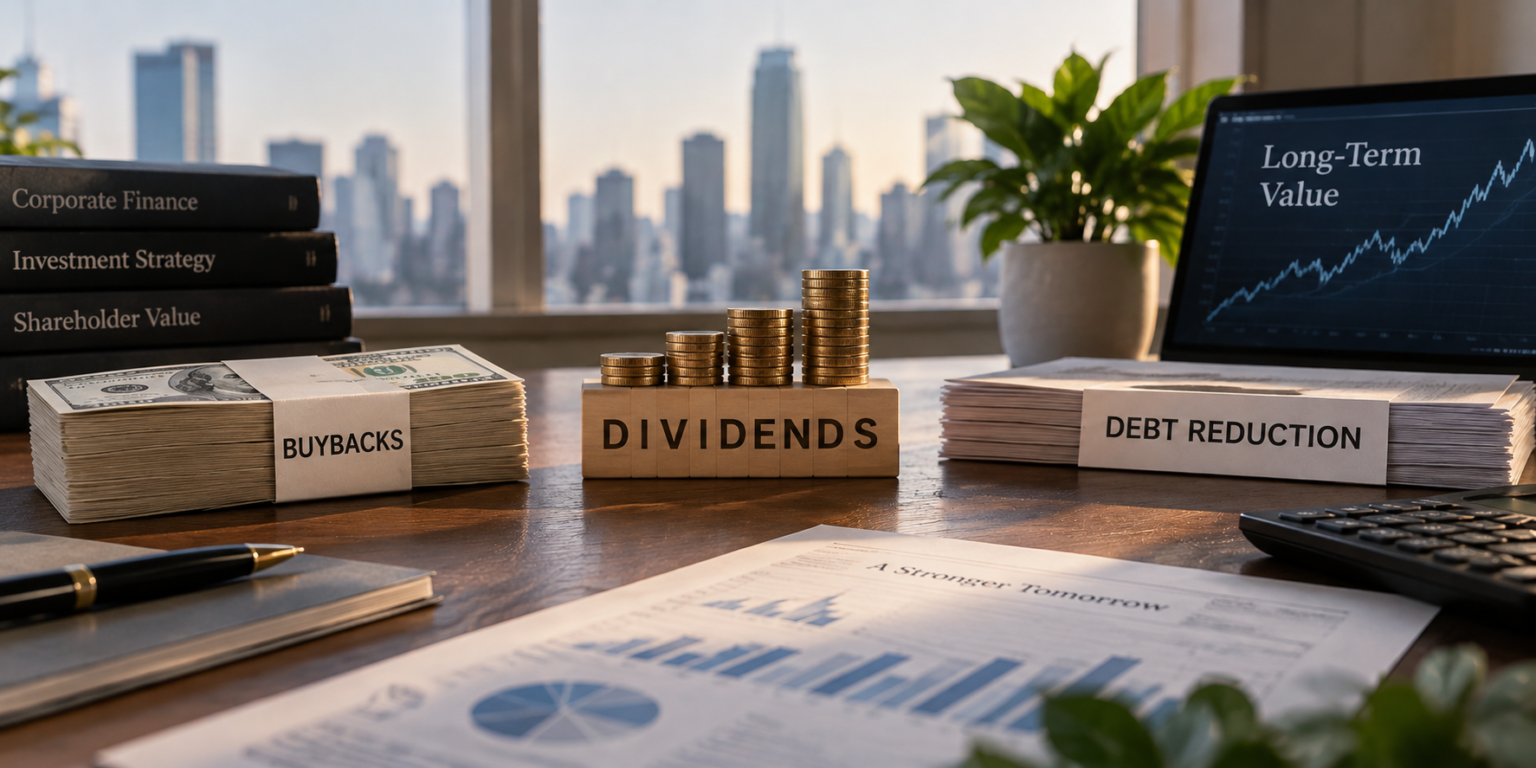

When a company produces more cash than it needs to run the business, the decision can appear reassuringly simple. Management can repurchase shares, pay a dividend, or reduce debt. Each choice is routinely presented as evidence of financial strength, yet none creates shareholder value merely because money has moved out of the corporate bank account. The outcome depends on the price paid for the shares, the reliability of future cash flows, the cost and maturity of the debt, and the returns available from reinvesting in the business.
The sums involved are considerable. S&P 500 companies spent $249 billion on share repurchases in the third quarter of 2025, while paying $168.1 billion in dividends. Over the 12 months to September 2025, buybacks exceeded $1 trillion, and dividends reached $664.9 billion, according to S&P Dow Jones Indices.
These figures describe the scale of capital being returned, but they say little about whether individual decisions were sensible. Investors still need to ask what management could have done with the cash and whether the chosen use improved the value of each remaining share.
Shareholder value begins before cash is returned
The first question is not whether buybacks, dividends or debt reduction are preferable. It is whether the cash is genuinely surplus. Free cash flow should be calculated after the company has funded day-to-day operations, maintenance spending, tax obligations, and credible investments needed to protect its competitive position.
A business that cuts essential investment to finance a payout may report attractive cash returns today while weakening its future earning power.
Growth spending deserves a more demanding test. Management should retain cash only when it can invest at an expected return above the company’s cost of capital, which is the return required by lenders and shareholders for financing the business.
A company does not create value by opening more stores, buying another business, or expanding production if the expected return fails to compensate for the risk. Returning excess cash can be more disciplined than pursuing growth for its own sake.
Cash reserves also have strategic value. Cyclical manufacturers, banks, airlines and commodity producers require larger buffers than subscription businesses with predictable revenue.
Pension commitments, litigation, regulation and access to credit can further change the appropriate amount. Only after these needs are recognised does the choice among distributions and debt repayment become meaningful.
When share buybacks create value
A buyback reduces the number of shares outstanding. Continuing shareholders then own a larger percentage of the company, and earnings per share may increase even if total profit remains unchanged. That arithmetic is useful, but it should not be mistaken for operating progress. A higher earnings-per-share figure does not automatically mean the underlying business has become more productive or valuable.
The decisive issue is price. If a company repurchases shares below a reasonable estimate of intrinsic value, the transaction can increase the value attributable to each remaining share. If it buys above intrinsic value, wealth moves from continuing shareholders to those who sell at the inflated price. Berkshire Hathaway has repeatedly expressed this principle in its shareholder letters. Its 2018 letter argued that repurchases must be price-sensitive because buying an overvalued stock destroys value.
Buybacks are also more flexible than regular dividends. A board can increase purchases when cash generation is strong and reduce them when conditions deteriorate without creating the same sense of a broken commitment. They can offset dilution from employee share compensation, although investors should examine the net change in share count rather than the headline amount authorised. A company may announce a large programme while the actual reduction in shares remains small because new stock is being issued at the same time.
Warning signs include repurchases financed with expensive borrowing, purchases concentrated when the share price is unusually high, and programmes seemingly designed to support earnings-per-share targets linked to executive pay.
The US Securities and Exchange Commission has noted that buybacks can affect EPS and other measures used in compensation plans. Investors should therefore compare repurchase timing with valuation, insider selling and changes in net debt, not simply applaud the announcement.
Why dividends remain valuable
Dividends distribute cash to shareholders without requiring them to sell shares. They are particularly suitable for mature companies with stable earnings, limited reinvestment needs and a shareholder base that values dependable income. Utilities, consumer staples, telecommunications groups and established financial companies often fit this profile, although sector labels alone are not enough to guarantee safety.
The strength of a dividend lies in its clarity. Cash has left the company and reached shareholders, making the return difficult to disguise through accounting. A stable or gradually rising dividend can also impose discipline on management by reducing the funds available for weak acquisitions or unnecessary expansion.
The CFA Institute’s analysis of dividends and repurchases treats both as forms of payout policy, with the appropriate choice shaped by company circumstances and market rules.
The weakness is the expectation of continuity. Investors often interpret a dividend increase as a commitment and a cut as evidence that management misjudged the durability of cash flows. Boards should therefore fund regular dividends from recurring free cash flow, not temporary asset sales or additional debt. When excess cash results from a one-off disposal or an unusually strong year, a special dividend may be more honest than permanently raising the regular payment.
Dividend yield also needs context. An unusually high yield may reflect a falling share price and market concern that the payment is unsustainable. Investors should examine free-cash-flow coverage, debt maturities, capital expenditure requirements, and the history of payments across an economic cycle. Tax treatment varies among countries and investors, so the most efficient form of distribution is not identical in every market.
When debt reduction is the strongest choice
Debt repayment is less visible than a buyback announcement or dividend increase, but it can be the most valuable use of cash when financial risk is elevated. Repaying debt produces a relatively certain saving equal to the interest that will no longer be paid, adjusted for any tax benefit attached to interest expense. It also lowers refinancing risk, reduces exposure to changing interest rates, and gives management more room to act during a downturn.
The case is strongest when debt carries a high or floating interest rate, large maturities are approaching, earnings are cyclical, or credit metrics are close to limits set by lenders or rating agencies. In such circumstances, using cash for buybacks can transfer risk to the remaining shareholders. A company may reduce its share count but leave each share supported by a more fragile balance sheet.
Lower debt can create an option that is difficult to value in advance. A resilient company can continue investing, acquire distressed assets, or avoid issuing shares at depressed prices when competitors are under pressure.
This flexibility often becomes most valuable precisely when access to capital becomes scarce. The benefit may not appear immediately in earnings per share, but it can protect long-term ownership value.
Debt reduction is not always the best answer. A company with predictable cash flow, modest borrowing and inexpensive long-term debt may gain little from eliminating it ahead of schedule. Excessive caution can leave the balance sheet inefficient and deprive shareholders of cash that could be used more productively elsewhere. The target should be appropriate debt, not necessarily zero debt.
A practical comparison
| Choice | Most likely to create value when | Warning signs | Useful measures |
|---|---|---|---|
| Share buybacks | Shares appear undervalued, cash flow is strong, and the balance sheet remains resilient | Purchases at high valuations, rising debt, heavy stock-based compensation or EPS-linked incentives | Net share-count reduction, free-cash-flow yield, valuation, net debt and repurchase price |
| Dividends | Cash flow is recurring, reinvestment needs are moderate, and the payment can survive a downturn | Dividends funded through borrowing, weak coverage or repeated promises unsupported by cash | Dividend coverage, payout ratio, free cash flow, payment history and capital requirements |
| Debt reduction | Borrowing costs are high, maturities are near, or business earnings are volatile | Paying down cheap debt while overlooking strong investments or leaving excessive idle cash | Interest coverage, net debt to operating earnings, maturity schedule, credit rating and refinancing cost |
Six questions investors should ask
1. Is the cash genuinely surplus?
Start with free cash flow rather than reported net income. Deduct realistic maintenance investment, working-capital needs, and other recurring obligations. If the payout depends on asset sales or new borrowing, it may not be repeatable.
2. What return could the core business earn?
Compare prospective returns from reinvestment with the cost of capital. A company with a credible opportunity to earn high returns should normally fund it before distributing cash. Management should still disclose how earlier investments performed rather than asking investors to accept projected returns indefinitely.
3. How strong is the balance sheet under stress?
Examine debt maturities, fixed versus floating rates, interest coverage, and the stability of earnings. The relevant question is not whether the company can service debt in a good year, but whether it can do so during a recession or industry downturn.
4. At what valuation are shares being repurchased?
A buyback policy without valuation discipline is merely an instruction to spend. Berkshire’s long-standing approach is useful because it links repurchases to intrinsic value and adequate liquidity. Investors should be sceptical when management discusses the size of a programme but avoids discussing price.
5. How durable is the proposed dividend?
A regular dividend should be supportable through a full business cycle. If management cannot defend the payment during a moderate downturn, a smaller base dividend combined with occasional buybacks or special dividends may be more responsible.
6. Are incentives shaping the decision?
Buybacks can lift per-share figures, acquisitions can increase company size, and dividend promises can please income-focused investors. Boards should explain how executive incentives, share issuance and performance targets affect capital-allocation choices. Clear disclosure helps investors distinguish economic reasoning from financial presentation.
The right answer is usually a sequence
Buybacks, dividends, and debt reduction are not competing ideologies. A well-managed company may use all three at different points in its development. It can maintain a sustainable dividend, repay debt until the balance sheet reaches a prudent range, and use buybacks selectively when shares trade below intrinsic value. The mix should change when valuation, financing costs, or operating risk changes.
Research from McKinsey reinforces the point that neither the size nor the mix of dividends and repurchases automatically determines shareholder returns. The underlying source of value remains the cash produced by the business, driven by growth and returns on invested capital. A company’s payout strategy decides how and when surplus cash is distributed, but it cannot compensate for poor underlying business performance.
The soundest capital-allocation sequence is therefore clear. Protect the existing business, preserve enough financial resilience to withstand adverse conditions, fund investments expected to earn more than their cost, and then return genuinely excess cash using the method best suited to valuation and cash-flow stability. The form of the payout matters, but the discipline behind it matters more.
Stay connected with Business Herald for the latest business news, insights, and updates.
Follow us on Facebook, Instagram, LinkedIn, and YouTube.
Join our growing community on WhatsApp and Telegram for real-time updates delivered directly to you.