

The map of artificial intelligence has usually been drawn in chips, power lines and fibre routes. A less visible boundary is now shaping it: the amount of water a city can supply, the capacity of its pipes and the public legitimacy of using that supply to cool machines.
The data-centre water problem will not halt AI investment around the world, but it could decide which projects advance quickly, which require costly redesigns and which remain trapped in planning disputes. For developers and investors, water is moving from the sustainability report into the economics of location.
Water Becomes a Key Infrastructure Priority
Electricity remains the most immediate physical constraint on new AI capacity. The International Energy Agency expects global data-centre electricity consumption to rise from about 460 terawatt-hours in 2024 to around 945 terawatt-hours by 2030, with AI driving much of the increase.
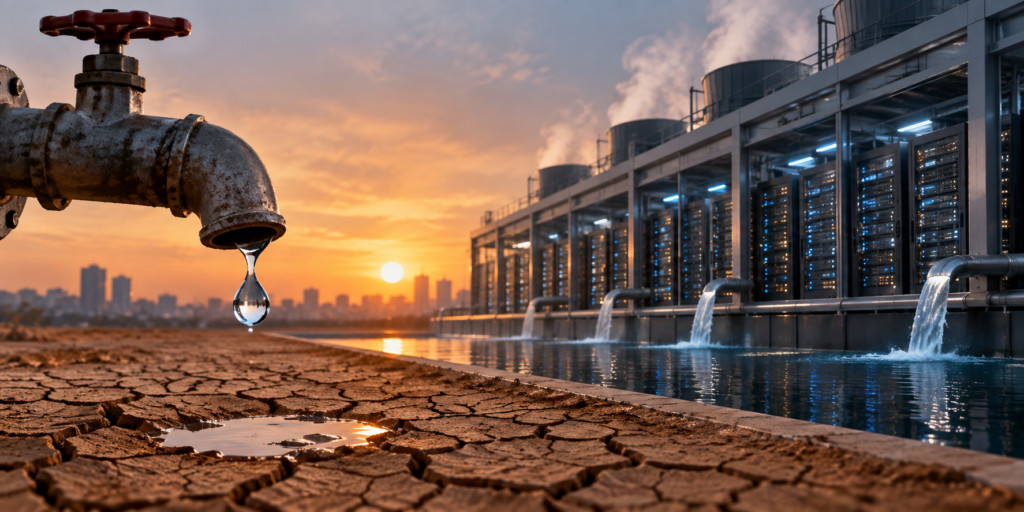
More power produces more heat inside facilities and can also increase the water consumed by electricity generation. A site with available land and a promised grid connection may therefore remain unsuitable if the local water system cannot support its cooling needs during hot and dry periods.
Water will not replace power, fibre, latency, land prices or tax treatment in location decisions. It will join them as a factor capable of rejecting an otherwise attractive site. Water pressure occurs at the level of a watershed and utility, so national abundance can coexist with local shortages.
The scale of the data-centre water problem
Lawrence Berkeley National Laboratory estimates that US data centres consumed 66 billion litres of water onsite in 2023, up from 21.2 billion litres in 2014. Hyperscale and colocation facilities accounted for 84% of the 2023 total. Its 2028 scenarios put hyperscale consumption between 60 billion and 124 billion litres.
These figures cover all data-centre computing, not AI alone, and the future range reflects uncertainty about deployment and cooling technology.
The electricity system creates a larger but less visible footprint. The same study associated nearly 800 billion litres of indirect water consumption with US data-centre electricity in 2023. Its estimate uses regional grid mixes and excludes company-specific power contracts, so it is not measured facility consumption. It nevertheless shows why waterless cooling can still depend on water elsewhere.
One industry, widely different water demands
Sweeping comparisons conceal enormous variation. A peer-reviewed LBNL study found that water consumption per computing workload could differ by more than 10,000 times, depending on efficiency, utilisation, cooling, climate and the electricity system.
Claims that every AI query consumes a fixed amount of water are therefore unreliable without a defined model, location and measurement boundary.
Reporting practices create further confusion. Withdrawal measures water taken from a source, while consumption measures the portion not returned for immediate reuse, often because it evaporates. Companies also calculate water efficiency using different scopes. Fleet averages can therefore conceal a stressed location or a severe summer peak.
When a manageable share becomes a local conflict
Data centres use less water nationally than agriculture and several heavy industries. That comparison offers little reassurance to a town where one proposed campus could become a major utility customer. Virginia illustrates the difference between statewide abundance and local concentration.
A 2024 legislative review found that data centres accounted for less than 0.5% of statewide water withdrawals, yet their share across six utilities ranged from 0.2% to 21%. The review recommended giving local authorities clear power to require and examine water estimates when considering new facilities.
Santiago shows how the same issue can reshape an actual project. A Chilean environmental court partially reversed the permit for Google’s proposed Cerrillos data centre and required the assessment to consider climate change and pressure on the Central Santiago Aquifer.
Google subsequently withdrew the original permitting process and said it would submit a new project using air-cooled technology at the same location. Water did not push the company out of Chile, but it changed the cooling system, timetable and approval process.
Cooling without an easy answer
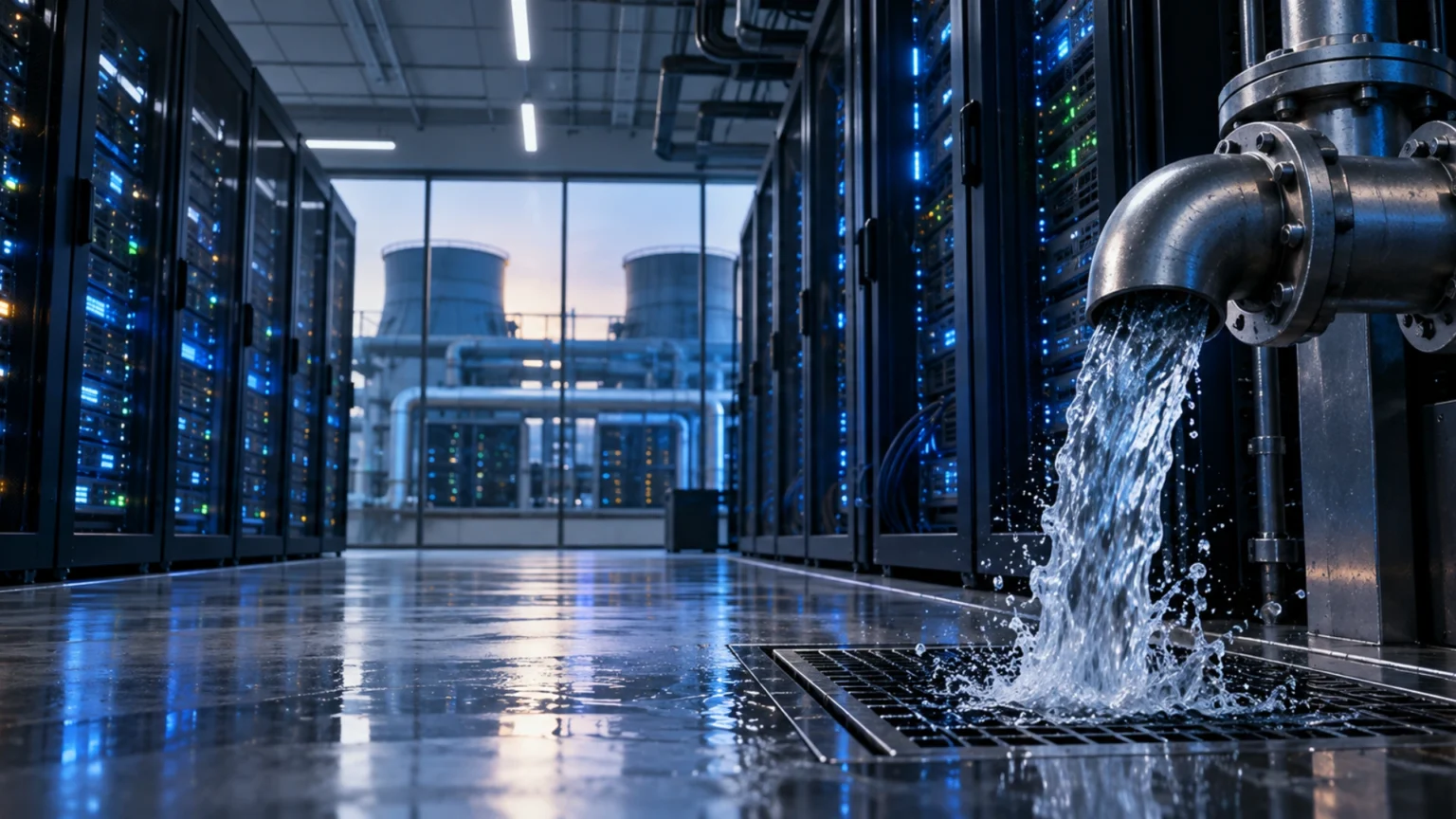
Operators can reduce direct water consumption, but every cooling choice carries a cost. Evaporative cooling removes heat efficiently and usually requires less electricity, yet it consumes water. Dry or air-cooled systems avoid most operational water use but can demand more power, particularly during hot weather.
If that additional electricity comes from water-intensive generation, part of the burden moves from the data-centre site to the power system.
Direct-to-chip liquid cooling removes heat efficiently from dense AI hardware. Coolant can circulate in a closed loop, but the facility must still release the heat outdoors. A dry cooler can do this without evaporation, while a cooling tower consumes water. The final heat-rejection system therefore determines much of the water demand.
Microsoft says its new AI-optimised design circulates coolant in a closed loop and consumes no water through evaporation during operation. The first facilities are expected from late 2027, including one in Phoenix. Microsoft acknowledges a modest increase in electricity use compared with evaporative designs. Operating data will show how the system performs in extreme heat.
Reclaimed wastewater can protect drinking supplies, although it requires treatment plants, pipes and utility agreements. Seawater works in fewer coastal locations. The strongest sites will offer not simply water, but an appropriate source supported by dependable infrastructure.
How water could redraw the AI map
Cooler regions may gain because they can use outside air or dry cooling for longer periods. Yet cold weather does not guarantee water security, affordable power or rapid permits. Warmer markets can remain competitive through reclaimed supplies and zero-evaporation cooling.
Geography may also divide by workload. Large training jobs can operate farther from users and move towards regions with abundant power and lower water stress. Customer-facing services requiring very low delay will remain near population and business centres, where efficient cooling will matter more than relocation.
What boards and investors should examine
The financial risk comes less from the price of water than from delayed permits, redesigns, drought restrictions and utility upgrades. Investors should examine maximum summer demand, water rights, reclaimed supply and shortage rules. They should test every planned phase because a utility may support the first building but not the full campus.
Governments are demanding better information. European Union rules require data centres with at least 500 kilowatts of installed computing capacity to report environmental performance, including water indicators. Similar disclosure requirements are likely to spread. Regions with reliable utilities and predictable rules could approve projects faster than places offering generous incentives but uncertain resources.
Water will become a test of execution
The next generation of AI infrastructure will not simply move to the wettest parts of the world. Developers will continue to follow power, connectivity, customers and political stability. Water will influence the choice between otherwise viable locations and determine what companies must spend to make a contested site acceptable.
The winning regions will combine dependable electricity and fibre with a defensible water plan. The winning operators will disclose local demand, design for drought conditions and invest in shared infrastructure before opposition hardens.
AI companies have spent heavily to secure chips and power. Their ability to secure water and public consent may now determine how quickly those investments begin producing a return.
Stay connected with Business Herald for the latest business news, insights, and updates.
Follow us on Facebook, Instagram, LinkedIn, and YouTube.
Join our growing community on WhatsApp and Telegram for real-time updates delivered directly to you.