
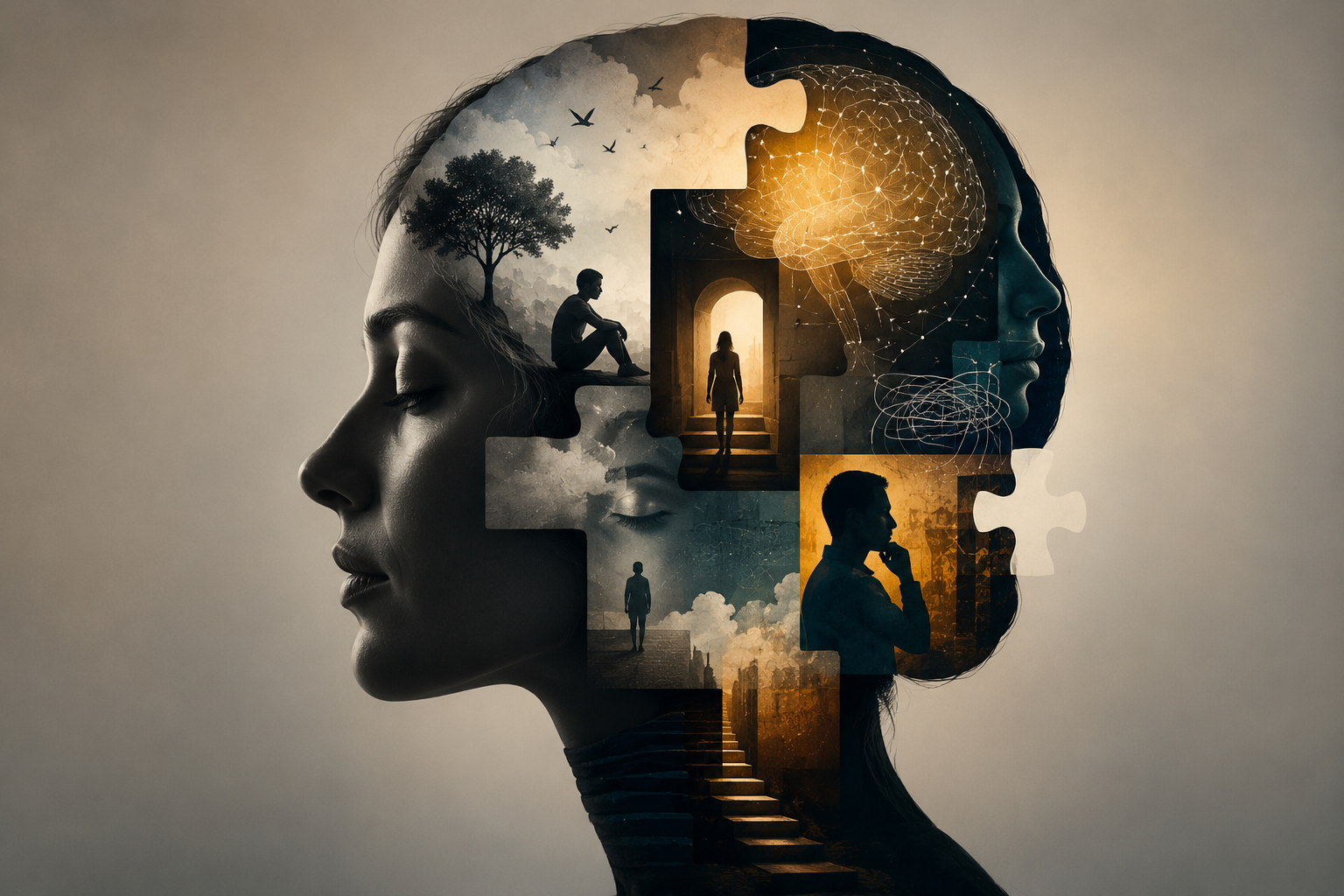

The human mind and behavior remain among the most complex subjects in science.
Every decision, memory, emotional reaction, and social interaction emerges from processes involving the brain, body, personal experience, and surrounding environment. Even seemingly simple actions—choosing a product, recognising a face or responding to criticism—can involve multiple systems operating simultaneously.
The brain interprets sensory information, stores memories, anticipates consequences and coordinates physical action. Yet biology alone does not determine how a person will behave. Family relationships, culture, education, stress, opportunity, and social expectations can all influence how mental processes develop and are expressed.
Modern neuroscience is gradually mapping this complexity. Researchers are identifying new brain-cell types, examining neural circuits, and studying how genes and environments interact across the lifespan. However, science still does not possess a complete explanation of consciousness, personality, motivation or individual differences.
Understanding the mind is therefore not simply a medical or philosophical pursuit. It has major implications for education, leadership, healthcare, product design, public policy and the global economy.
Table of Contents
- What Is the Human Mind?
- How the Brain Produces Behavior
- Perception Is an Interpretation
- Memory Is Reconstructed, Not Replayed
- How Emotions Shape Decisions
- Habits, Rewards and Automatic Behavior
- Genes, Experience and the Environment
- Neuroplasticity and the Changing Brain
- The Social Nature of Human Behavior
- Sleep, Stress and Cognitive Performance
- Mental Health and Behavioral Functioning
- Why Behavioral Science Matters to Business
- India’s Expanding Mental-Health Infrastructure
- The Future of Brain and Behavior Research
- Frequently Asked Questions
What Is the Human Mind?
The mind generally refers to the mental processes through which people perceive, think, remember, feel, imagine and make decisions.
These processes depend on the brain, but they are also influenced by signals from the body and information from the environment.
The brain receives sensory input, compares it with previous experience and produces responses. It controls or coordinates thought, memory, emotion, movement, vision, breathing and many other processes required for daily functioning.
However, the mind should not be understood as a single command centre located in one part of the brain.
Different networks contribute to attention, language, memory, emotional regulation and action. These networks interact continuously, and the same brain region may contribute to several functions depending on the situation.
This distributed organisation helps explain why mental processes are difficult to reduce to one chemical, gene or anatomical structure.
How the Brain Produces Behavior
Behavior is the observable expression of processes occurring across the nervous system, body, and environment.
When a person reaches for an object, the brain must recognise the object, determine its position, select an action, and coordinate muscles. When a person enters a social situation, the brain may simultaneously interpret facial expressions, recall previous experiences, monitor social expectations, and regulate emotion.
Behavior therefore emerges from multiple levels of activity:
- genes and molecular processes;
- brain cells and chemical signalling;
- neural circuits and networks;
- bodily states;
- past learning;
- immediate circumstances; and
- social and cultural environments.
The US National Institute of Mental Health studies these levels together, including the genetic, biological, behavioral, and environmental mechanisms contributing to mental function and complex social behavior.
This framework challenges simplistic explanations such as describing a person as naturally rational, emotional, disciplined, or impulsive.
The same individual may behave differently when tired, threatened, socially observed or placed under intense time pressure. Human behavior is often situational rather than fixed.
Perception Is an Interpretation
Human beings do not experience the external world directly.
The eyes, ears, skin, and other sensory systems collect information. The brain then organises that information into meaningful perceptions.
This process is efficient but selective.
The brain cannot consciously process every sound, image, sensation, and environmental change simultaneously. Attention prioritises certain signals while filtering others. Expectations and previous experiences can also influence what receives attention and how it is interpreted.
Two people may therefore experience the same event differently without either deliberately misrepresenting it.
This has important consequences for communication and leadership. A message that appears clear to its sender may be interpreted through the recipient’s existing beliefs, emotional state, and expectations.
Effective communication is not only about transmitting information. It also requires understanding how people select, interpret, and remember that information.
Memory Is Reconstructed, Not Replayed
Memory gives people a sense of personal continuity, but it does not function like a video archive.
The brain encodes information, stores aspects of an experience, and later reconstructs it. Context, emotion, and subsequent information can influence what is retrieved.
Research supported by the National Institute of Neurological Disorders and Stroke has examined how the brain separates continuous experiences into distinct events and stores them as individual memory sequences. These findings show that memory formation involves active organisation rather than passive recording.
Different forms of memory also rely on partly distinct systems.
Working memory keeps information available for immediate use. Long-term memory preserves knowledge and experiences over longer periods. Procedural memory supports learned skills, while emotional memories can influence reactions even when a person does not consciously recall the original event.
Because memory is reconstructive, confidence should not automatically be treated as proof of accuracy.
In business settings, written records, structured feedback and transparent documentation can reduce dependence on imperfect recollection during hiring, performance reviews and major decisions.
How Emotions Shape Human Decision-Making
Emotion and reason are often presented as opposing forces. In practice, they work together.
Emotions help assign significance to events. Fear can direct attention towards danger. Satisfaction can reinforce successful behavior. Anger may signal perceived injustice, while empathy can influence cooperation and social judgement.
Problems arise when emotional responses become disproportionate to the situation or override relevant information.
Stress, for example, can narrow attention and increase sensitivity to immediate threats. Excitement can encourage overconfidence, while anxiety may lead people to avoid decisions carrying uncertain outcomes.
This does not mean that better decisions require eliminating emotion.
A more realistic objective is emotional awareness: recognising when feelings are providing useful information and when they may be distorting judgement.
For leaders and investors, this distinction matters during negotiations, market volatility and organisational crises. Decisions presented as purely analytical may still be influenced by fear of loss, loyalty, status or pressure to conform.
Habits, Rewards and Automatic Behavior
Not every action requires conscious analysis.
Repeated behaviors can gradually become habits, allowing the brain to perform familiar tasks with less deliberate effort. This efficiency reduces cognitive demand but can also make established behavior difficult to change.
The National Institute of Mental Health describes habit formation as a frequent consequence of reward learning. Once established, habitual behavior can become relatively resistant to changes in the value of its original outcome.
Habits are shaped by context, repetition and reinforcement.
A notification can trigger phone checking. Entering a particular room can prompt an established routine. Recognition or financial rewards may reinforce workplace behavior, even when the long-term consequences are undesirable.
This has significant implications for consumer products and organisational systems.
Companies can design environments that make beneficial behavior easier, such as simplifying cybersecurity procedures or creating clear default settings. However, the same principles can be used manipulatively to maximise attention, spending or compulsive engagement.
Responsible behavioral design should improve user outcomes rather than exploit psychological vulnerability.
Genes, Experience and the Environment
Human behavior is influenced by biology, but biological influence is not the same as predetermined destiny.
Genes contribute to brain development and may affect vulnerability to certain mental-health conditions. However, common conditions such as anxiety and depression generally reflect combinations of genetic variation, life experiences and environmental factors.
The environment can influence which opportunities, stressors and relationships a person experiences.
Nutrition, education, exposure to trauma, social support and economic security can all affect development and behavior. These influences may interact with inherited characteristics rather than operating separately.
This is why attempts to divide behavior into “nature” or “nurture” are usually misleading.
The more useful question is how biological and environmental factors interact across time.
A genetic predisposition may increase risk without making an outcome inevitable. A supportive environment may reduce vulnerability, while prolonged stress may intensify it.
Neuroplasticity and the Changing Brain
The brain is not a completely fixed structure.
Neuroplasticity refers to its ability to change activity, connections and organisation in response to experience, learning, injury or internal conditions.
Learning a skill can strengthen relevant neural pathways. Repeated experience can make particular responses more efficient. Following injury, the nervous system may sometimes reorganise functions to support recovery.
Plasticity continues across life, although its mechanisms and degree vary with age, brain region, health and circumstance.
This capacity provides a biological foundation for learning and behavior change, but it should not be exaggerated. Neuroplasticity does not mean every condition can be reversed through positive thinking or practice.
Change usually requires repetition, appropriate support and realistic environmental conditions.
For organisations, the practical lesson is that employee capability is not static. Training, feedback and job design can influence performance. However, learning programmes must allow people to practise skills rather than merely consume information.
The Social Nature of Human Behavior
Human behavior develops within relationships.
People learn language, values, habits and expectations through interaction with families, communities and institutions. Social approval can reinforce behavior, while rejection can create powerful emotional responses.
Individuals also adjust behavior according to perceived group norms.
A worker may remain silent because colleagues appear unwilling to challenge a decision. A consumer may prefer a product because it signals membership in a desired group. An investor may follow a market trend partly because others appear confident.
Culture further shapes which behaviors are rewarded, tolerated or discouraged.
This means psychological research should not assume that findings from one population automatically apply everywhere. Social context can affect how emotions are expressed, how authority is viewed and how people respond to incentives.
Businesses operating across countries must therefore distinguish universal human needs from culturally specific behavior.
Sleep, Stress and Cognitive Performance
Mental performance is closely connected to physical state.
Sleep supports attention, memory, emotional regulation and communication between nerve cells. The National Institute of Neurological Disorders and Stroke describes sleep as important to multiple brain functions, including how neurons communicate.
The US Centers for Disease Control and Prevention advises that adults aged 18 to 60 generally require at least seven hours of sleep and notes that sufficient sleep supports attention, memory and emotional well-being.
Stress is also a normal adaptive response. In short bursts, it can help people react to urgent demands.
Chronic or poorly managed stress, however, can interfere with concentration, relationships, sleep and decision-making.
Workplaces can intensify these pressures through excessive workloads, discrimination, low control, job insecurity and unclear expectations. The World Health Organization identifies these conditions as risks to employee mental health.
Well-being initiatives cannot compensate for structurally unhealthy work.
Meditation applications and motivational seminars may have limited value when workers face unrealistic targets, unpredictable schedules or abusive management. Sustainable improvement requires changes to how work is organised.
Mental Health and Behavioral Functioning
Mental health is more than the absence of a diagnosed condition.
The World Health Organization defines it as a state of well-being that enables people to manage life’s stresses, develop their abilities, learn, work and contribute to their communities.
Mental disorders involve significant disturbances in cognition, emotional regulation or behavior that are usually associated with distress or impaired functioning.
It is important not to pathologise every difficult emotion.
Sadness, worry, anger and fear are normal parts of human experience. Clinical concern becomes more relevant when symptoms persist, cause substantial distress or interfere with daily life.
Global need remains considerable. WHO reported in September 2025 that nearly one in seven people worldwide—approximately 1.1 billion people—were living with a mental disorder based on 2021 estimates. Anxiety and depressive disorders were the most common.
Effective prevention and treatment options exist, but access remains uneven. Mental-health information should therefore encourage evidence-based professional care rather than self-diagnosis.
Why Human Mind and Behavior Matter to Business
Understanding the human mind and behavior has direct commercial relevance.
Companies depend on people to evaluate risk, collaborate, innovate, serve customers and respond to change. Consumer markets are also built around attention, trust, motivation and perceived value.
Behavioral insights can improve:
- leadership and team communication;
- product and service design;
- customer experience;
- employee learning;
- negotiation;
- financial decision-making;
- workplace safety;
- public communication; and
- organisational change.
The business cost of poor mental health is substantial.
WHO estimates that depression and anxiety result in approximately 12 billion lost working days each year, costing the global economy around $1 trillion in reduced productivity.
These figures do not mean businesses should treat mental health purely as a productivity tool.
Support is first a matter of health, dignity and responsible employment. Yet the economic evidence demonstrates that well-designed workplaces can protect both people and organisational resilience.
As WHO Director-General Dr Tedros Adhanom Ghebreyesus stated, “Investing in mental health means investing in people, communities, and economies.”
Leadership Through a Behavioral Lens
Traditional management often assumes that financial rewards and penalties are sufficient to influence performance.
Human motivation is more complicated.
Employees also respond to autonomy, fairness, social recognition, belonging and perceived purpose. Poorly designed incentives may encourage workers to optimise the measured target while neglecting the organisation’s actual objective.
A sales target, for example, may increase revenue while encouraging aggressive customer practices. A productivity metric may increase visible output while reducing quality or collaboration.
Behaviorally informed leadership asks broader questions:
- What behavior does the system truly reward?
- Does the team feel safe raising concerns?
- Are employees receiving clear and timely feedback?
- Is cognitive overload increasing mistakes?
- Are performance expectations perceived as fair?
- Does the organisation’s stated culture match daily experience?
Leadership quality often depends less on inspiring slogans than on designing systems that make constructive behavior possible.
Technology, Artificial Intelligence and the Mind
Advances in artificial intelligence are creating new tools for studying and influencing behavior.
Machine-learning systems can analyse language, detect patterns in health data and support scientific research. Digital platforms can also personalise education and improve access to psychological support.
However, behavioral data is highly sensitive.
Systems that infer mood, attention or vulnerability could be used for beneficial purposes, but they could also enable intrusive surveillance or manipulation. AI-generated mental-health guidance may sound confident without being clinically accurate.
Organisations using behavioral technologies must therefore address:
- informed consent;
- data privacy;
- algorithmic bias;
- clinical validation;
- explainability;
- human oversight; and
- responsibility when automated advice causes harm.
Technology should expand access to appropriate support, not replace qualified professionals in situations requiring diagnosis or treatment.
India’s Expanding Mental-Health Infrastructure
India is increasingly using digital infrastructure to widen access to mental-health services.
The National Tele Mental Health Programme, known as Tele-MANAS, was launched in October 2022. By March 3, 2026, it operated through 53 cells across 36 states and Union Territories, supported 20 languages and had handled more than 34.34 lakh calls.
The wider District Mental Health Programme had also been sanctioned across 767 districts by March 2026. Mental-health services were being integrated into comprehensive primary healthcare packages delivered through Ayushman Arogya Mandirs.
This expansion creates opportunities in:
- telehealth infrastructure;
- regional-language support;
- digital triage;
- professional training;
- workplace well-being;
- clinical information systems;
- preventive care; and
- responsible mental-health technology.
However, scale should not be confused with clinical quality.
Digital tools must connect users to trained professionals, protect personal data and provide clear escalation routes for cases requiring urgent or specialist support.
For India’s healthcare and technology sectors, the opportunity lies in building accessible systems without compromising safety or human oversight.
The Future of Brain and Behavior Research
Neuroscience is entering a more detailed phase of discovery.
The NIH BRAIN Initiative is building reference atlases of brain-cell types and their anatomical organisation. These tools are intended to help researchers understand brain function, neural circuits and the biological foundations of disorders.
Earlier NIH-supported work identified more than 3,000 brain-cell types in research involving human brain tissue, illustrating how much cellular diversity remains to be understood.
Future progress will depend on integrating several forms of evidence:
- cellular and molecular data;
- brain imaging;
- genetics;
- behavioral observation;
- computational modelling;
- clinical research; and
- social and environmental information.
This research may eventually improve diagnosis and allow treatments to target specific circuits or biological mechanisms more precisely.
Yet ethical questions will grow alongside scientific capability.
Societies will need to determine how brain data can be collected, who can access it and whether employers, insurers or governments should be allowed to use biological information to predict behavior.
The future of neuroscience will therefore be shaped as much by governance as by technical discovery.
Unraveling the Mind Without Oversimplifying It
The human mind and behavior cannot be explained by one brain region, personality label or motivational theory.
Thoughts and actions emerge from interactions involving biology, experience, relationships and immediate context. Memory is reconstructed. Emotions influence judgement. Habits reduce cognitive effort, while stress and sleep affect how effectively people think and respond.
The brain is capable of change, but change is neither limitless nor effortless.
This complexity should encourage humility.
Scientific discoveries can reveal important mechanisms without reducing a person to neural activity or genetic risk. Behavioral patterns can be measured without ignoring culture, dignity and individual agency.
For businesses, governments and healthcare systems, the objective should not be to control human behavior more efficiently. It should be to create environments in which people can make informed decisions, perform meaningful work and access support when they need it.
The human mind remains difficult to fully understand because it is not a static machine. It is a developing biological, psychological and social system shaped continuously by the world around it.
Frequently Asked Questions
What is the human mind?
The human mind refers to mental processes such as perception, thought, memory, emotion, imagination and decision-making. These processes depend on the brain while also being influenced by the body and surrounding environment.
What is the relationship between the human mind and behavior?
Mental processes influence how people interpret situations and select actions. Behavior is also shaped by learning, biology, social relationships, culture, and immediate circumstances.
How does the brain control behavior?
The brain processes sensory information, evaluates possible responses, and coordinates action through interconnected cells and neural circuits. Different networks contribute to memory, emotion, attention, movement, and social behavior.
Are human behaviors genetic or learned?
Most complex behaviors reflect interactions between biology and experience. Genes can influence tendencies or vulnerability, while learning, relationships and environmental conditions affect how these influences are expressed.
What is neuroplasticity?
Neuroplasticity is the nervous system’s ability to change its activity, organisation or connections in response to learning, experience, injury or other influences.
How do emotions affect decisions?
Emotions influence attention, motivation and perceptions of risk or value. They can provide useful information but may also distort judgement when reactions are unusually intense or poorly understood.
How are habits formed?
Habits develop when behavior is repeatedly performed and reinforced in a stable context. Over time, the action can become more automatic and less dependent on conscious evaluation.
Does sleep affect behavior?
Yes. Sleep supports memory, attention, emotional regulation and communication between brain cells. Poor sleep can make concentration and everyday performance more difficult.
Why is mental health important at work?
Mental health can influence confidence, attendance, communication, and capacity to work. Poorly designed workplaces can increase psychological risks, while supportive environments can improve employee well-being and organisational resilience.
Can technology understand the human mind?
Technology can detect patterns in language, physiology, and behavior, but it cannot currently provide a complete or infallible understanding of an individual’s mind. Psychological and clinical conclusions require context, validation and appropriate professional oversight.
Stay connected with Business Herald for the latest business news, insights, and updates.
Follow us on Facebook, Instagram, LinkedIn, and YouTube.
Join our growing community on WhatsApp and Telegram for real-time updates delivered directly to you.