
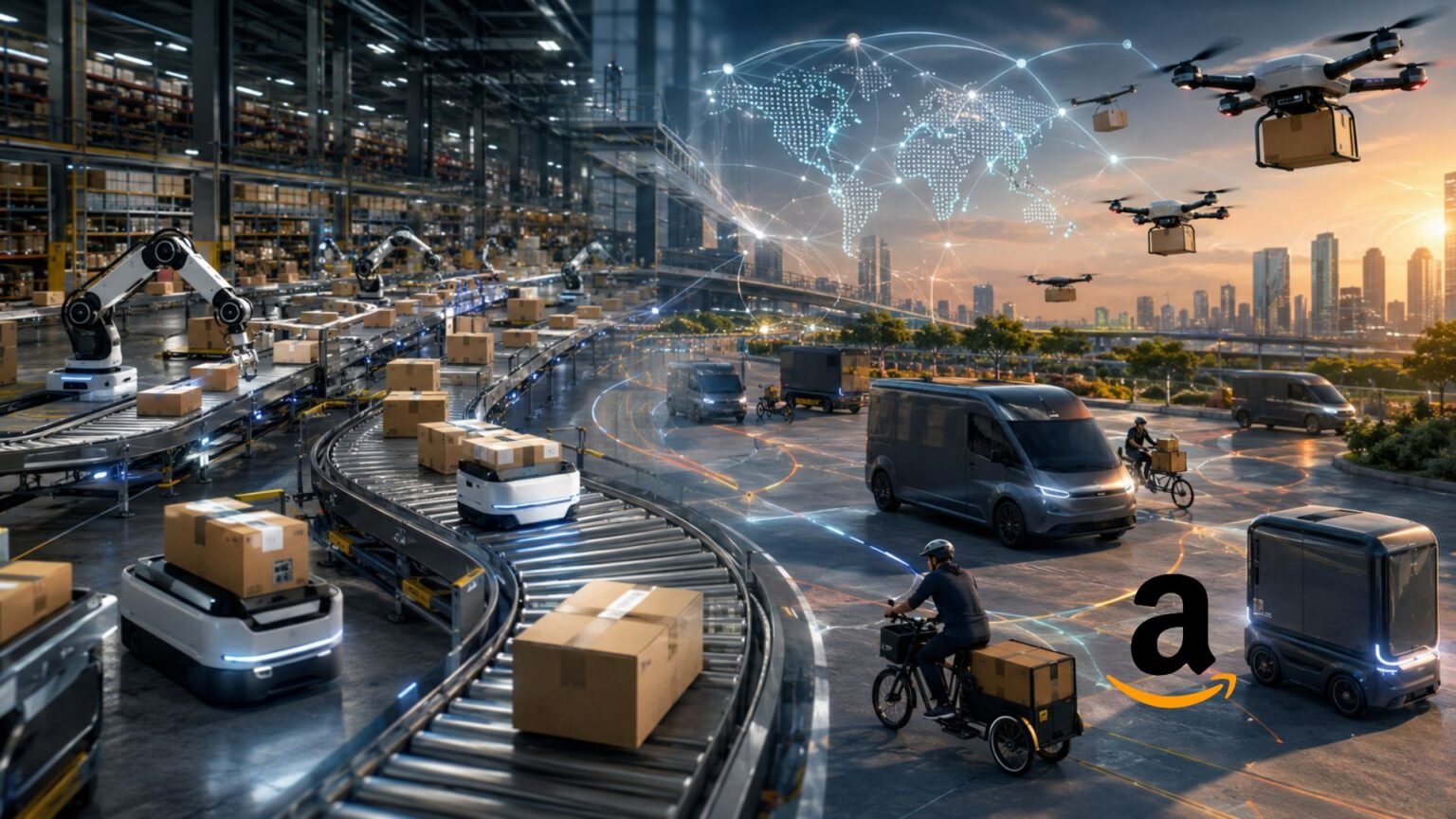

The Amazon future of shipping is no longer defined simply by faster vans or larger warehouses. It is becoming an interconnected system in which artificial intelligence forecasts demand, robots move products, electric vehicles complete urban routes and autonomous aircraft deliver selected items within an hour.
For customers, the most visible result may be a package arriving on the same day it was ordered. Behind that moment, however, sits an enormous network of fulfilment centres, delivery stations, inventory systems, transportation partners, algorithms and employees.
Amazon says it delivered more than 13 billion items to Prime members on the same day or the next day during 2025, its fastest delivery performance to date. That scale demonstrates why the company’s logistics investments matter far beyond online retail. Amazon is developing technologies and operating models that could influence how goods move through cities, warehouses and international supply chains.
Its ambition appears to be moving beyond a conventional delivery network. Amazon is gradually building what could become a predictive, automated and increasingly electrified commerce infrastructure.
1. The Amazon Future of Shipping Begins Before an Order
Traditional shipping begins after a customer places an order. Amazon’s emerging model starts much earlier.
Artificial intelligence can study purchasing patterns, regional demand, seasonal activity and inventory movement to estimate which products customers in a particular area are likely to buy. Products can then be positioned closer to anticipated demand before individual purchases occur.
Amazon has introduced AI-powered systems designed to improve demand forecasting, delivery-location accuracy and robotic coordination. Better forecasting can help the company determine what inventory should be stored in each region, while more accurate location data can reduce unsuccessful delivery attempts and driver confusion.
This changes the economics of shipping.
When an item is already available in a nearby facility, Amazon may avoid moving it across several states or regions. Shorter journeys can produce quicker delivery, lower transportation requirements and more efficient use of local inventory.
The competitive advantage is not merely speed. It is the ability to turn enormous quantities of customer and operational data into physical decisions across the supply chain.
Amazon is effectively working toward a system that asks not only, “How quickly can this order be delivered?” but also, “Where should this product be located before the order exists?”
2. Hyperlocal Fulfilment Is Redefining Delivery Speed
For years, e-commerce companies relied heavily on large regional warehouses built to serve broad territories. Amazon’s evolving strategy adds smaller, specialised facilities located closer to densely populated customer markets.
Same-Day Delivery sites are designed to store frequently purchased products and complete multiple parts of the fulfilment process under one roof. Rather than sending an item through several separate buildings, these facilities can receive, pick, pack and dispatch selected orders within a compressed timeframe.
This model reduces the physical distance between inventory and customers. It also gives Amazon greater control over one of the most expensive and operationally complex parts of e-commerce: the final mile.
The strategic importance of these sites extends beyond same-day van delivery. Amazon has also been integrating Prime Air drone operations with selected Same-Day Delivery locations, suggesting that these facilities could eventually become multimodal logistics hubs supporting vans, independent delivery partners and autonomous aircraft.
The fulfilment centre of the future may therefore look less like a distant warehouse and more like a digitally coordinated neighbourhood distribution platform.
3. Robots Are Becoming the Physical Engine of Amazon Logistics
Robotics has been central to Amazon’s fulfilment network for more than a decade, but its role is becoming more sophisticated.
In June 2025, Amazon announced that it had deployed its one-millionth robot. The company also introduced DeepFleet, an AI foundation model intended to improve how its mobile robots coordinate movement across fulfilment facilities. Amazon said the technology could increase robotic fleet travel efficiency by approximately 10%.
That improvement may appear incremental, but small efficiency gains can become significant when applied across a network containing one million machines.
Amazon’s robotic systems perform different tasks, including transporting inventory pods, sorting packages, moving carts and assisting employees with physically demanding activities. The company has also tested robotic systems at delivery stations, the facilities where packages are organised before being loaded onto delivery vehicles.
The deeper objective is not necessarily to create warehouses without people. Amazon publicly presents its strategy as one of human-robot collaboration, with machines handling repetitive movement while employees manage exceptions, technical operations, quality control and decisions requiring greater flexibility.
Nevertheless, the transition will reshape logistics employment. Some manual roles may decline or change, while demand may grow for maintenance specialists, robotic technicians, process engineers, software professionals and employees trained to supervise automated systems.
Amazon’s challenge will be to ensure that productivity improvements are accompanied by credible investment in workplace safety, employee development and accessible retraining.
4. Delivery Drones Could Create an Express Lane in the Sky
Few technologies represent Amazon’s shipping ambition more clearly than Prime Air.
Amazon’s MK30 delivery drone was introduced as a quieter aircraft with twice the range of its previous model. The company says it can operate in a wider range of weather conditions and was developed through extensive safety and regulatory testing.
Customers in eligible service areas can order selected products for drone delivery, with Amazon promoting delivery times of 60 minutes or less. The service is intended for relatively lightweight items that can be carried safely by the aircraft.
The potential use cases are substantial.
A household could receive an urgently needed phone charger, pharmacy product or everyday essential without waiting for a conventional vehicle route. In less congested areas, drones could also bypass road traffic and reduce the need to dispatch a van for an individual lightweight package.
However, drone delivery remains a developing part of the network rather than a universal replacement for ground transportation.
Airspace regulation, weather, noise, customer acceptance, property layouts and operating costs will all influence how quickly the service can scale. Amazon has been engaging with aviation regulators as it seeks rules that could support broader commercial drone operations while maintaining safety standards.
Prime Air is therefore best understood as a specialised express layer within Amazon’s broader logistics network. Its long-term value may lie in complementing vans and local fulfilment sites rather than replacing them.
5. Electric Delivery Vehicles Are Scaling Rapidly
Speed is only one part of the Amazon future of shipping. The environmental impact of delivering billions of packages has become equally important.
Amazon reports that it now operates more than 50,000 electric delivery vans globally. This places the company more than halfway toward its goal of deploying at least 100,000 electric delivery vehicles by 2030. Its wider fleet experiments include electric cargo bikes, three-wheelers, delivery vans and heavy-duty vehicles selected according to regional conditions and route requirements.
Electrification can reduce tailpipe emissions and urban noise, especially on predictable last-mile routes where vehicles return regularly to charging facilities.
Amazon is also using micromobility hubs to support deliveries by electric cargo bike, electric moped and on foot. By June 2026, Amazon and its partners had completed more than 100 million such deliveries across Europe. The company said over 30 million of those deliveries occurred in 2025 through more than 70 hubs across over 50 cities.
These systems are particularly relevant in historic or congested city centres where large vans can face parking limitations, emissions restrictions and narrow streets.
Electrification, however, does not automatically solve every sustainability concern. The environmental outcome depends on the energy used for charging, vehicle manufacturing, battery supply chains, route utilisation and the total number of journeys generated by rising demand.
Amazon says it is also working to improve vehicle efficiency, package utilisation and alternative delivery methods as part of its broader transportation decarbonisation strategy.
6. AI Is Becoming the Network’s Decision-Making Layer
Robots provide physical movement, but artificial intelligence increasingly determines how that movement should occur.
Amazon’s logistics network must constantly answer complex questions. Which facility should process an order? Which product should be stored locally? What route should a driver follow? How should packages be grouped? When will demand rise? Which delivery location is most accurate?
AI allows these decisions to be updated continuously using real-time and historical information.
The company has also introduced agentic AI tools intended to assist front-line employees and new robotic systems designed to support the expansion of Same-Day Delivery. These developments suggest a future in which operational software does more than provide recommendations. It may coordinate tasks, detect disruptions and help workers resolve problems as they emerge.
The result could be a network that behaves more like a responsive digital platform than a fixed chain of warehouses and vehicles.
Yet greater reliance on AI introduces new responsibilities. Incorrect data, system failures or poorly designed optimisation goals could affect workers, customers and communities. Human oversight, cybersecurity, explainability and operational resilience will remain essential as logistics decisions become increasingly automated.
7. The Shipping Network May Become a Business Platform
Amazon’s logistics investments also carry a broader commercial implication.
The company has built capabilities in fulfilment, warehousing, freight, last-mile delivery, route optimisation and returns management. These assets can support Amazon’s own retail marketplace, but they may also be offered as services to independent merchants and businesses.
This creates the possibility that Amazon’s shipping infrastructure could evolve into a platform in the same way Amazon Web Services transformed internal computing capabilities into a major external business.
A merchant may increasingly be able to use Amazon for storage, inventory management, order fulfilment and delivery even when a transaction originates beyond Amazon’s main marketplace.
Such expansion could create valuable convenience for sellers. It could also deepen Amazon’s influence over the infrastructure of digital commerce, raising important questions around competition, merchant dependence, pricing and access to logistics data.
The future of shipping is therefore not simply a technological story. It is also a question of who controls the systems through which modern commerce operates.
The Obstacles Amazon Still Needs to Overcome
Amazon’s vision is ambitious, but its success is not guaranteed.
Drone services require regulatory approval and community trust. Electric fleets require extensive charging infrastructure. Robotics demand large capital investments and skilled maintenance. Hyperlocal fulfilment depends on accurate forecasting and sufficient order density.
The company must also balance faster delivery promises with working conditions, public-road safety, packaging waste and the environmental consequences of encouraging increasingly frequent purchases.
Another challenge is reliability. A highly automated network can become more efficient, but it may also become vulnerable to software failures, cyberattacks, power disruptions or inaccurate forecasts. Amazon will need resilient backup systems and meaningful human supervision across critical operations.
Finally, competitors are making their own logistics investments. Retailers, delivery companies, technology firms and startups are experimenting with autonomous vehicles, fulfilment robotics, smart lockers and rapid delivery platforms. Amazon’s scale provides an advantage, but innovation across the industry will remain intense.
Why Amazon’s Shipping Strategy Matters Beyond Amazon
Amazon has repeatedly changed consumer expectations.
Two-day delivery once appeared exceptional. Same-day and next-day arrival are now increasingly treated as normal in major markets. If drone delivery, predictive inventory and electric last-mile networks scale successfully, customers may begin expecting those capabilities from other retailers as well.
That pressure could accelerate investment throughout the logistics sector.
Retailers may place inventory closer to customers. Delivery providers may adopt more electric vehicles. Warehouses may use greater automation. Cities may redesign kerb space and charging infrastructure. Regulators may create new frameworks for low-altitude autonomous aircraft.
Amazon’s greatest influence may therefore come not only from the technologies it deploys, but from the standards it establishes for the rest of the market.
A Bold Vision Built on Convergence
The Amazon future of shipping is not based on one breakthrough invention. It is built on convergence.
Artificial intelligence predicts demand. Local fulfilment centres shorten distances. Robots move inventory. Electric vehicles serve neighbourhoods. Micromobility networks navigate crowded cities. Drones create a rapid option for selected packages.
Each innovation addresses a different point in the delivery journey. When connected through data, they begin to form a logistics system that is faster, more adaptive and potentially less carbon-intensive.
Whether Amazon can scale this system responsibly will depend on more than engineering. It will require regulatory cooperation, environmental accountability, employee participation and public trust.
The company’s destination is clear: a future in which shipping becomes predictive rather than reactive, automated but still human-supervised, and fast without relying exclusively on conventional transportation.
The package arriving at a customer’s door may look ordinary. The network behind it is becoming anything but ordinary.
Stay connected with Business Herald for the latest business news, insights, and updates.
Follow us on Facebook, Instagram, LinkedIn, and YouTube.
Join our growing community on WhatsApp and Telegram for real-time updates delivered directly to you.