

Transportation is no longer evolving through improvements to engines, roads and vehicle design alone.
The sector is being rebuilt around batteries, software, artificial intelligence, sensors, digital infrastructure and cleaner energy. Cars are becoming connected computing platforms, electric vehicles are beginning to interact with power grids, and autonomous systems are moving from controlled trials into commercial transport services.
Railways are adopting common digital signalling and data-sharing standards. Airlines and fuel producers are scaling sustainable aviation initiatives, while ports and shipping companies are preparing for renewable fuels, shore power and increasingly digital operations.
These transportation technology innovations are changing more than the way people and goods move. They are reshaping automotive supply chains, energy demand, infrastructure investment, insurance, urban planning and industrial competition.
The International Energy Agency estimates that electric-car sales exceeded 20 million in 2025, representing one-quarter of all new cars sold worldwide. Sales are expected to reach approximately 23 million in 2026, equal to nearly 28% of the global market.
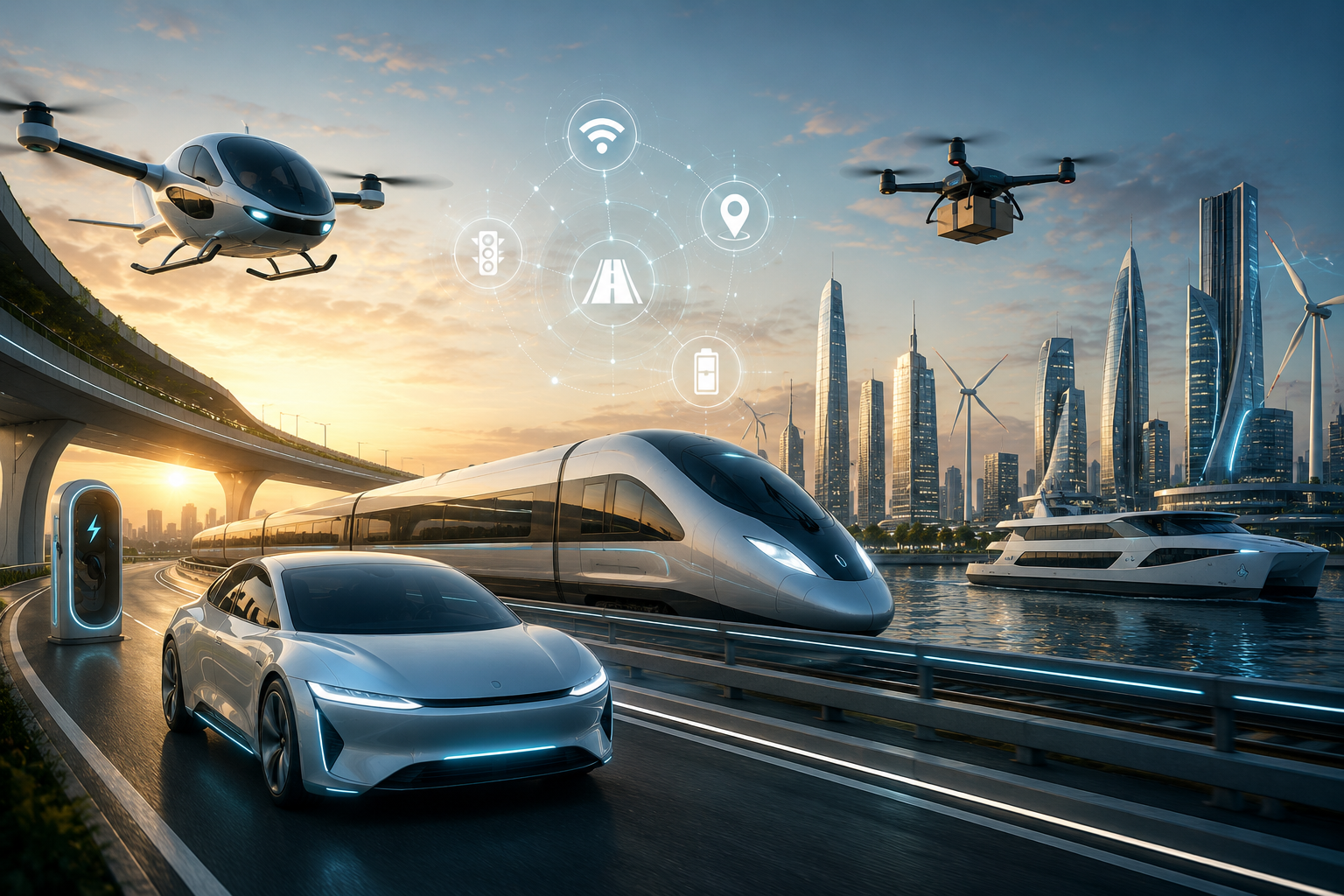
For businesses and investors, the emerging mobility landscape is no longer centred on one winning vehicle technology. It is becoming an interconnected system involving vehicles, software, electricity networks, communication platforms and physical transport infrastructure.
Table of Contents
- Transportation Enters a Software-and-Energy Era
- Electric Vehicles Move into the Mainstream
- Ultra-Fast Charging Changes the EV Proposition
- Vehicles Become Flexible Energy Assets
- Software-Defined Vehicles Transform Car Ownership
- Autonomous Mobility Moves Towards Commercial Deployment
- Smart Public Transport and Mobility Platforms
- Digital Railways Increase Capacity and Reliability
- Aviation Invests in Cleaner Fuels and New Aircraft
- Shipping Prepares for Renewable Fuels
- AI Transforms Freight and Logistics
- India’s Transportation Technology Opportunity
- Investment Opportunities Across Future Mobility
- Risks That Could Slow Transportation Innovation
- Frequently Asked Questions
Transportation Technology Innovations Enter a Software-and-Energy Era
The traditional transport industry was divided into relatively separate markets.
Automotive companies manufactured cars. Energy businesses supplied fuel. Infrastructure operators managed roads, ports and railways. Technology providers supplied navigation or communication systems.
Those boundaries are becoming less distinct.
Electric vehicles connect the automotive and electricity industries. Autonomous vehicles combine transportation with artificial intelligence, cloud computing and advanced semiconductors. Modern public-transport networks rely on real-time data, contactless payments and journey-planning platforms.
The business model is changing alongside the technology.
A vehicle can now generate revenue through software features, fleet services, charging, data and digital subscriptions long after the initial sale. Infrastructure owners can use sensors and predictive analytics to improve maintenance. Energy companies are becoming charging-network operators, while technology businesses are entering mobility and logistics.
The future transport market will therefore be shaped by ecosystems rather than standalone products.
Electric Vehicles Move into the Mainstream
Electric mobility remains the most visible transformation occurring across road transport.
Global electric-car sales rose by approximately 20% in 2025 to exceed 20 million units. EVs represented nearly 55% of car sales in China, 28% in Europe and just under 10% in the United States. Several emerging Southeast Asian markets also recorded sharp growth.
This growth is changing the competitive structure of the automotive industry.
Battery-electric vehicles contain fewer mechanical components than conventional internal-combustion vehicles. Their electronic architecture makes them particularly compatible with software control, connected services and automated-driving systems.
The next phase of competition will not be determined by sales growth alone. Manufacturers will need to improve:
- battery cost and durability;
- charging speed and availability;
- vehicle efficiency;
- supply-chain security;
- software integration;
- resale value; and
- recycling and material recovery.
The commercial opportunity also extends beyond passenger cars.
Electric buses, two-wheelers, three-wheelers, delivery vehicles and selected commercial fleets can achieve high utilisation, making operating-cost savings particularly important.
Ultra-Fast Charging Changes the EV Proposition
Charging time remains one of the most closely watched barriers to wider EV adoption.
Vehicle manufacturers and battery producers are responding with higher-voltage platforms, improved thermal management and battery chemistries capable of accepting greater power.
The latest systems combine battery packs operating above 800 volts with high-power charging infrastructure. The IEA reported that megawatt-scale charging technology can bring selected passenger EV batteries close to a full charge in less than ten minutes under suitable conditions.
More than 30 high-voltage electric-car models were introduced globally in 2025, and over 80% came from Chinese manufacturers. Several battery and automotive groups announced additional charging systems during early 2026 capable of achieving charging times below ten minutes.
However, headline charging speeds should be interpreted carefully.
Fewer than 5% of the global electric-car stock in 2025 could use chargers delivering more than 250 kilowatts. Ultra-fast charging also requires stronger electricity connections, advanced cooling and carefully controlled battery conditions.
For investors, this creates opportunities in:
- high-power charging equipment;
- power electronics;
- silicon-carbide and gallium-nitride semiconductors;
- battery cooling;
- charging-network software;
- grid connections; and
- energy storage at charging locations.
The charging experience could become as important to EV adoption as vehicle range.
Vehicles Become Flexible Energy Assets
Electric vehicles can do more than consume electricity.
Smart charging allows a vehicle to shift charging towards periods when electricity is cheaper, cleaner or more widely available. Bidirectional charging can also allow electricity stored in the battery to power a building or return energy to the grid.
Vehicle-to-grid technology, commonly called V2G, could help electricity systems balance supply and demand. EV owners may eventually earn revenue by providing services such as frequency regulation or reducing charging during periods of grid congestion.
The technology has several potential applications:
- Vehicle-to-home: providing backup electricity or reducing household power costs.
- Vehicle-to-building: supporting commercial energy management.
- Vehicle-to-load: powering tools, appliances or equipment.
- Vehicle-to-grid: selling electricity or flexibility services to the wider power system.
Large-scale deployment will require compatible vehicles, chargers, communication standards, market rules and incentives. Battery degradation and customer participation must also be managed carefully.
The long-term implication is significant.
An electric vehicle may evolve from a transport asset into a mobile energy-storage device connected to homes, businesses and electricity networks.
Software-Defined Vehicles Transform Car Ownership
Modern vehicles are increasingly defined by software rather than mechanical specifications alone.
A software-defined vehicle uses centralised computing, sensors and connected systems to manage functions that were previously controlled through separate hardware components.
Manufacturers can update features remotely, diagnose faults, improve energy management and introduce additional services after the vehicle has been sold.
This could support recurring revenue through:
- driver-assistance subscriptions;
- navigation and connectivity;
- battery-performance upgrades;
- fleet-management tools;
- entertainment services;
- insurance products; and
- predictive maintenance.
Software also changes competition.
Automakers must now develop capabilities in cybersecurity, cloud infrastructure, interface design and data management. Suppliers that previously sold isolated components may need to provide integrated digital platforms.
However, the model creates new consumer and regulatory questions.
Vehicle owners may question whether important features should require continuing subscriptions. Software faults can affect several systems simultaneously, and manufacturers may need to support updates for many years.
Cybersecurity also becomes critical when braking, acceleration, steering and charging are digitally controlled.
Autonomous Mobility Moves Towards Commercial Deployment
Fully autonomous private cars remain distant, but selected automated-mobility services are becoming commercially relevant.
The IEA reported in May 2026 that electric Level 4 robotaxi services were operating commercially in more than 20 cities worldwide. These systems operate within limited geographic or operational areas and are monitored as centralised fleets.
Advanced driver-assistance systems are spreading more quickly.
Around half of all new cars sold globally in 2025 included Level 2 technology capable of controlling both speed and steering under specified conditions. Drivers must still supervise these systems and remain responsible for the vehicle.
The sector is gradually separating into two paths.
Private passenger vehicles are moving towards more capable driver assistance, while commercial fleets are testing higher levels of autonomy within controlled areas such as city zones, ports, mines, warehouses and logistics corridors.
Regulation is also advancing.
In January 2026, a United Nations working group adopted draft global technical and regulatory provisions for automated-driving systems. A revised proposed UN regulation was issued in June following further review.
Commercial success will depend on more than driving capability.
Companies must prove:
- safety in unusual conditions;
- legal responsibility;
- cyber resilience;
- insurance viability;
- cost-effective fleet maintenance; and
- public acceptance.
Autonomous transport is likely to scale first where routes, environments and use cases can be clearly controlled.
Smart Public Transport and Mobility Platforms
The future of mobility cannot be built around privately owned vehicles alone.
Congested and rapidly growing cities need public transport that is frequent, accessible, and easy to use. Technology can improve that experience through real-time arrival information, integrated payments, demand forecasting, and multimodal journey planning.
Mobility-as-a-Service platforms aim to combine public transport, shared mobility, and other travel options within one digital interface.
A traveller may be able to plan and pay for a journey involving:
- metro or suburban rail;
- electric buses;
- bicycle or scooter sharing;
- taxis or ride-hailing;
- demand-responsive shuttles; and
- Walking connections.
Public transport digitalisation increasingly uses artificial intelligence, Internet of Things sensors and predictive models to improve network planning and passenger information.
However, technology should strengthen public transport rather than merely create more mobility applications.
Successful platforms need common data standards, fair access, reliable service and integration between public and private operators.
The investment opportunity lies not only in consumer-facing apps but also in the underlying ticketing, fleet, data and payment infrastructure.
Digital Railways Increase Capacity and Reliability
Rail innovation is increasingly focused on signalling, interoperability and data rather than train speed alone.
The European Rail Traffic Management System creates a common framework for signalling and speed control across participating rail networks. It is intended to increase infrastructure capacity, safety and cross-border interoperability while reducing the complexity of maintaining different national systems.
Digital train control can allow services to operate more efficiently on existing tracks. Predictive-maintenance systems can analyse equipment condition and help operators repair assets before failures interrupt service.
Rail data standards are also evolving.
A new European telematics specification entered into force on March 2, 2026, establishing a common framework for transparent rail-data sharing while addressing quality, cybersecurity and operational use.
These developments demonstrate that railway modernisation does not always require completely new lines.
Digital signalling, communication and asset-management systems can increase the value of existing infrastructure.
For technology providers, opportunities include:
- signalling equipment;
- train-control software;
- telecommunications;
- predictive maintenance;
- cybersecurity;
- passenger-information systems; and
- freight-data platforms.
Aviation Invests in Cleaner Fuels and New Aircraft
Commercial aviation is difficult to electrify because aircraft require extremely high energy density.
Near-term decarbonisation efforts are therefore concentrating on more efficient aircraft, operational improvements and sustainable aviation fuels.
ICAO’s global framework includes a collective vision to reduce carbon dioxide emissions from international aviation by 5% by 2030 through sustainable aviation fuels, lower-carbon fuels and other cleaner energy sources, compared with no use of cleaner energy.
In June 2026, ICAO and the International Air Transport Association expanded cooperation on systems for tracking SAF use and progress. The sector still faces major constraints involving production capacity, cost, feedstock sustainability and infrastructure.
Electric aviation may develop earlier in shorter-range applications.
Advanced Air Mobility includes electric or highly automated aircraft designed to transport passengers or cargo over shorter distances. In March 2026, the US Federal Aviation Administration selected eight projects across 26 states for an eVTOL integration pilot programme.
The FAA also began developing new research infrastructure in June 2026 for procedures, training and operational analysis involving vertical-take-off-and-landing aircraft.
Commercial eVTOL services still need to prove safety, aircraft durability, noise performance, operating economics and public acceptance.
The most credible initial markets may include medical transport, airport connections, emergency response and high-value cargo rather than mass urban commuting.
Shipping Prepares for Renewable Fuels
Maritime transport faces a different technology challenge.
Large ships travel long distances while carrying substantial cargo, making battery-only propulsion difficult for many international routes.
The sector is exploring sustainable biofuels, methanol, ammonia, hydrogen, e-fuels, fuel cells and onboard carbon-capture technologies.
The International Maritime Organization says meeting its ambition of net-zero greenhouse-gas emissions from international shipping by or around 2050 will require large-scale renewable-fuel markets and new maritime infrastructure.
That infrastructure includes:
- renewable-energy generation;
- alternative-fuel production;
- fuel transport and storage;
- port bunkering systems;
- shore power; and
- ships capable of safely using new fuels.
Different fuels have different challenges involving cost, energy density, emissions, availability and safety.
Shipping companies must also prepare their workforces. IMO initiatives are developing training guidance for ammonia, hydrogen, methanol, battery-powered ships, fuel cells and other emerging technologies.
Ports could become central nodes in the new energy economy, connecting shipping, renewable power and industrial-fuel production.
Artificial Intelligence Transforms Freight and Logistics
Freight transportation is becoming increasingly data-driven.
AI systems can analyse orders, traffic, fuel use, warehouse capacity and delivery schedules to identify more efficient routes and reduce empty vehicle movement.
Connected sensors can monitor:
- vehicle condition;
- cargo temperature;
- container location;
- driver behaviour;
- fuel or battery consumption; and
- estimated arrival times.
Digital freight platforms can match cargo with available capacity, while predictive-maintenance systems help fleet owners reduce unplanned downtime.
The larger opportunity lies in connecting systems that currently operate separately.
A shipment may involve factories, trucks, ports, ships, railways, warehouses and last-mile delivery. Shared data can improve coordination across these stages.
However, interoperability and cybersecurity remain significant barriers.
A digitally connected supply chain becomes more efficient, but it also creates more potential entry points for cyberattacks or data manipulation.
India’s Transportation Technology Opportunity
India’s transport transition will differ from mobility changes in markets dominated by private passenger cars.
Two-wheelers, three-wheelers, buses and commercial fleets are particularly important to the Indian mobility system. This creates an opportunity to build electric-vehicle solutions designed around high utilisation, affordability and local operating conditions.
The ₹10,900 crore PM E-DRIVE programme supports electric two-wheelers, three-wheelers, buses, ambulances, trucks, charging infrastructure and testing facilities. The programme has been extended until March 31, 2028 for several components.
By January 27, 2026, more than 22.12 lakh electric vehicles had been sold under the programme, including 19.19 lakh electric two-wheelers and 2.93 lakh electric three-wheelers. The scheme includes ₹4,391 crore for 14,028 electric buses and ₹2,000 crore for public charging infrastructure.
India had 29,151 public EV charging stations installed by the end of December 2025, according to information provided by the Ministry of Heavy Industries.
In May 2026, proposals worth ₹503.86 crore had been approved for 4,874 additional chargers across several states and public-sector energy companies. The government is also developing Unified Bharat e-Charge, intended to help drivers discover and pay across multiple charging networks through one interface.
The minister described the charging expansion as “powering the future of India.”
India’s strongest opportunities include:
- affordable electric two- and three-wheelers;
- electric buses and commercial fleets;
- batteries and advanced battery materials;
- charging equipment and payment platforms;
- fleet-management software;
- public-transport technology;
- rail modernisation;
- smart logistics; and
- automotive electronics and semiconductors.
For readers following Business News India, the key issue is whether India can capture manufacturing and technology value rather than functioning mainly as an end market.
Local battery production, power electronics, software, charging equipment and component ecosystems will determine how much economic value remains within the country.
Investment Opportunities Across Future Mobility
Transportation innovation creates opportunities across several distinct layers.
Vehicle Manufacturing
Electric cars, buses, trucks, two-wheelers, autonomous shuttles and specialised aircraft require substantial capital and operational expertise.
Batteries and Components
Battery cells, thermal-management systems, power electronics, electric motors and advanced semiconductors are critical parts of the value chain.
Charging and Energy
Charging networks, grid connections, software platforms and energy-storage systems will expand as electric fleets grow.
Software and Data
Connected vehicles create demand for operating systems, navigation, fleet optimisation, cybersecurity and predictive maintenance.
Infrastructure
Rail signalling, intelligent roads, digital ports and airport systems can improve the efficiency of existing assets.
Alternative Fuels
Sustainable aviation fuel, maritime e-fuels, hydrogen and methanol could create large new energy supply chains.
Investors should distinguish between high-growth technologies and profitable business models.
Important questions include:
- Does the company solve a measurable transport problem?
- Is the technology commercially deployable?
- How much capital is required?
- Who pays for the infrastructure?
- Is the system compatible with common standards?
- Can the company scale safely?
- Does regulation support or delay adoption?
The mobility market may grow rapidly while individual businesses struggle with manufacturing costs, infrastructure delays or weak margins.
Risks That Could Slow Transportation Innovation
The direction of transport transformation appears clear, but several risks could slow progress.
Infrastructure Gaps
Electric vehicles and cleaner transport systems require charging, grids, ports, depots and maintenance facilities.
High Capital Requirements
Vehicles, batteries, aircraft and infrastructure require large investments before producing meaningful revenue.
Technology Fragmentation
Competing charging, software and communication standards can make adoption more difficult.
Cybersecurity
Connected and autonomous transport systems create potential risks involving safety, privacy and operational continuity.
Battery and Mineral Supply
Electric mobility depends on stable supplies of minerals, components and manufacturing capacity.
Regulatory Delays
Autonomous vehicles and new aircraft require safety standards, certification and clear rules governing responsibility.
Weak Consumer Economics
A technologically advanced mobility service may still fail if it costs substantially more than existing transport options.
Unequal Accessibility
Innovation should improve mobility for wider populations rather than serving only affluent consumers or selected urban areas.
Transportation Technology Is Becoming a Connected System
The most important transportation technology innovations are converging.
Electric vehicles require batteries, chargers, and electricity networks. Autonomous mobility depends on sensors, software, computing, and regulation. Digital railways require common signalling and secure data. Cleaner aviation and shipping need new fuels and major infrastructure investment.
The future of mobility will not be defined by one revolutionary vehicle.
It will emerge from the interaction of transport, energy, software, finance, and public policy.
The winning companies will be those that can turn technical innovation into reliable, affordable, and safe services. Governments will need to establish standards and invest in infrastructure without locking markets into technologies that may become outdated.
For investors, transportation offers structural growth but also high capital requirements and long commercialisation timelines.
The strongest opportunities may belong to businesses providing the essential components, software and infrastructure used across multiple forms of mobility.
Transportation is not merely becoming faster or cleaner.
It is becoming connected, intelligent and increasingly integrated with the wider digital and energy economy.
Frequently Asked Questions
What are transportation technology innovations?
Transportation technology innovations include electric vehicles, autonomous-driving systems, intelligent railways, connected public transport, sustainable aviation fuels, alternative marine fuels and AI-powered logistics.
What technologies are shaping the future of transportation?
The main technologies include batteries, ultra-fast charging, artificial intelligence, sensors, vehicle software, digital signalling, renewable fuels, robotics and smart mobility platforms.
How are electric vehicles changing transportation?
Electric vehicles reduce dependence on internal-combustion engines and create new markets for batteries, charging, software and electricity services. Global electric-car sales exceeded 20 million in 2025.
Are fully autonomous vehicles available?
Level 4 robotaxis operate commercially within restricted geographic areas in more than 20 cities, but fully autonomous Level 5 vehicles capable of driving everywhere are not currently available.
What is a software-defined vehicle?
A software-defined vehicle uses central computing and connected systems to control major functions. Features and performance can be changed or improved through software updates.
What is vehicle-to-grid technology?
Vehicle-to-grid technology allows an electric vehicle to return stored electricity to the grid. It can help manage peak demand and create potential revenue for EV owners.
How is transportation technology affecting public transport?
Technology can improve ticketing, journey planning, passenger information, network design and fleet management. Electric buses and integrated mobility platforms can also improve accessibility and reduce local emissions.
What is sustainable aviation fuel?
Sustainable aviation fuel is a renewable or waste-derived aviation fuel that meets established sustainability criteria and can reduce lifecycle emissions compared with conventional jet fuel.
What transportation opportunities exist in India?
India has opportunities in electric two-wheelers, three-wheelers, buses, charging equipment, batteries, fleet software, intelligent public transport and automotive components.
What are the biggest investment risks in transport technology?
Major risks include high capital costs, infrastructure shortages, regulatory delays, technology fragmentation, weak margins and uncertainty over consumer adoption.
Stay connected with Business Herald for the latest business news, insights, and updates.
Follow us on Facebook, Instagram, LinkedIn, and YouTube.
Join our growing community on WhatsApp and Telegram for real-time updates delivered directly to you.