

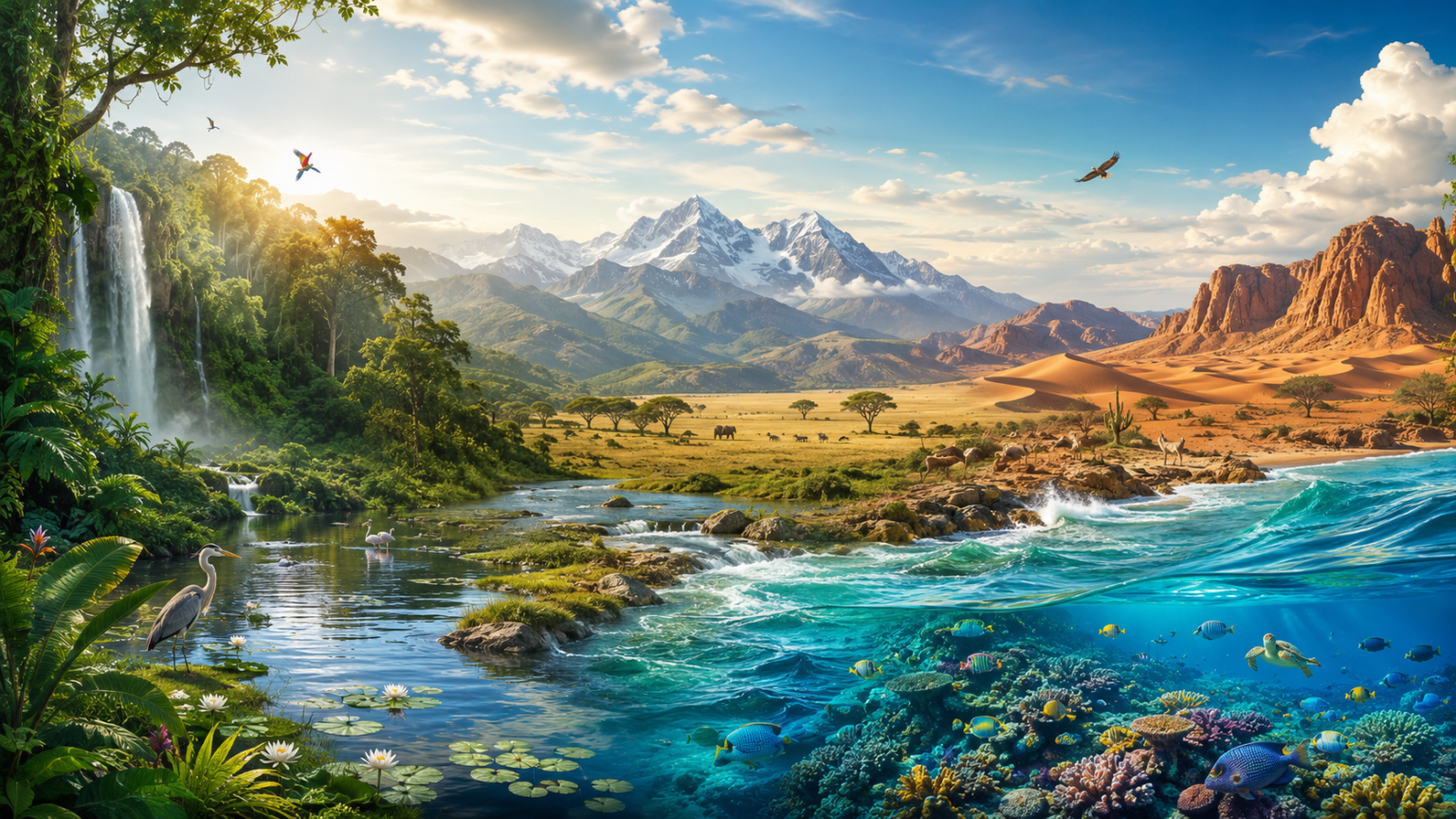

Earth’s diverse ecosystems form the living infrastructure of the planet.
From dense tropical forests and expansive grasslands to frozen tundra, freshwater wetlands, and coral reefs, each ecosystem contains a distinct network of organisms interacting with water, soil, air, sunlight, and climate.
These systems provide far more than remarkable landscapes. They regulate water, support food production, maintain soil health, store carbon, protect coastlines, and sustain industries ranging from agriculture and fisheries to tourism, pharmaceuticals, and insurance. UNEP identifies services such as freshwater provision, pollination, erosion control, and climate regulation as foundations of human well-being and economic stability.
Yet ecosystems rarely function in isolation. Rivers connect mountains to wetlands. Forests influence rainfall and soil conditions. Coastal ecosystems depend on nutrients transported from inland landscapes. The condition of one habitat can therefore affect communities and businesses located hundreds or even thousands of kilometres away.
Traversing the world’s ecosystems reveals a central truth: nature is not a collection of separate assets. It is an interconnected operating system supporting the global economy.
Table of Contents
- What Makes an Ecosystem Complex?
- Forest Ecosystems
- Grasslands and Savannas
- Desert Ecosystems
- Freshwater Ecosystems and Wetlands
- Coastal and Marine Ecosystems
- Mountain and Polar Ecosystems
- Urban Ecosystems
- Why Ecosystems Matter to Business
- The Threats Reshaping Nature
- Restoring Earth’s Diverse Ecosystems
- Frequently Asked Questions
What Makes Earth’s Diverse Ecosystems So Complex?
An ecosystem includes living components, known as biotic factors, and non-living components, known as abiotic factors.
Plants, animals, fungi and microorganisms interact with sunlight, temperature, water, minerals and atmospheric conditions. Energy generally enters ecosystems through sunlight, while nutrients circulate through soil, water, organisms and decomposition.
The complexity comes from the number of relationships involved.
A single tree may provide shelter for birds, food for insects, shade for seedlings and nutrients for fungi. Its roots can stabilise soil and influence how water moves through the landscape. When that tree dies, decomposers return its nutrients to the ecosystem.
These relationships create food webs rather than simple food chains. Changes affecting one species can spread through predators, prey, vegetation, and the physical environment.
Biodiversity increases the range of functions performed within an ecosystem. However, the value of an ecosystem cannot be measured only by counting species. Its health also depends on ecological integrity, genetic diversity, connectivity, and the ability to recover after disturbance.
The Kunming-Montreal Global Biodiversity Framework recognises this complexity by calling for biodiversity to be integrated into land-use planning, agriculture, forestry, finance, and business decision-making.
Forest Ecosystems: The Planet’s Living Framework
Forests range from humid tropical rainforests and seasonal woodlands to temperate forests and northern boreal systems.
Their vegetation, wildlife, and ecological processes vary significantly. Tropical forests usually contain exceptional biological diversity, while boreal forests are adapted to cold temperatures, short growing seasons, and periodic fires.
According to the Food and Agriculture Organization’s Global Forest Resources Assessment 2025, forests cover approximately 4.14 billion hectares, equal to 32% of the planet’s land area. Nearly half of the world’s forests are located in tropical regions.
Forests regulate carbon and water cycles, protect soils, reduce erosion, and provide food, fuel, timber, and other renewable materials. They also support the livelihoods of communities and supply chains across agriculture, construction, paper, consumer goods, and tourism.
However, global deforestation remained approximately 10.9 million hectares annually during 2015–2025. Although that was below the 17.6 million hectares recorded annually during 1990–2000, the continuing loss remains substantial.
FAO Director-General Qu Dongyu said forest assessments support “decisions, policies and investments related to forests and the ecosystem services they provide.”
The statement reflects a broader economic shift. Forests are increasingly viewed not merely as sources of raw material but as productive natural assets requiring long-term management.
Grasslands and Savannas: More Than Open Space
Grasslands include tropical savannas, temperate prairies, steppes and high-altitude meadows.
They are generally shaped by seasonal rainfall, grazing, fire and soil conditions. Trees may be sparse or absent, but the apparent simplicity of an open landscape can conceal a highly complex ecological system.
Grasslands provide habitat for insects, birds, grazing mammals, predators and soil organisms. Their root networks can stabilise soil, store carbon below ground and support the movement of water through landscapes.
They are also central to agriculture and livestock production.
The challenge is that economic value is often measured through immediate output rather than long-term ecosystem condition. Overgrazing, intensive cultivation, poorly planned infrastructure and the suppression or misuse of fire can alter vegetation, reduce soil fertility and increase erosion.
Sustainable grassland management therefore requires balancing food production with native vegetation, water conservation, wildlife movement and the livelihoods of pastoral communities.
Desert Ecosystems: Life at the Limits
Deserts are defined by low precipitation rather than temperature. They include hot environments such as the Sahara and cold deserts found in Central Asia, Patagonia and polar regions.
Desert species survive through extraordinary adaptations.
Some plants store water or minimise moisture loss through specialised leaves. Animals may become active at night, shelter underground or obtain much of their water from food. Seeds can remain dormant for extended periods before rapidly germinating after rainfall.
These adaptations demonstrate that ecosystems do not require abundant resources to become biologically complex.
Deserts are also economically important. They support pastoralism, tourism, mineral extraction and expanding renewable-energy infrastructure.
However, desert ecosystems can recover slowly from physical disturbance. Roads, mining, off-road traffic and poorly located energy projects may fragment habitats or damage biological soil crusts that help stabilise the land.
Desertification is different from the natural existence of deserts. It refers to land degradation in dry regions driven by interacting factors such as climate variability and unsustainable land management.
The Convention on Biological Diversity estimates that 20% to 40% of global land may already be degraded, affecting the well-being of at least 3.2 billion people.
Freshwater Ecosystems and Wetlands
Freshwater ecosystems include rivers, lakes, streams, marshes, peatlands, floodplains and groundwater-connected habitats.
Although freshwater represents only a limited share of the planet’s total water, these ecosystems support drinking-water supplies, agriculture, fisheries, transport, energy generation and biodiversity.
Wetlands perform several critical functions. They can absorb floodwater, recharge groundwater, filter pollutants, support migratory species and store significant quantities of carbon.
Their economic value is increasingly measurable.
The Global Wetland Outlook 2025 found that at least 400 million hectares of wetlands had been lost since 1970. Nearly one-quarter of the remaining wetland area was considered degraded. The report estimated that surviving wetlands generate up to $39 trillion in benefits annually through water, food, climate regulation and other ecosystem services.
Wetland loss can therefore translate into higher infrastructure costs, declining fisheries, worsening water insecurity and greater exposure to floods.
Replacing natural water regulation with dams, drainage systems, treatment plants and flood defences can also impose significant financial costs on governments and communities.
Protecting wetlands is not an alternative to development. In many locations, it is a form of essential infrastructure investment.
Coastal and Marine Ecosystems
Oceans cover most of the planet, but marine ecosystems differ dramatically according to depth, temperature, currents, chemistry and distance from land.
Coastal environments include mangroves, salt marshes, seagrass meadows, estuaries and coral reefs. These habitats serve as nurseries for marine life, protect shorelines and support fisheries, tourism and coastal livelihoods.
Coral Reefs
Coral reefs are among the planet’s most biologically rich environments.
They cover approximately 1% of the world’s oceans but provide habitat for at least 25% of marine life. Healthy reefs support fisheries and tourism while reducing the impact of waves, storms, flooding and erosion on coastal communities.
Reefs are threatened by rising ocean temperatures, acidification, pollution, unsustainable fishing and physical damage. NOAA estimates that the world has already lost between 30% and 50% of its coral reefs.
Mangroves and Seagrass
Mangroves grow where land and saltwater meet. Their root systems trap sediment, provide shelter for fish and reduce coastal erosion.
Seagrass meadows support marine food webs and create habitat for juvenile fish, turtles and other species. Like mangroves, they can also store carbon within vegetation and sediment.
The financial case for conserving these habitats is becoming stronger as coastal cities confront rising climate and disaster risks.
Restoration cannot fully compensate for continued destruction, but carefully designed mangrove, wetland and coral projects can strengthen coastal resilience when combined with pollution control, sustainable fisheries and climate action.
Mountain and Polar Ecosystems
Mountain ecosystems change rapidly with elevation.
Temperature, rainfall, wind and soil conditions can vary across relatively short distances, creating distinct habitats from valleys to alpine zones. Mountains are also sources of major river systems, making their ecological condition important to communities far downstream.
Changes in glaciers, snow cover, vegetation and rainfall can affect water availability, agriculture and hydropower.
Polar ecosystems face even more extreme conditions. Species depend on seasonal cycles of ice, snow and marine productivity. Disturbances to those cycles can alter feeding, breeding and migration patterns.
Mountain and polar environments demonstrate why ecosystem protection cannot be managed solely within political boundaries. Water systems, wildlife corridors, and climate processes cross state and national borders, requiring regional cooperation.
Urban Ecosystems: Nature Within Cities
Cities are built environments, but they are also ecosystems.
Urban parks, lakes, rivers, street trees, gardens, wetlands, and green roofs provide habitat while influencing heat, air quality, stormwater, and human health.
Well-designed green and blue spaces can help reduce urban heat, absorb rainfall, and create recreational areas. Poorly planned development can produce the opposite result by removing vegetation, covering soil, and building over natural drainage systems.
The Global Biodiversity Framework calls for cities to increase the area, quality, connectivity, and accessibility of green and blue spaces while integrating biodiversity into urban planning.
This is directly relevant to developers and infrastructure investors.
Projects that ignore drainage, heat exposure and ecosystem connectivity may face higher operating costs, regulatory challenges and physical risks. Nature-inclusive design can improve resilience while creating more attractive and liveable urban environments.
How Earth’s Ecosystems Are Connected
Ecosystem categories are useful for study, but nature rarely follows clear boundaries.
Mountain rainfall feeds rivers. Rivers transport water, nutrients and sediment into wetlands and estuaries. Mangroves and seagrass support fish that later move into coral reefs or open oceans.
Migratory animals connect distant habitats. Birds may depend on wetlands across several countries during one annual journey. Marine species can travel between coastal nurseries and offshore feeding grounds.
Atmospheric processes create another layer of connectivity. Forest loss can influence local rainfall, temperature and soil moisture. Ocean changes can affect weather systems and coastal productivity.
Fragmentation interrupts these connections.
A protected forest may still decline if it is separated from migration routes, water sources or neighbouring habitats. Effective conservation must therefore focus on landscapes, river basins and seascapes rather than isolated sites.
This is why the global biodiversity framework emphasises ecologically representative, well-connected and equitably managed conservation systems.
Why Ecosystems Matter to Business and Investors
Ecosystem decline is increasingly recognised as a material economic and financial risk.
Companies rely on nature for water, raw materials, pollination, soil fertility, climate regulation and protection from hazards. Banks and investors may be indirectly exposed through companies operating in agriculture, food, mining, forestry, fisheries, real estate and infrastructure.
The World Bank estimates that the collapse of selected ecosystem services, including pollination, fisheries and timber provision, could reduce global GDP by $2.7 trillion annually by 2030.
For readers following Business News India, the issue is particularly relevant to agricultural productivity, urban water security, coastal development, tourism, insurance exposure and infrastructure resilience.
Corporate expectations are also changing.
Target 15 of the Global Biodiversity Framework calls for large companies and financial institutions to assess and disclose their biodiversity dependencies, impacts and risks across operations, supply chains and investment portfolios.
This means biodiversity is moving closer to mainstream corporate governance.
Businesses may increasingly need to answer questions such as:
- Where do critical natural resources originate?
- Which facilities depend on vulnerable water systems?
- Could ecosystem decline disrupt suppliers?
- Are operations affecting protected or high-integrity habitats?
- How could biodiversity rules influence licences and capital costs?
- Is restoration creating credible commercial opportunities?
The businesses that map these dependencies early may be better positioned to manage regulation, supply-chain disruption and changing investor expectations.
The Major Threats Reshaping Ecosystems
The decline of ecosystems is driven by several connected pressures.
Land-use and sea-use change can replace natural habitats with agriculture, infrastructure, mining or urban development. Pollution introduces plastics, chemicals, nutrients and untreated waste into terrestrial and aquatic environments.
Climate change modifies temperature, rainfall, ocean chemistry and the frequency of extreme events. Overexploitation depletes wildlife, timber and fisheries faster than populations can recover.
Invasive alien species can outcompete native organisms, change fire patterns and disrupt food webs.
The Global Biodiversity Framework includes targets to reduce pollution, cut the introduction of invasive alien species, limit climate impacts and bring the loss of high-biodiversity areas close to zero by 2030.
These pressures do not operate independently.
A coral reef stressed by warming may be less able to recover from pollution. A fragmented forest may become more vulnerable to fire. An overused wetland may offer less protection during drought or flooding.
Effective environmental policy must therefore address cumulative risk rather than treating each problem separately.
Restoring Earth’s Diverse Ecosystems
Protection prevents damage, while restoration attempts to recover ecological functions that have already been lost.
Restoration may involve re-establishing native vegetation, reconnecting rivers to floodplains, removing invasive species, rebuilding soils, restoring mangroves or improving the conditions that allow coral reefs to recover.
However, restoration is not simply planting trees.
A successful project must consider which ecosystem originally existed, why it declined, how local communities use the land and whether long-term management and financing are available.
Global policy ambitions are substantial. The Kunming-Montreal framework calls for at least 30% of degraded terrestrial, freshwater, coastal and marine ecosystems to be under effective restoration by 2030. It separately seeks to conserve at least 30% of land, inland waters, coastal areas and oceans.
Financing remains the central challenge.
UNEP’s State of Finance for Nature 2026 found that approximately $7.3 trillion flowed into nature-negative activities in 2023, compared with $220 billion for nature-based solutions. UNEP estimates annual nature-based investment must reach $571 billion by 2030 to meet global climate, biodiversity and land-restoration targets.
This gap also represents an investment opportunity.
Potential growth areas include:
- ecosystem monitoring and satellite analytics;
- regenerative agriculture;
- sustainable forestry;
- water and wetland restoration;
- biodiversity-linked finance;
- nature-based coastal protection;
- environmental DNA and species monitoring;
- native seed and nursery businesses;
- ecological consulting; and
- natural-capital accounting.
The opportunity is not to place a price on every part of nature. It is to recognise that economic decisions already assign value, often implicitly, when ecosystems are conserved, degraded or replaced.
Traversing Towards a Nature-Positive Future
Earth’s diverse ecosystems are living networks connecting climate, water, food, biodiversity and economic activity.
Forests regulate water and supply renewable resources. Grasslands sustain food systems and soil health. Wetlands reduce floods and improve water security. Coral reefs support marine life, tourism and coastal protection.
Their benefits frequently remain invisible until they disappear.
The next stage of environmental action must move beyond treating conservation as a specialist issue separate from development. Ecosystem condition belongs within infrastructure planning, corporate risk management, public finance, investment decisions and national economic strategy.
Protecting nature does not require stopping all human activity. It requires recognising ecological limits, using resources responsibly and investing in the systems on which long-term prosperity depends.
The greatest wonder of Earth’s ecosystems is not simply their variety. It is the way forests, rivers, oceans, wildlife and human societies remain connected within one complex planetary system.
Frequently Asked Questions
What are Earth’s diverse ecosystems?
Earth’s ecosystems include forests, grasslands, deserts, rivers, lakes, wetlands, mountains, polar regions, oceans, coral reefs, mangroves and urban environments. Each contains living organisms interacting with its physical surroundings.
What are the main types of ecosystems?
The two broad categories are terrestrial and aquatic ecosystems. Terrestrial ecosystems include forests, grasslands, deserts and tundra, while aquatic ecosystems include freshwater, coastal and marine environments.
Why are ecosystems important?
Ecosystems provide food, clean water, raw materials, soil fertility, pollination, climate regulation, recreation and protection from natural hazards. These services support communities and economic activity.
Which ecosystem contains the greatest biodiversity?
Tropical forests and coral reefs are among the most biologically diverse ecosystems. Coral reefs cover only about 1% of the ocean but support at least 25% of marine life.
What is an ecosystem service?
An ecosystem service is a benefit that people receive from nature. Examples include crop pollination, water filtration, carbon storage, soil formation, flood regulation and coastal protection.
How does climate change affect ecosystems?
Climate change alters temperature, rainfall, sea level, ocean chemistry and extreme-weather patterns. These changes can affect species distribution, migration, reproduction and the ability of ecosystems to recover from disturbances.
What is ecosystem restoration?
Ecosystem restoration is the process of assisting the recovery of degraded natural systems. It may include restoring native vegetation, wetlands, soils, rivers, mangroves or marine habitats.
Why should businesses care about biodiversity?
Businesses depend on water, raw materials, stable climates and functioning supply chains. Ecosystem decline can create operational, regulatory, reputational, insurance and investment risks.
Can damaged ecosystems fully recover?
Some ecosystems can recover substantially when the causes of degradation are removed. Recovery prospects depend on the severity of damage, ecological conditions, connectivity, local involvement and long-term management.
What is the global 30-by-30 target?
The 30-by-30 target seeks to effectively conserve at least 30% of terrestrial, inland-water, coastal and marine areas by 2030. A related target calls for 30% of degraded ecosystems to be under effective restoration.
Stay connected with Business Herald for the latest business news, insights, and updates.
Follow us on Facebook, Instagram, LinkedIn, and YouTube.
Join our growing community on WhatsApp and Telegram for real-time updates delivered directly to you.