

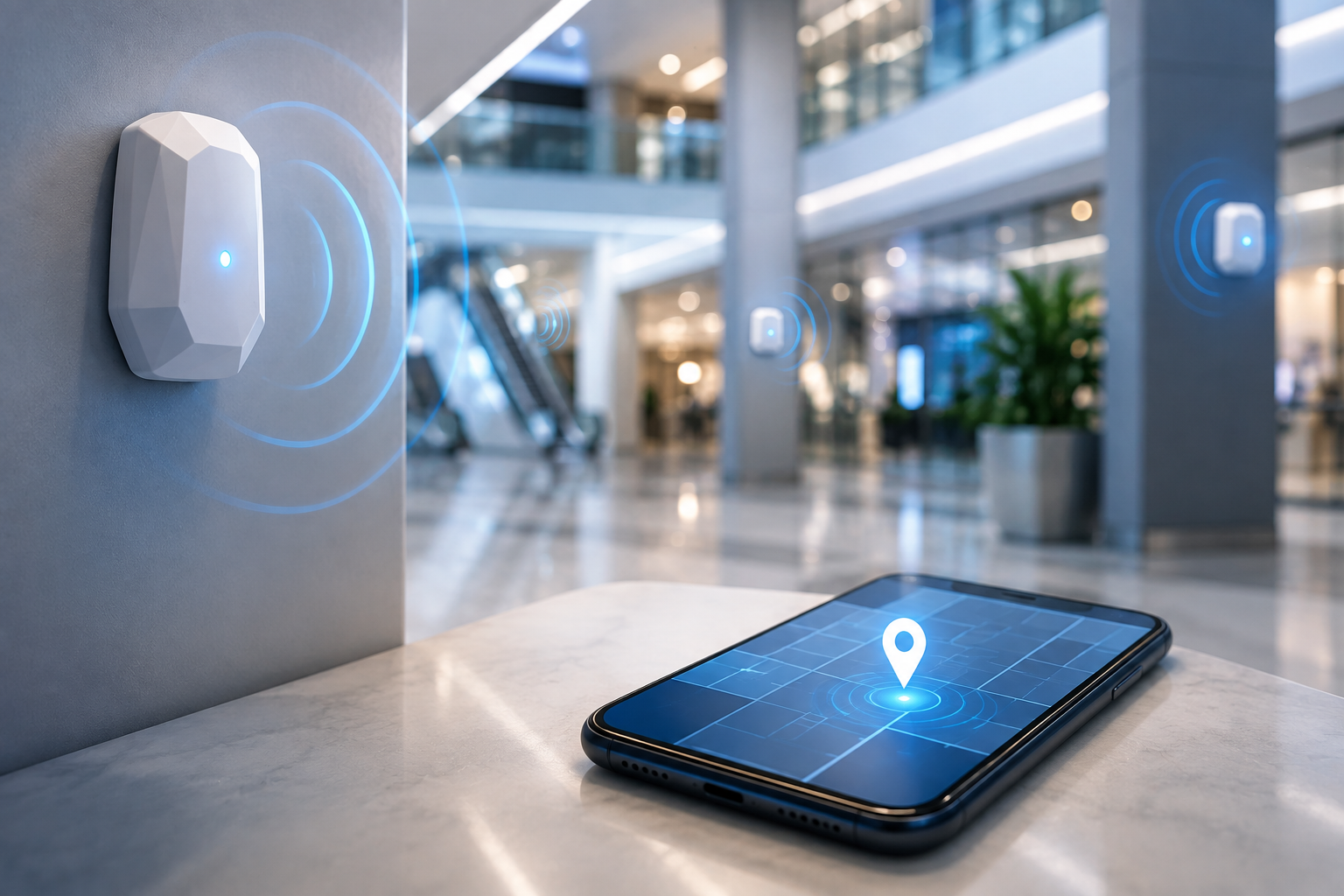

A Bluetooth indoor positioning system uses Bluetooth technology to determine the location of people, smartphones, equipment, or other connected devices inside buildings where traditional GPS can be unreliable.
Airports, hospitals, warehouses, shopping centers, offices, factories, museums, and other large facilities increasingly need accurate indoor location information. Finding a particular room, tracking an important asset, guiding visitors, or locating equipment can become difficult when satellite-based positioning is unavailable.
Bluetooth addresses this challenge by combining low-power wireless communication with positioning techniques such as received signal strength indication (RSSI), trilateration, Angle of Arrival (AoA), Angle of Departure (AoD), and newer ranging capabilities such as Bluetooth Channel Sounding.
The important point is that Bluetooth does not rely on a single positioning technique. Different components can work together depending on the accuracy, cost, environment, and application requirements.
What Is a Bluetooth Indoor Positioning System?
A Bluetooth indoor positioning system is a technology setup that uses Bluetooth signals and known reference points to estimate the location of a device inside an indoor environment.
Unlike GPS, which depends on signals from satellites, Bluetooth positioning can use fixed transmitters or receivers installed throughout a building.
In a typical indoor navigation deployment, Bluetooth Low Energy beacons are placed at known locations. A smartphone or other receiving device detects those signals and uses information such as signal strength and the known locations of the beacons to estimate its position.
The result can be displayed as a position on a digital floor map.
For example, a visitor entering an airport could open an indoor navigation application and receive directions to a departure gate. A worker in a factory could locate a particular piece of equipment. A hospital could use positioning technology to help staff locate mobile medical assets.
The technology therefore connects three important elements:
Bluetooth signals + positioning infrastructure + location software
Together, they transform wireless connectivity into location intelligence.
How Does a Bluetooth Indoor Positioning System Work?
The exact architecture depends on the application, but the basic process can be understood in several stages.
1. Bluetooth Devices Create Reference Points
The first step is establishing known locations inside a building.
These can be Bluetooth Low Energy beacons or fixed locator devices positioned at predetermined points.
Each reference point has a known location within the facility.
For example, a shopping center might install Bluetooth transmitters near entrances, corridors, elevators, and major stores.
The positioning software knows where each transmitter is located.
2. A Smartphone or Tag Detects Bluetooth Signals
A smartphone, wearable, asset tag, or another Bluetooth-enabled device detects nearby signals.
In a traditional beacon-based system, the receiving device can measure the received signal strength from multiple Bluetooth transmitters.
Because the signal becomes weaker as distance generally increases, RSSI can provide an estimate of how far the receiving device is from a transmitter.
However, RSSI is not a perfect distance measurement.
Walls, furniture, people, reflections, interference, antenna characteristics, and other environmental conditions can affect signal strength.
That is why indoor positioning systems require algorithms and calibration rather than simply converting signal strength into an exact distance.
3. Positioning Algorithms Process the Data
The system then combines measurements from multiple reference points.
One traditional approach is trilateration.
If a device can estimate its distance from several fixed Bluetooth transmitters whose locations are known, the system can calculate an approximate position based on the intersection of those distance estimates.
Bluetooth SIG describes this type of RSSI-based positioning as a way to estimate distance and use trilateration to determine a device’s position.
More advanced systems can combine additional information to improve the result.
This is where direction finding and newer ranging technologies become important.
The Role of RSSI in Indoor Positioning
RSSI, or Received Signal Strength Indicator, has historically been one of the most accessible techniques for Bluetooth positioning.
It essentially tells a receiving device how strong a Bluetooth signal appears to be.
A stronger signal can generally indicate that the transmitter is closer, while a weaker signal can indicate greater distance.
But the relationship is not perfectly predictable.
Imagine a Bluetooth beacon located 10 meters away in an empty hallway. The signal may behave differently from a beacon located the same distance away behind several walls or pieces of equipment.
This makes RSSI particularly useful for applications where approximate positioning is sufficient.
For example, a warehouse might only need to know whether an asset is in Zone A, Zone B, or Zone C.
For applications requiring more precise positioning, other Bluetooth capabilities can complement RSSI.
Bluetooth Direction Finding Adds Direction
Bluetooth Direction Finding introduced a major development in Bluetooth positioning.
Bluetooth Direction Finding supports two techniques:
- Angle of Arrival (AoA)
- Angle of Departure (AoD)
Both approaches use antenna arrays to determine the direction of a Bluetooth signal.
Angle of Arrival
In an AoA system, the transmitting device can use a single antenna while the receiving locator uses multiple antennas arranged in an array.
As the signal reaches the antenna array, differences in the signal’s phase provide information that can be used to calculate the direction from which the signal arrived.
This approach is particularly relevant to real-time locating systems where assets or tags transmit signals to fixed locators.
Angle of Departure
AoD reverses much of the arrangement.
A fixed locator uses multiple antennas to transmit the signal, while a receiving device such as a smartphone can use a single antenna.
The receiving device processes the signal information to determine its relative direction.
Bluetooth SIG specifically identifies indoor navigation as an AoD use case, including environments such as airports, museums, and convention centers.
This means a positioning system can move beyond asking:
“How far away am I?”
It can also ask:
“Which direction is the signal coming from?”
That additional information can significantly improve positioning capabilities.
Bluetooth Channel Sounding Takes Positioning Further
The latest evolution is Bluetooth Channel Sounding, introduced with Bluetooth Core Specification 6.0.
Rather than relying primarily on received signal strength to estimate distance, Channel Sounding uses standardized radio techniques for fine ranging.
The Bluetooth SIG specification describes two main measurement methods:
- Phase-Based Ranging (PBR)
- Round-Trip Timing (RTT)
These methods can be used independently or together to calculate distance between connected Bluetooth devices.
Bluetooth SIG says Channel Sounding is designed to provide more accurate distance measurements than traditional path-loss calculations based on RSSI and includes security mechanisms for distance measurement.
This development matters because precise distance awareness can strengthen many location-based applications.
Bluetooth SIG highlights use cases including digital keys, Find My experiences, and other connected-device applications where knowing how far away another device is can be valuable.
How Bluetooth Technologies Work in Tandem
The real strength of a Bluetooth indoor positioning system comes from combining different capabilities rather than expecting one technology to solve every positioning problem.
Consider a modern indoor location architecture.
Bluetooth Low Energy
BLE provides the low-power wireless foundation.
It allows devices such as beacons, tags, smartphones, and sensors to exchange or broadcast information efficiently.
RSSI
RSSI can provide a useful indication of signal strength and approximate proximity.
It is particularly useful when the application does not require extremely precise positioning.
Direction Finding
AoA and AoD introduce directional information.
Instead of relying only on signal strength, the system can determine where a signal is coming from or where it is directed.
Channel Sounding
Channel Sounding introduces standardized fine-ranging capabilities designed to improve distance awareness.
Location Engine
All of this information ultimately needs to be interpreted by software.
The location engine can combine measurements, known device coordinates, maps, calibration information, filtering, and positioning algorithms to estimate the final location.
The result is a layered architecture in which each technology contributes a different piece of information.
Where Bluetooth Indoor Positioning Systems Are Used
The applications extend across multiple industries.
Airports and Transportation
Large airports can use indoor positioning for navigation, wayfinding, and location-based services.
Passengers could potentially use smartphones to navigate terminals, locate gates, or find facilities.
Bluetooth SIG identifies airports among the environments where Bluetooth direction-finding-based indoor navigation can be used.
Hospitals
Hospitals contain large numbers of mobile assets and complex floor layouts.
Bluetooth positioning can help locate equipment, support staff workflows, and improve visibility into where important assets are located.
Bluetooth-based RTLS solutions are already used for tracking assets and people in environments such as hospitals and warehouses.
Warehouses
In warehouses, knowing where equipment, inventory, vehicles, or workers are located can improve operational visibility.
A basic system may provide zone-level awareness, while more advanced implementations can provide more precise positioning.
Manufacturing
Factories can use indoor positioning to monitor tools, materials, vehicles, and workers.
Location data can become part of a broader industrial IoT system, helping organizations understand movement through a facility.
Retail
Shopping centers can use indoor positioning to support navigation and location-based experiences.
Instead of relying on customers to interpret a static floor map, an indoor positioning application can potentially provide more context-aware navigation.
Smart Buildings
Offices and commercial buildings can use positioning technology for navigation, asset visibility, space management, and connected-building experiences.
Bluetooth SIG describes location services as supporting applications ranging from proximity solutions to precise positioning.
Advantages of Bluetooth Indoor Positioning
A Bluetooth indoor positioning system offers several potential advantages.
Works Where GPS Struggles
Satellite positioning can become unreliable inside large buildings.
Bluetooth infrastructure can instead be deployed directly inside the environment.
Low-Power Connectivity
Bluetooth Low Energy is designed for efficient wireless communication, making it suitable for battery-powered tags and sensors.
Flexible Deployment
Organizations can design systems around their specific requirements.
A simple environment may only require proximity detection, while a high-precision application may use direction finding or advanced ranging.
Broad Device Ecosystem
Bluetooth is already widely implemented across smartphones, tablets, laptops, wearables, and IoT devices.
Bluetooth SIG describes this existing ecosystem as an important foundation for expanding distance-aware applications through Channel Sounding.
Multiple Accuracy Levels
One of Bluetooth’s strengths is that organizations do not necessarily need to deploy the most sophisticated positioning technology everywhere.
A facility might use RSSI for basic zone awareness and introduce more advanced technologies where precise positioning creates greater value.
Challenges to Consider
Bluetooth positioning is powerful, but it is not magic.
Indoor radio environments are complicated.
Signal Interference
Other wireless signals and electronic equipment can influence radio performance.
Multipath Effects
Signals can reflect from walls, furniture, equipment, and other surfaces.
These reflections can make positioning calculations more difficult.
Infrastructure Requirements
A large facility may require numerous beacons, locators, or other infrastructure components.
Their placement, calibration, maintenance, and power requirements need to be considered.
Device Compatibility
Not every Bluetooth-enabled device necessarily supports every positioning capability.
For example, Channel Sounding may require appropriate hardware and software support, and Bluetooth SIG notes that upgrading existing products depends on the manufacturer and device architecture.
Accuracy Depends on the Environment
Claims about positioning accuracy should always be interpreted in context.
A controlled laboratory environment can behave very differently from a busy hospital, warehouse, airport, or factory.
The quality of antenna design, infrastructure placement, algorithms, calibration, radio conditions, and device support can all affect real-world performance.
Bluetooth vs. Traditional GPS for Indoor Positioning
GPS is exceptionally useful outdoors because it relies on satellite signals to determine geographic position.
Inside buildings, however, those signals can be weakened or blocked.
Bluetooth takes a different approach.
Instead of asking satellites to determine where a device is, an indoor Bluetooth system creates a local positioning environment using known Bluetooth reference points and device measurements.
This makes Bluetooth particularly suitable for location services inside structured environments such as buildings, campuses, warehouses, hospitals, and transportation facilities.
The two technologies are therefore not necessarily competitors.
A connected device could use GPS outdoors and Bluetooth-based positioning indoors, depending on the environment and application.
The Future of Bluetooth Indoor Positioning
The future of indoor positioning is likely to be less about choosing one technology and more about combining complementary capabilities.
RSSI can provide practical proximity information.
Direction Finding can add directional awareness.
Channel Sounding can provide more sophisticated distance measurement.
Software can then combine these inputs with digital maps, sensors, device data, and application logic.
That creates the possibility of increasingly intelligent indoor environments.
A warehouse could understand where critical assets are.
A hospital could improve equipment visibility.
An airport could provide more intuitive navigation.
A smart building could respond differently depending on where people or devices are located.
The broader trend is clear: Bluetooth is evolving from a technology primarily associated with wireless connectivity into a platform capable of supporting increasingly sophisticated location services.
The Bottom Line
A Bluetooth indoor positioning system works by bringing together wireless signals, fixed reference points, positioning algorithms, and increasingly sophisticated distance and direction technologies.
RSSI provides a foundation for estimating proximity. Direction Finding adds information about signal direction through AoA and AoD. Bluetooth Channel Sounding, introduced in Bluetooth Core 6.0, adds standardized fine-ranging capabilities based on phase and timing measurements.
The result is a flexible technology stack that can support everything from basic proximity detection to sophisticated indoor navigation and asset tracking.
The most important development may not be Bluetooth becoming a replacement for GPS.
Bluetooth is becoming a practical location layer for the places where GPS has always struggled: inside the buildings, facilities, and connected environments where people and machines increasingly operate.
Stay connected with Business Herald for the latest business news, insights, and updates.
Follow us on Facebook, Instagram, LinkedIn, and YouTube.
Join our growing community on WhatsApp and Telegram for real-time updates delivered directly to you.