

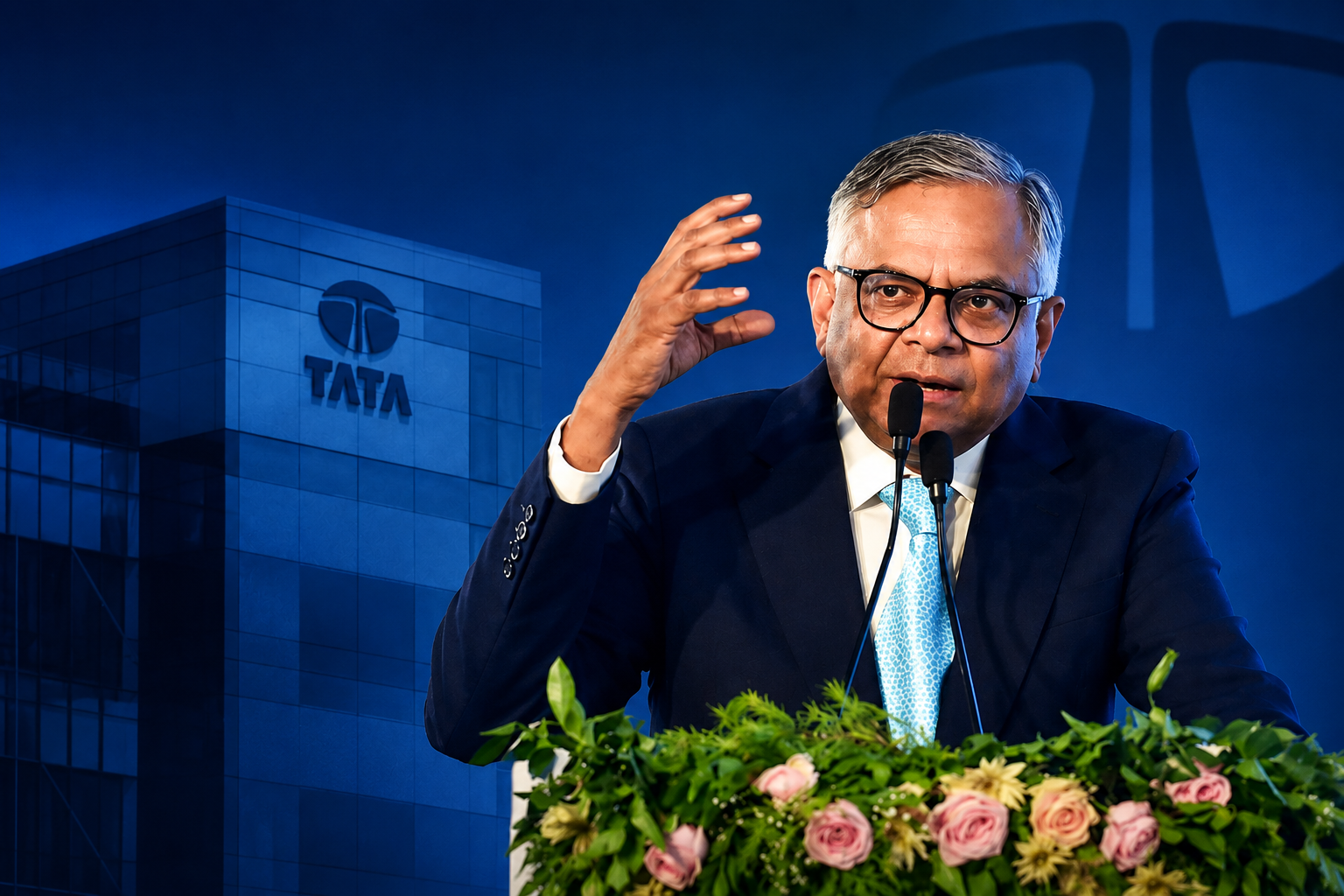

N. Chandrasekaran, chairman of Tata Sons, informed the company’s board on August 12, 2026, that he will not seek another term after his current tenure ends on February 20, 2027. He will continue to lead Tata Sons until then, giving the group time to plan a leadership transition. The decision was communicated to the board as part of the succession process and does not amount to an immediate resignation or forced removal.
The announcement came on August 12, 2026, six days before Tata Sons’ annual general meeting scheduled for August 18. Chandrasekaran said the group needed certainty about who would lead it beyond February 2027 because several strategic projects were at critical stages. His decision follows months of disagreement over a proposed five-year extension and wider tensions between Tata Sons and Tata Trusts, which owns about 66% of the holding company.
Why N Chandrasekaran steps down as Tata Sons chairman
The sequence began with support for another term. Chandrasekaran said Sir Dorabji Tata Trust and Sir Ratan Tata Trust had unanimously recommended extending his tenure by five years. The proposal was also recorded and recommended through Tata Sons’ nomination and remuneration process before being placed before the Tata Sons board on February 24, 2026.
That board process did not produce unanimous backing. Chandrasekaran said one board member did not support the proposal and that, without unanimity, he chose to defer the decision. Six months later, with no resolution reached, he informed the board that he had decided “not to offer myself for reappointment” when his term expires.
Reuters reported in February that Noel Tata, chairman of Tata Trusts, opposed Chandrasekaran’s reappointment during a closed-door Tata Sons board meeting. Reuters said differences included whether Tata Sons should be listed, losses at Air India, the planned exit of a minority shareholder, and board representation. Business Standard separately reported that Noel Tata had raised reservations over the performance of some newer group businesses.
The available record therefore points to a voluntary withdrawal from the next-term process after the proposed extension failed to secure unanimous support. There is no reported board vote removing Chandrasekaran from his current chairmanship, and he is expected to complete the term he already holds. That distinction is important because this is not an immediate forced removal from office.
What Chandrasekaran said about the timing
In his statement, Chandrasekaran said Tata Sons needed leadership clarity for employees, investors, partners, and other stakeholders. He also asked the board to decide on succession soon so that a proper transition could be arranged.
The decision was communicated to the Tata Sons board on August 12. The credible sources reviewed do not identify a separate public venue or press conference where the announcement was made. The decisive action was Chandrasekaran’s written communication to the board, followed by the publication of his statement.
Tata Group stocks fall on leadership uncertainty
The announcement triggered an immediate reaction across listed Tata companies. In Wednesday’s trade, Reuters reported Tata Consultancy Services falling as much as 5.3%, Tata Motors Passenger Vehicles down 3.3%, while Titan and Tata Steel slipped more than 2% each. These were intraday moves, not closing prices.
The market response matters because Tata Sons sits at the centre of one of India’s largest corporate networks. Tata’s FY2025-26 annual report said group companies generated $185 billion in combined revenue, while its 26 publicly listed companies had a combined market capitalisation of $277 billion as of March 31, 2026. Tata Sons is the group’s principal investment holding company.
For investors, the immediate issue is therefore less about an abrupt operational handover and more about uncertainty over who will take charge after February 2027. N Chandrasekaran steps down as Tata Sons chairman only at the end of his existing tenure, giving the board several months to put a succession plan in place.
Chandrasekaran’s rise from TCS to Tata Sons
N. Chandrasekaran’s journey within the Tata Group spans nearly four decades. He joined Tata Consultancy Services in 1987 and steadily rose through the ranks, eventually becoming CEO and managing director in 2009. After leading TCS through a major phase of growth, he was appointed chairman of Tata Sons in 2017, placing him at the helm of the entire Tata Group.
He took charge after one of the most turbulent leadership periods in Tata history, following the 2016 removal of Cyrus Mistry as Tata Sons chairman. Under Chandrasekaran, the group expanded its exposure to aviation, electronics, semiconductors, digital businesses, and battery manufacturing while maintaining major positions in technology services, automobiles, steel, power, consumer products, and hospitality.
Chandrasekaran described leading Tata Sons as “a great honour and a profound responsibility.”
The group’s latest annual report said aggregate Tata Group revenue reached ₹16.24 trillion in FY2025-26, while profit after tax rose to about ₹1.71 trillion. Tata Sons itself reported revenue of ₹423.67 billion and profit after tax of about ₹319.61 billion for the year. The scale of those figures helps explain why leadership continuity at the holding company carries significance well beyond Tata Sons itself.
What happens next at Tata Sons
The next formal milestone is Tata Sons’ August 18 AGM. Business Standard reported that Chandrasekaran’s reappointment as a director following retirement by rotation was due to come before shareholders. His withdrawal from consideration for another term as chairman changes the leadership context around that meeting, but does not itself identify his successor.
No successor has been formally announced in the credible sources reviewed for this report. Chandrasekaran has asked the board to settle the succession soon, but any named candidate or timetable beyond the confirmed February 20, 2027, end of his current tenure would remain speculative until Tata Sons makes an announcement.
The transition also comes as Tata Sons faces an unresolved strategic question over whether the privately held company could ultimately be required to list. Reuters reported on August 6 that the Reserve Bank of India had kept Tata Sons within the upper layer of non-banking financial companies, even as its application to surrender its NBFC registration remained pending. The regulatory position leaves the potential listing question unresolved.
For Business News India readers and investors tracking the conglomerate, the most important fact is therefore precise: N Chandrasekaran steps down as Tata Sons chairman when his current term ends in February 2027, rather than leaving the post immediately. The board now has a defined transition window, but the identity of Tata Sons’ next chairman remains unconfirmed.
Stay connected with Business Herald for the latest business news, insights, and updates.
Follow us on Facebook, Instagram, LinkedIn, and YouTube.
Join our growing community on WhatsApp and Telegram for real-time updates delivered directly to you.