

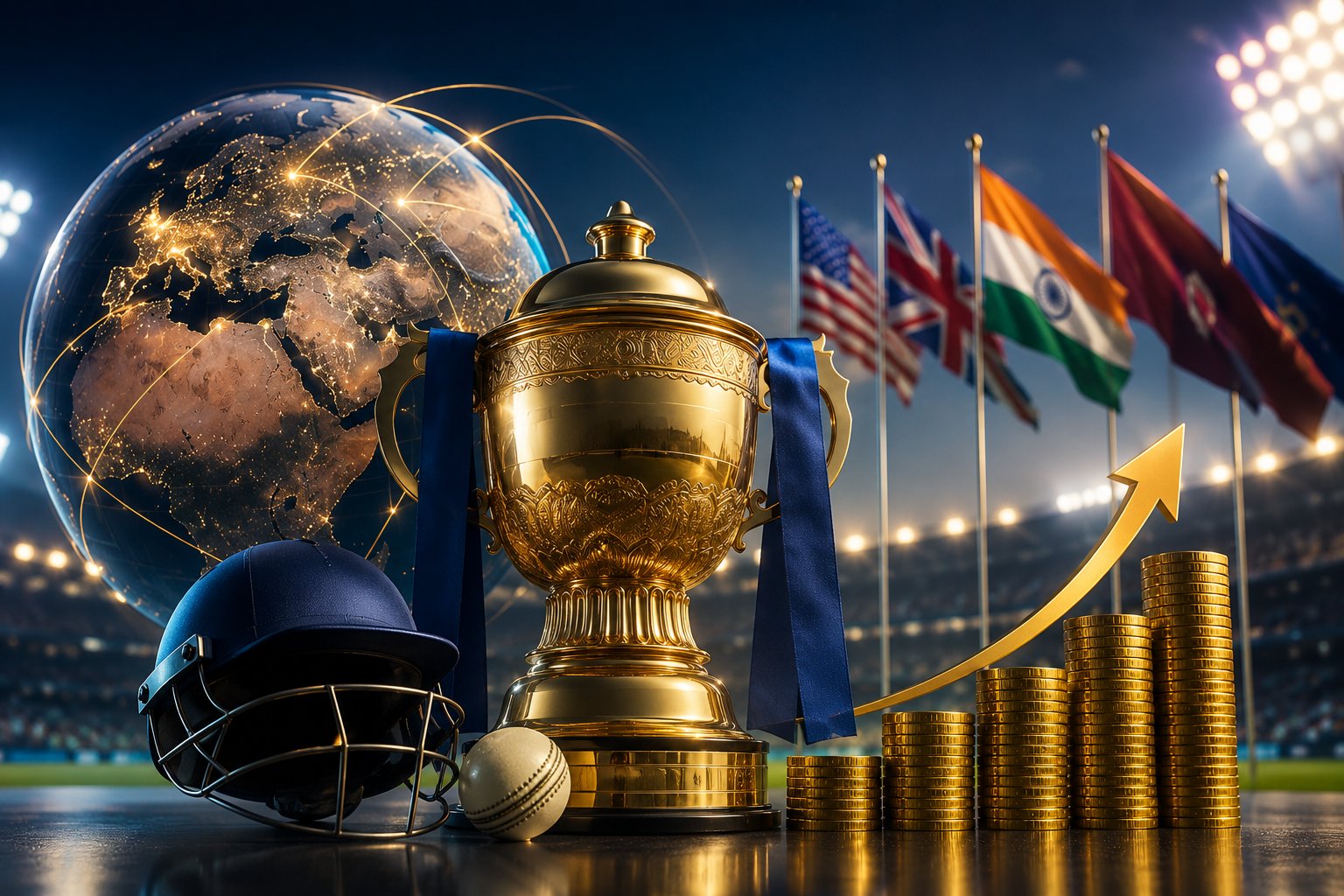

IPL business value has surged 11.4% year on year to $20.6 billion in 2026, strengthening the Indian Premier League’s position as one of the world’s most commercially valuable sports properties.
The IPL business value has climbed 11.4% year on year to $20.6 billion in 2026, reinforcing the Indian Premier League’s position as one of the world’s most commercially powerful sporting competitions.
The latest estimate comes from Houlihan Lokey’s 2026 IPL Brand Valuation Study. The investment bank said the league had delivered double-digit business-value growth for a second consecutive year. Its standalone brand value increased 10.3% to $4.3 billion, adding more than $1.1 billion in value since 2023.
The figures demonstrate how the IPL has developed beyond a seasonal cricket tournament into a broader sports, media, and consumer-business ecosystem.
Record Franchise Deals Reset IPL Valuation Benchmarks
Recent ownership transactions have provided investors with clearer market benchmarks for valuing IPL franchises.
A consortium comprising Blackstone, Bolt Ventures, Aditya Birla Group, and the Times of India Group announced in March an agreement to acquire Royal Challengers Bengaluru for $1.78 billion. The transaction represented a league record.
In May, the Mittal family and Adar Poonawalla announced the purchase of Rajasthan Royals for $1.65 billion. Together, the transactions highlighted the premium investors are prepared to pay for established teams with large audiences, recognised brands, and access to the IPL’s central revenue system.
Royal Challengers Bengaluru also remained the IPL’s most valuable individual franchise brand, with an estimated brand value of $312 million. It became the first IPL team to cross the $300 million brand-value threshold.
These valuations suggest that buyers are no longer assessing teams solely on match results. Fan loyalty, sponsorship potential, digital reach, merchandise opportunities, and access to media-rights income have become central components of franchise value.
What Is Driving IPL Business Value Growth?
The IPL’s investment appeal is partly based on the scarcity of available franchises. The league has only 10 teams, creating limited opportunities for global investors seeking exposure to India’s expanding sports and entertainment market.
Its centralised revenue-sharing structure also provides franchises with a degree of income visibility that is unusual in professional sport.
The Board of Control for Cricket in India pools revenue from media rights and central sponsorship agreements, retains half, and distributes the remaining amount equally among the teams. Each franchise reportedly receives approximately $55 million annually from the central pool, before including local sponsorship, ticketing, and other commercial income.
The current television and streaming rights, held by the merged Reliance-Disney India business until 2027, were acquired for approximately $6.2 billion. On a per-match basis, those rights made the IPL the world’s second-most valuable sports league after the National Football League, according to analysts cited by Reuters.
This combination of scarce franchises, predictable central distributions, and growing audience monetisation has helped turn IPL teams into increasingly attractive long-term assets.
Harsh Talikoti, a director in Houlihan Lokey’s Financial and Valuation Advisory business, described the IPL as a “unique convergence of sport, media, and consumer opportunity.”
From Cricket Tournament to Commercial Ecosystem
The rise in IPL business value reflects strong media-rights revenue, record franchise transactions, growing sponsorship demand, and increasing interest from private equity firms and global investors.
Its commercial model has since expanded across four major areas:
Media rights: Television and streaming platforms pay substantial premiums for live matches that can attract mass audiences.
Sponsorships: League-level and team-level partnerships allow brands to reach consumers across television, digital platforms, stadiums, and social media.
Franchise appreciation: Limited team supply and growing revenues have increased the value of ownership stakes.
Consumer monetisation: Merchandise, ticket sales, licensing, digital content, and international brand extensions provide additional opportunities beyond central distribution.
The league attracted a record 1.19 billion viewers across television and digital platforms in 2025, according to figures reported by Reuters. That scale has made the IPL particularly important for consumer brands seeking nationwide visibility in India.
Several franchise owners have also expanded their cricket brands into leagues in South Africa, the United Arab Emirates, the Caribbean, England, and the United States. This strategy allows owners to develop year-round sporting businesses rather than relying entirely on the Indian tournament.
What The Valuation Means for Brands and Advertisers
For marketers, the latest IPL business valuation reflects the commercial strength of live sport in an increasingly fragmented media environment.
Unlike conventional entertainment programming, major sporting events generate real-time viewing, social-media discussion, and repeat fan engagement. This gives advertisers opportunities to combine television exposure with creator partnerships, digital campaigns, merchandise collaborations, and experiential marketing.
Strong franchise identities also allow companies to build long-term partnerships around individual teams rather than limiting their participation to league-wide advertising.
However, rising valuations may also make sponsorship rights and franchise partnerships more expensive. Brands will therefore face greater pressure to measure campaign performance through engagement, customer acquisition, sales impact, and long-term brand recall.
Risks Remain Despite Rising Valuations
The IPL’s outlook is strong, but its current valuation is not without risk.
The next media-rights auction will be a critical test. Reduced competition among broadcasters following consolidation in India’s media industry could affect future bidding intensity.
The IPL also faces competition from a growing number of short-format cricket leagues worldwide. A crowded international calendar could create scheduling pressures for leading players and reduce the exclusivity of franchise cricket.
Investors must also account for regulatory developments, sponsorship-market conditions, team performance and changes in consumer viewing behaviour.
The Business Herald View
The IPL’s rise to a $20.6 billion business valuation represents more than the financial success of a cricket competition. It demonstrates how Indian intellectual property, media distribution, and consumer loyalty can combine to create an investment-grade global asset.
For investors following Business News India, the record franchise transactions are particularly significant. They show that private equity firms, family offices, and strategic corporate groups increasingly view Indian sport as a scalable commercial sector rather than a prestige-driven investment.
The league’s next phase will depend on its ability to expand global audiences, strengthen digital monetisation and preserve competition for media rights. If those conditions remain favourable, IPL franchise valuations could continue rising even faster than the underlying sports market.
Stay connected with Business Herald for the latest business news, insights, and updates.
Follow us on Facebook, Instagram, LinkedIn, and YouTube.
Join our growing community on WhatsApp and Telegram for real-time updates delivered directly to you.