

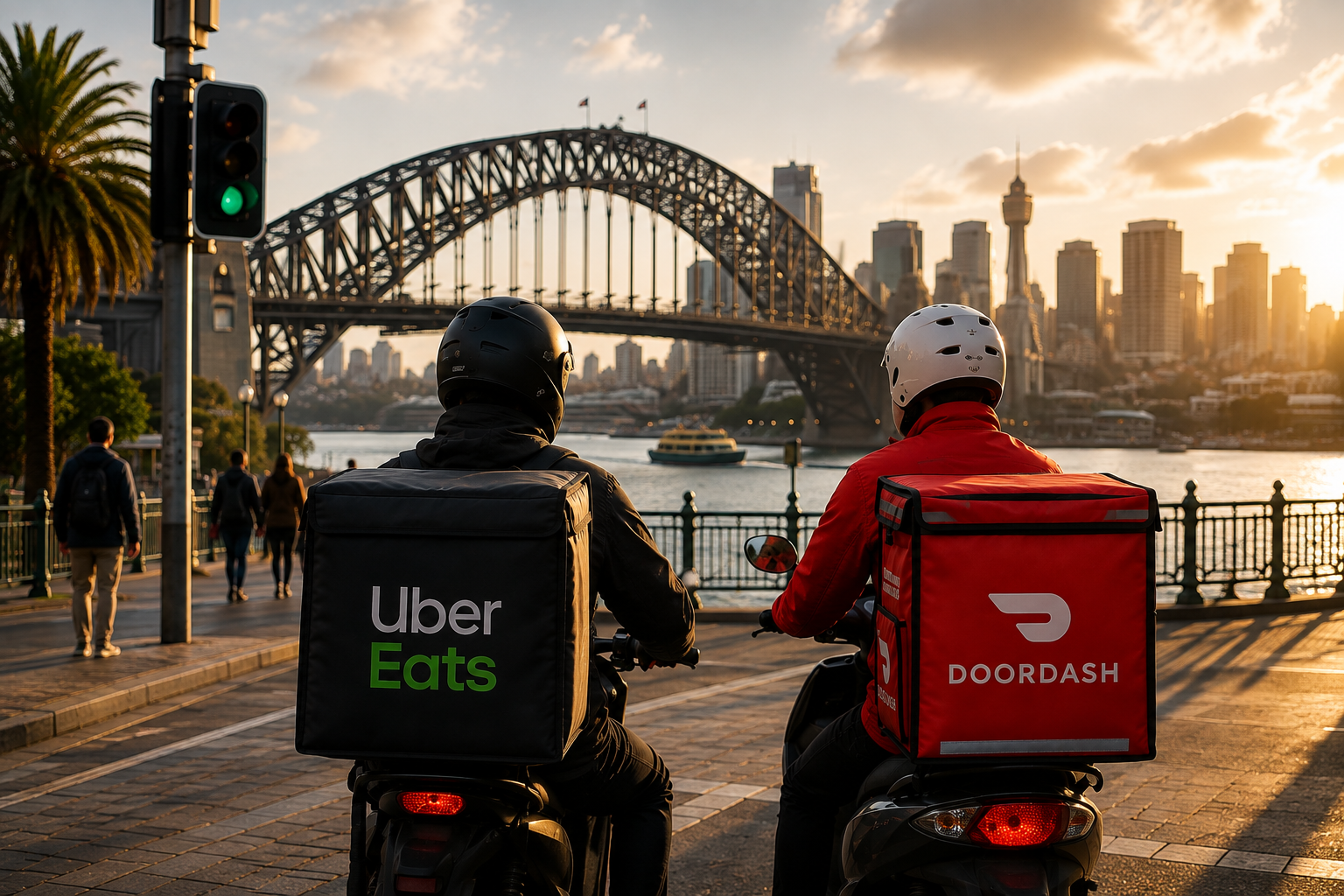

From 17 August 2026, new Australian gig worker rules will establish minimum earnings and insurance standards for certain on-demand food and grocery delivery workers. The Fair Work Commission, or FWC, estimates the framework through its coverage rules, while Reuters reports that about 250,000 workers are expected to benefit.
The headline number is a minimum hourly safety-net rate beginning at A$31.30. But focusing only on that figure misses what makes the order strategically important.
The real test is whether Australia can strengthen income and accident protections without dismantling the flexibility that platforms and many workers consider central to gig work.
Australia has not simply imposed a conventional employee minimum wage on delivery platforms. Instead, it has created a regulatory framework for workers who remain contractors but qualify as “employee-like workers” under Australian law. That makes the decision relevant to platform founders, CFOs, investors and policymakers far beyond the food-delivery industry.
What Changed Under Australia’s Gig Worker Rules?
On 11 August, an expert panel of the Fair Work Commission made the Interim On-Demand Delivery Employee-like Worker Minimum Standards Order. It takes effect on 17 August 2026.
The order primarily covers employee-like workers using digital platforms to deliver food, beverages and supermarket groceries on demand. Vehicles with, a carrying capacity above one tonne are excluded.
The safety-net hourly rates from 17 August through 31 December 2026 are:
- A$31.30 for workers using no vehicle or a pedal-powered bicycle
- A$31.30 for an electric bicycle or scooter
- A$31.50 for combustion motorcycles or scooters
- A$32.00 for other eligible motor vehicles with carrying capacity up to one tonne
From 1 January 2027, those rates rise by A$0.50 to A$31.80, A$31.80, A$32.00 and A$32.50 respectively. From 2028, the rates are scheduled for annual adjustment linked to the preceding Fair Work Commission Annual Wage Review, unless the Commission orders another adjustment.
For context, Australia’s National Minimum Wage has been A$26.44 an hour since 1 July 2026. But the comparison should be handled carefully. Gig workers covered by the new order remain contractors, and the order continues to make them responsible for several costs that an employee may not personally bear.
That distinction matters when analysing the economics.
The Most Important Change Is “Engaged Time”
The business significance of the order sits in two words: engaged time.
The earnings floor is calculated using the period that generally begins when a worker accepts an engagement and ends when that engagement is completed. If a worker is already completing another engagement when accepting a new one, the relevant timing starts after the earlier engagement finishes.
This is not the same as paying a worker for every hour that an app is switched on.
The order excludes certain periods, including breaks, time lost for reasons outside the platform operator’s control, and defined instances of unreasonable delay or other “non-engaged time.” Workers also retain the right to decide whether and when to accept engagements, with time away from the platform remaining unpaid.
That nuance is crucial. A simplistic reading would describe the change as an A$31.30 hourly wage. Legally and economically, it is more precise to describe it as an earnings floor applied to engaged delivery time.
Platforms can use earnings periods of up to 21 days. If total payments during an earnings period fall below the applicable floor, the platform must make a top-up payment.
For a CFO or marketplace operator, this shifts the issue from headline wage rates to delivery-level unit economics.
Platforms now have to ask whether their existing mix of base payments, incentives, and order allocation consistently clears the regulated earnings floor across engaged hours. Where it does not, the top-up mechanism creates an additional cost.
The order does not tell us how large that cost will be for Uber Eats, DoorDash, or any other platform. That would depend on actual worker earnings, engagement duration, vehicle mix, geography, and platform operating practices. Any claim about the eventual margin impact before those data are available would be speculation.
Why This Is Not Simply Employee Reclassification
Australia’s approach is notable because the government did not need to turn every covered contractor into an employee to establish minimum conditions.
Changes that took effect in August 2024 created a category of employee-like workers. These are independent contractors performing digital platform work who meet statutory criteria, including characteristics such as relatively low bargaining power, limited authority over how work is performed, or remuneration comparable to, or below, that of employees doing similar work.
The framework gave the Fair Work Commission power to establish tailored minimum standards while taking account of issues including worker preferences, multiple-platform working, and business viability.
That hybrid structure is what makes the gig worker rules especially interesting internationally.
The regulatory debate has often been framed as a binary choice: either gig workers are contractors with considerable flexibility, or employees with conventional workplace protections.
Australia is testing a third route.
Workers can remain independent contractors while specific minimum protections are imposed on the commercial relationship.
For platform businesses, that distinction could prove highly consequential. It potentially preserves important features of marketplace labour models while reducing the regulatory space in which basic compensation and protection are left entirely to platform design.
Whether that balance proves sustainable is now the more important question.
Insurance May Matter as Much as the Pay Floor
The order also changes the risk allocation around workplace injury.
Digital labour platform operators must, at their own expense, maintain personal accident insurance providing a “reasonable minimum level of cover” that reflects the worker’s activities on the platform. The order does not prescribe a specific dollar amount of coverage.
There is another important limitation.
The mandated personal accident insurance does not have to provide coverage equivalent to Australian workers’ compensation schemes.
Workers also retain significant responsibilities. They must maintain compulsory third-party insurance for vehicles used to perform deliveries and inform their insurer about that commercial use. The order separately places vehicle acquisition, registration where required, fuel, maintenance, repairs and other running costs on the worker.
That makes the financial structure clearer.
Australia has strengthened the safety net without transferring every operating cost or employment-style benefit to platforms.
For investors and finance teams assessing platform economics, the distinction matters because gross hourly earnings are not the same as net worker income after vehicle and operating expenses.
The Order Goes Beyond Pay and Insurance
The Fair Work Commission framework is broader than the headlines suggest.
The order also establishes requirements covering records, dispute resolution, worker information, consultation and platform feedback. Platforms must retain prescribed records for seven years, including gross and net amounts paid and aggregate engaged hours during each earnings period. Workers can request access to relevant records.
Platforms must also provide information with engagement requests, including the collection location, approximate delivery location, estimated minimum delivery fee, and estimated time required.
Each platform covered by the order must establish a feedback forum involving platform representatives, worker delegates and the union. The forum is designed for discussion and feedback rather than binding operational decision-making.
These provisions matter commercially because modern delivery platforms are not simply logistics businesses. They are algorithmically coordinated labour marketplaces.
Once regulators begin specifying what data must be disclosed, how compensation must be calculated, and how disputes can be escalated, compliance moves deeper into the software and marketplace architecture itself.
That can affect product design, payment systems, workforce operations and governance, not merely the HR department.
Why Uber Eats and DoorDash Supported the Framework
Perhaps the most unusual element of the Australian story is that the standards did not emerge solely from an adversarial regulatory fight.
The Transport Workers’ Union, Uber Eats and DoorDash made a joint submission proposing minimum standards in November 2025. The proposal included minimum safety-net pay, accident insurance, dispute processes, worker representation, and feedback mechanisms.
Uber Eats Australia and New Zealand managing director Ed Kitchen argued at the time that “fair standards and flexibility should not be mutually exclusive.” DoorDash APAC Vice President similarly presented the proposal as a way to raise standards while retaining flexibility.
That alignment should not be overstated. Unions, workers, and platforms do not have identical economic interests.
But strategically, participation gives large platforms an opportunity to shape a predictable regulatory framework instead of waiting for fragmented rules to develop around them.
The Fair Work Commission itself noted that Uber, DoorDash, the TWU, and individual employee-like workers supported making the order substantially in the proposed form.
For founders operating in regulated marketplaces, there is a broader lesson here.
When regulation becomes inevitable, the commercial question often changes from whether rules will exist to whether an industry can help design rules that are operationally workable.
What the Rules Could Mean for Platform Economics
The immediate investor question is whether higher minimum compensation will damage delivery-platform margins.
There is not yet enough evidence to answer that responsibly.
What can be said is that the framework creates several variables that management teams will have to optimise around:
- Engaged time per order
Longer pickup waits, inefficient routing, or low order density could increase the amount of time against which the earnings floor is assessed. - Marketplace density
Platforms that can match workers and orders efficiently may be better positioned to spread compensation across more completed deliveries. - Vehicle mix
Different vehicle classes carry slightly different minimum safety-net rates. - Insurance and compliance costs
Platforms now have explicit insurance, record-keeping, and worker-engagement obligations. - Pricing and incentives
Companies may reassess delivery fees, incentives or merchant economics if labor-related costs rise, although the order itself does not prescribe how platforms should respond.
The correct analytical approach is therefore not to assume immediate price increases or margin compression.
Instead, investors should watch what happens to cost per delivery, worker supply, order completion times, consumer pricing, merchant fees and contribution margins after implementation.
Those metrics will tell us whether the Australian model changes the economics of the marketplace or primarily formalises a floor beneath compensation structures that major platforms can already absorb.
Australia Could Become a Global Gig Work Test Case
The timing is significant.
In June 2026, the International Labour Conference adopted ILO Convention No. 193 on decent work in the platform economy, the first international labour convention dedicated specifically to platform work. It addresses areas including remuneration, occupational safety, worker status and algorithmic management.
Ratification and implementation remain matters for individual governments. The ILO itself does not automatically impose the convention’s requirements on every member country.
That means national experiments now matter.
Australia offers a particularly interesting one because it is attempting to regulate platform work without eliminating independent-contractor status as the organising principle of the model.
If the framework delivers stronger protections while maintaining labour supply, service reliability, and commercially viable platforms, policymakers elsewhere will have a concrete model to study.
If it creates significant unintended consequences, those will be equally instructive.
Either outcome makes Australia more than a local labour-policy story.
The Framework Is Still Interim
The word “Interim” in the order’s title deserves attention.
The Fair Work Commission deliberately adopted an interim framework while related minimum-standard proceedings for last-mile delivery remain underway. The order provides for a review if the Commission publishes a notice of intent and draft order in either of those related cases.
That means investors, platforms and workers should not treat the August rules as the final endpoint of Australia’s gig-economy reforms. This is the beginning of live regulatory implementation.
The next evidence will come from how the system operates in practice: how frequently top-up payments are required, how platforms interpret engaged time, how insurance standards evolve, how workers respond and whether delivery marketplace economics materially change.
Those outcomes will matter more than political labels attached to the policy.
What Business Leaders Should Watch Next
For executives and investors exposed to platform businesses, five questions deserve attention:
- Do worker earnings rise materially after implementation?
- How frequently do platforms need to make safety-net top-ups?
- Does delivery efficiency improve as platforms optimise around engaged time?
- Do insurance and compliance obligations materially affect operating costs?
- Does Australia influence regulation in other platform-heavy economies?
The deeper issue is no longer whether governments will pay attention to gig work. The ILO decision and Australia’s regulatory framework show that the policy conversation has already moved forward.
The commercial debate is now about what form regulation takes.
Australia’s experiment asks whether a platform economy can preserve genuine flexibility while accepting a more enforceable floor underneath pay, insurance, and procedural protections.
That is a question with implications well beyond Uber Eats and DoorDash.
Stay connected with Business Herald for the latest business news, insights, and updates.
Follow us on Facebook, Instagram, LinkedIn, and YouTube.
Join our growing community on WhatsApp and Telegram for real-time updates delivered directly to you.