
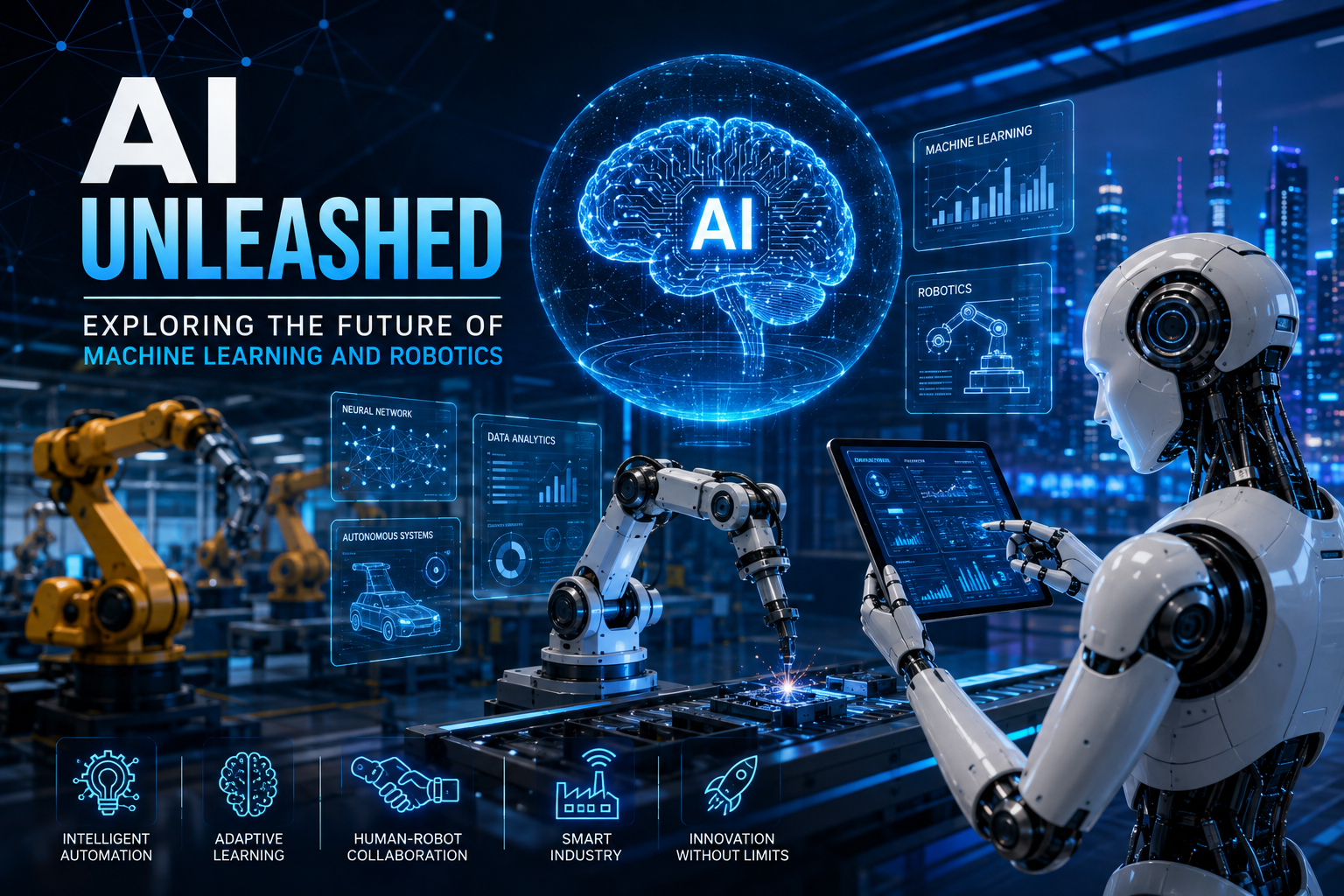

Artificial intelligence is moving beyond the screen.
The first wave of modern AI helped machines recognise images, translate languages and predict consumer behaviour. Generative AI then made it possible for software to create text, images, video and computer code. The next stage could be even more consequential: intelligent systems capable of planning tasks, making decisions and acting through robots in the physical world.
The future of machine learning and robotics will therefore be defined by more than powerful algorithms. It will depend on whether those algorithms can operate reliably inside factories, hospitals, warehouses, farms, vehicles and homes.
This convergence is already attracting significant capital. Stanford University’s 2026 AI Index found that global corporate AI investment more than doubled in 2025. Private investment rose 127.5%, while generative AI captured nearly half of all private AI funding. Organisational AI adoption also increased to 88%, although the deployment of autonomous AI agents remained in the single digits across most business functions.
For investors, companies and policymakers, the central question is no longer whether AI will influence the economy. It is where AI will generate sustainable value, how quickly robotics will commercialise that intelligence and which businesses will successfully move from experimentation to scale.
Table of Contents
- What Is Machine Learning?
- How AI and Robotics Are Converging
- The Technologies Shaping the Next AI Era
- From Generative AI to Autonomous Agents
- The Rise of Physical AI
- Robotics Moves Beyond Traditional Factories
- How AI Will Transform Major Industries
- India’s AI and Robotics Opportunity
- The Investment Case for AI and Robotics
- Jobs, Skills and the Future Workforce
- Safety, Regulation and Responsible AI
- What Could Slow the AI Revolution?
- Frequently Asked Questions
What Is Machine Learning?
Machine learning is a branch of artificial intelligence that allows computer systems to identify patterns and improve their performance using data rather than relying exclusively on manually written rules.
A conventional software program follows predetermined instructions. A machine-learning system instead examines examples, detects relationships, and uses those relationships to make predictions or decisions.
Machine learning is already used to:
- detect fraudulent transactions;
- recommend products and entertainment;
- forecast equipment failures;
- analyse medical images;
- recognise speech and objects;
- optimise logistics routes;
- assess credit and insurance risks; and
- control automated machines.
Deep learning, a specialised area of machine learning, uses layered neural networks to process complex data such as images, language, audio and video.
Generative AI extends these capabilities by producing new outputs, while agentic AI attempts to combine perception, reasoning, planning and action.
How AI and Robotics Are Converging
Artificial intelligence and robotics are closely related, but they are not the same.
AI provides intelligence. It enables a system to interpret information, detect patterns, reason about situations and select an action.
Robotics provides embodiment. It allows an intelligent system to move, manipulate objects and interact with the physical environment through sensors, motors, cameras and mechanical components.
Traditional industrial robots were highly effective at repetitive tasks, but they generally operated within carefully controlled environments. Their actions were preprogrammed, and unexpected changes could interrupt production.
Machine learning is making robots more adaptable.
An AI-enabled robot can use cameras and sensors to identify objects, estimate distances, detect defects and adjust its movements. Over time, it may learn from demonstrations, simulations or operational data.
The International Federation of Robotics identifies AI and autonomy as a central robotics trend for 2026. It says analytical AI can support predictive maintenance and route planning, while generative and agentic AI can help robots learn tasks, create simulation data and respond to natural-language or visual instructions.
This transition could transform robots from specialised machines into flexible operational platforms.
The Technologies Shaping the Future of Machine Learning and Robotics
Several technologies are advancing simultaneously, creating the foundation for a more autonomous economy.
1. Multimodal Artificial Intelligence
Multimodal AI systems can process several types of information at once, including language, images, video, audio and sensor data.
For robots, this is essential. A useful machine must often understand spoken instructions, identify the correct object, estimate its position and determine how to handle it safely.
A warehouse robot, for example, may need to interpret a request, locate a package, navigate around workers and place the item in the correct area.
Multimodal learning brings these separate capabilities into a more unified system.
2. Edge AI
Many AI systems rely on cloud data centres. However, robots and autonomous machines often need to make decisions immediately.
Edge AI allows computation to occur on the device or close to where data is generated. This can reduce latency, limit dependence on internet connectivity and improve privacy by keeping sensitive information closer to its source.
Edge processing will be especially important for autonomous vehicles, factory robots, drones, medical devices and security systems.
3. Synthetic Data and Simulation
Training robots in the real world can be expensive, slow and dangerous. Simulation provides an alternative.
A virtual environment can generate millions of scenarios involving different lighting conditions, objects, surfaces and unexpected events. The robot can learn from these simulations before operating around people or valuable equipment.
Synthetic data can also help companies train systems where real-world data is limited, sensitive or difficult to label.
However, simulated performance does not automatically guarantee real-world reliability. Developers must address the gap between controlled digital environments and unpredictable physical conditions.
4. Reinforcement Learning
Reinforcement learning allows a system to learn through interaction.
The machine attempts an action, receives feedback and gradually improves its strategy. This approach can be useful for robotic movement, navigation, resource allocation and complex decision-making.
The challenge is ensuring that the reward system encourages safe and desirable behaviour rather than shortcuts that technically satisfy the objective but create unintended consequences.
5. Digital Twins
A digital twin is a virtual representation of a physical asset, process or environment.
Manufacturers can use digital twins to simulate production lines, test robot placements and predict equipment failures before changing the real factory. Logistics companies can model warehouses and supply networks, while infrastructure operators can simulate maintenance requirements.
The combination of digital twins, machine learning and robotics could reduce deployment risks and shorten the time required to automate complex operations.
From Generative AI to Autonomous Agents
Generative AI responds to prompts by producing an output. AI agents are designed to pursue a goal through a sequence of actions.
An agent may interpret an objective, divide it into smaller tasks, use software tools, retrieve information, monitor results and adjust its approach with limited human intervention.
In a business environment, AI agents could eventually:
- manage routine procurement;
- monitor inventory;
- resolve customer requests;
- schedule maintenance;
- test software;
- prepare financial reports;
- coordinate logistics; and
- supervise fleets of machines.
However, agentic AI remains at an early commercial stage. Stanford’s 2026 AI Index found that although generative AI was used in at least one business function by 70% of surveyed organisations, agent deployment remained in the single digits across nearly all functions.
That gap is important for investors.
The AI market has moved quickly from excitement around conversational interfaces to expectations of autonomous execution. Yet the ability to complete long, complex tasks reliably remains more difficult than generating a convincing response.
Businesses will need strong data systems, permission controls, evaluation procedures and human oversight before delegating critical operations to agents.
The Rise of Physical AI
Physical AI refers to intelligent systems that understand and act within the physical world.
It combines machine learning with robotics, spatial awareness, computer vision, simulation and control systems. The goal is to create machines that understand how objects move, how forces interact and how actions affect their surroundings.
This is more difficult than operating in a purely digital environment.
A software assistant may recover from a poorly written answer. A robot making an incorrect movement could damage equipment, contaminate a production line or injure a person.
Physical AI must therefore achieve higher standards of safety, predictability and real-time performance.
The International Federation of Robotics says robots are gaining versatility as information technology and operational technology converge. Real-time data exchange between software systems and physical machinery is becoming a foundational element of Industry 4.0.
The companies that solve this integration challenge may build some of the most valuable platforms of the next technology cycle.
Robotics Moves Beyond Traditional Factories
Industrial robotics is already a major global market.
Approximately 542,000 industrial robots were installed worldwide in 2024. The global operational stock reached 4.664 million robots, representing a 9% year-on-year increase. Asia accounted for 74% of new installations, while China alone represented 54% of global deployments.
Takayuki Ito, then president of the International Federation of Robotics, said the shift towards the digital and automated age had produced “a huge surge in demand.”
The next phase will extend far beyond fixed robotic arms.
Collaborative Robots
Collaborative robots, or cobots, are designed to work near people. They can support assembly, packaging, inspection and material handling without always requiring the fully isolated environments used by conventional industrial robots.
Cobots can make automation more accessible to small and medium-sized manufacturers because they are often easier to reprogramme and redeploy.
Autonomous Mobile Robots
Autonomous mobile robots can navigate warehouses, factories, hospitals and commercial buildings.
Unlike machines following fixed tracks, these robots use sensors and mapping systems to select routes, avoid obstacles and respond to changing environments.
Humanoid Robots
Humanoid robots are attracting attention because many workplaces are already designed for the human body.
A machine with human-like proportions could theoretically use stairs, tools, shelves and workstations without requiring companies to rebuild their infrastructure.
Commercial success, however, will depend on more than impressive demonstrations. The IFR says humanoid robots must prove their reliability, efficiency, cycle times, energy consumption, maintenance economics and safety under real industrial conditions.
Service and Medical Robots
Robots are increasingly being developed for surgery, rehabilitation, hospital logistics, inspection, cleaning, agriculture and assisted living.
Their adoption will depend heavily on regulation, cost, liability and public trust. In healthcare and other sensitive settings, a technically capable system must also meet strict standards for privacy, accuracy and safety.
How AI Will Transform Major Industries
Manufacturing
Manufacturing is likely to remain the largest proving ground for intelligent robotics.
AI can help factories inspect products, predict maintenance requirements, optimise energy use and adapt production to changes in demand. Robots can take over repetitive, hazardous or precision-intensive tasks.
The major shift will be from isolated machines to connected production systems in which robots, software and workers share real-time operational data.
Logistics and Retail
AI-powered robots can move inventory, sort packages and monitor warehouse conditions. Machine learning can forecast demand and coordinate fulfilment networks.
Retailers may increasingly automate stock counting, shelf monitoring and distribution while maintaining human roles in service, merchandising and complex decision-making.
Healthcare
Machine learning can support medical imaging, clinical documentation, drug research and patient monitoring. Robotics can assist surgery, rehabilitation and hospital logistics.
These systems are more likely to augment medical professionals than replace them entirely. Clinical responsibility, patient communication and ethical judgement require accountable human oversight.
Agriculture
Autonomous machines can monitor crops, identify weeds, optimise irrigation and apply chemicals more precisely.
For countries facing farm-labour shortages, water constraints and pressure to increase productivity, agricultural robotics could become an important investment area.
Financial Services
Machine learning is already widely used in fraud detection, trading, risk assessment and customer service.
The next phase may involve AI agents coordinating workflows across compliance, research, operations and reporting. Financial institutions will need strict controls because inaccurate autonomous decisions can create regulatory and systemic risks.
Energy and Infrastructure
AI can forecast power demand, optimise renewable-energy systems and detect equipment failures. Robots can inspect pipelines, power plants, mines and infrastructure in hazardous environments.
The combination of autonomous inspection and predictive maintenance may reduce downtime while improving worker safety.
India’s AI and Robotics Opportunity
India has the talent, software ecosystem, manufacturing ambitions and domestic market required to become a major participant in the future of machine learning and robotics.
Under the IndiaAI Mission, 38,231 GPUs had been onboarded from 14 empanelled service providers by 2026. The government said eligible startups and academic users could access the infrastructure at subsidised rates averaging approximately ₹65 per GPU hour, excluding certain high-end processors.
The mission is also supporting sovereign foundation-model development, India-specific AI applications and responsible-AI research. Government-backed programmes include 30 applications focused on areas such as agriculture, healthcare, climate change and natural disasters, alongside projects addressing bias, privacy, governance testing and machine unlearning.
Robotics adoption is also increasing.
India installed a record 9,100 industrial robots in 2024, up 7% from the previous year, making it the world’s sixth-largest market for annual robot installations. The automotive sector accounted for 45% of the country’s deployments.
This growth creates opportunities across:
- automotive and electronics manufacturing;
- warehouse and supply-chain automation;
- agricultural technology;
- healthcare robotics;
- defence and aerospace systems;
- industrial computer vision;
- autonomous mobility;
- AI infrastructure;
- regional-language AI; and
- robotics maintenance and integration.
India’s long-term opportunity may not depend on building the world’s largest frontier model. It may come from developing affordable AI systems and robots adapted to local languages, operating conditions, business economics and public-service requirements.
For readers following Business News India, this is an important distinction. The most commercially valuable Indian AI companies may be those that solve operational problems rather than simply replicate global consumer applications.
The Investment Case for AI and Robotics
The investment opportunity spans several layers of the technology stack.
AI Infrastructure
Training and operating AI systems requires semiconductors, data centres, networking equipment, power infrastructure and cooling systems.
These capital-intensive requirements have created opportunities for hardware manufacturers, cloud platforms, data-centre operators and energy providers.
They have also created risk. Infrastructure spending can rise faster than customer revenue, particularly if model efficiency improves or competitors reduce prices.
Foundation Models and Platforms
Large models can become platforms for software development, enterprise applications and autonomous agents.
However, model development is expensive, and performance advantages may narrow quickly. Investors must evaluate distribution, proprietary data, customer retention and unit economics rather than relying solely on benchmark leadership.
Enterprise Applications
Industry-specific AI applications may offer clearer revenue opportunities because they address measurable costs or productivity constraints.
Strong applications are likely to integrate with existing workflows, use domain-specific data and deliver outcomes that customers can verify.
Robotics Hardware
Robotics involves longer development cycles than software. Hardware businesses must manage manufacturing, supply chains, maintenance and deployment.
The advantage is that successful systems can become deeply embedded in customer operations, creating substantial switching costs.
Systems Integration
Many companies will require help connecting AI models, sensors, robots and legacy enterprise systems.
Systems integrators may capture significant value because real-world automation involves process redesign, employee training, safety assessment and ongoing technical support.
The most attractive businesses may therefore sit at the intersection of technology and implementation.
Productivity Will Matter More Than Demonstrations
The AI sector has produced remarkable technical demonstrations, but investors are increasingly asking whether those capabilities translate into durable economic returns.
Stanford’s AI Index reported that measured productivity gains were strongest in structured work where output could be monitored clearly. Studies cited in the report found gains of 14% to 15% in customer support, 26% in software development and 50% in marketing output, while more complex reasoning tasks produced less consistent results.
This suggests that successful AI deployment will require businesses to identify specific workflows rather than pursue automation as a vague strategic objective.
Companies should ask:
- Which process is being improved?
- How will the result be measured?
- What is the cost of errors?
- When must a human intervene?
- Does the system create a proprietary advantage?
- Can the deployment scale without excessive infrastructure costs?
AI will create value when it improves measurable outcomes, not merely when it appears technologically advanced.
Jobs, Skills and the Future Workforce
AI and robotics will automate some tasks, redesign others and create entirely new occupations.
The impact will differ by industry. Repetitive and rules-based work is more exposed, while roles involving complex judgement, accountability, relationships and physical adaptability may prove more resilient.
Stanford’s 2026 AI Index found that one-third of surveyed organisations expected AI to reduce their workforce during the following year. However, broad economy-wide job losses had not yet appeared, and almost half expected little or no workforce change.
The more immediate shift may involve job redesign.
Factory technicians may supervise connected robotic systems. Accountants may review AI-generated analysis. Doctors may use automated documentation and diagnostic support. Software developers may spend more time testing, integrating and supervising AI-generated code.
New demand could emerge for:
- robotics engineers;
- AI safety specialists;
- data curators;
- machine-learning operations professionals;
- automation consultants;
- cybersecurity experts;
- robot technicians;
- AI auditors; and
- human-machine interaction designers.
The workforce challenge is therefore not limited to protecting existing roles. Governments and companies must create credible pathways for workers to acquire skills that complement intelligent systems.
Safety, Regulation and Responsible AI
As AI systems gain autonomy, governance becomes a commercial requirement rather than a public-relations exercise.
Businesses must address bias, cybersecurity, privacy, explainability, intellectual property, accountability and physical safety.
These concerns become more serious when AI controls a machine. A flawed recommendation may be corrected before action. A robotic error can create immediate physical consequences.
The IFR warns that cloud-connected and AI-driven robotics introduces cybersecurity risks involving robot controllers, operational platforms and sensitive video, audio and sensor data. It also calls for robust testing, certification, human oversight and clearly defined liability.
Regulation is also becoming operational.
Transparency obligations under the European Union’s AI Act began applying on August 2, 2026. The rules require certain AI systems to inform users when they are interacting with AI and require machine-readable marking of qualifying AI-generated or manipulated content.
Companies selling AI products internationally will increasingly need compliance systems capable of adapting to different national rules.
Trust could become a competitive advantage. Enterprises may favour providers that offer clearer documentation, security controls, auditability and predictable performance, even when cheaper alternatives are available.
What Could Slow the AI Revolution?
The direction of AI development appears clear, but the pace is uncertain.
Several constraints could delay adoption.
High Infrastructure Costs
Advanced AI requires substantial computing capacity, energy and specialised chips. Rising infrastructure costs can weaken margins and limit access for smaller companies.
Poor Data Quality
AI systems depend on relevant, accurate and well-governed data. Many enterprises still operate fragmented databases and outdated software systems.
Reliability Problems
A system that works correctly most of the time may still be unsuitable for finance, healthcare, transport or industrial safety.
Cybersecurity Threats
More connected machines create more potential attack surfaces. A compromised robot or autonomous agent could affect physical operations as well as information systems.
Regulation and Liability
Uncertainty over responsibility for AI-driven decisions may slow deployment in high-risk sectors.
Workforce Resistance
Automation projects can fail when employees are excluded from implementation or fear that the technology is designed solely to remove jobs.
Weak Economics
A technically impressive system may still be commercially unviable if installation, maintenance, energy and supervision costs exceed the value it creates.
What the Future of Machine Learning and Robotics Could Look Like
The next decade is likely to produce a more distributed form of intelligence.
AI will operate across cloud platforms, personal devices, vehicles, factories and robots. Some systems will remain specialised, while others will coordinate multiple tools and machines.
The most realistic future is not one in which robots suddenly replace all human activity. It is one in which automation expands gradually across specific tasks.
Factories will become more adaptive. Warehouses will rely on mobile robotic fleets. Medical professionals will work alongside intelligent diagnostic and surgical tools. Farmers will use autonomous equipment to manage crops more precisely. Knowledge workers will supervise agents that complete routine digital processes.
The winners will not necessarily be the companies with the largest models or the most human-looking robots.
They will be the businesses that combine reliable technology with industry knowledge, distribution, safety and clear customer economics.
AI Unleashed: The Next Industrial Transformation
The future of machine learning and robotics represents the convergence of digital intelligence and physical capability.
Machine learning allows systems to interpret patterns. Generative AI allows them to create. Agentic AI allows them to plan. Robotics allows them to act.
Together, these technologies could transform manufacturing, logistics, healthcare, finance, agriculture and public infrastructure.
But technological possibility is not the same as commercial success.
Companies must move beyond demonstrations and focus on dependable outcomes. Investors must distinguish temporary excitement from durable competitive advantage. Policymakers must encourage innovation while establishing credible standards for safety and accountability.
AI is being unleashed, but its future will not be determined by algorithms alone. It will be shaped by the organisations, workers, investors and societies that decide how those algorithms are deployed.
The next chapter of automation will be written not only in code, but in factories, hospitals, farms, offices and cities around the world.
Frequently Asked Questions
What is the future of machine learning and robotics?
The future will involve more autonomous, adaptable and connected systems. Machine learning will help robots interpret their environments, learn tasks and make decisions, while robotics will allow AI to perform physical work.
How is machine learning used in robotics?
Machine learning is used for computer vision, object recognition, navigation, predictive maintenance, motion planning, quality inspection and human-robot interaction.
What is physical AI?
Physical AI refers to artificial intelligence that understands and interacts with the physical world through robots, vehicles, sensors and other machines.
What is agentic AI?
Agentic AI describes systems that can pursue goals by planning and completing multiple steps with limited human intervention. These systems may use software tools, retrieve information and adjust their actions based on results.
Will AI and robots replace human workers?
Some tasks will be automated, particularly repetitive and predictable activities. Many jobs will instead be redesigned around human supervision, judgement and collaboration with intelligent systems. The effect will vary considerably by industry and occupation.
Which industries will benefit most from robotics?
Manufacturing, logistics, automotive production, healthcare, agriculture, retail, construction, mining, energy and infrastructure are among the sectors most likely to increase robotics adoption.
Is India becoming a major robotics market?
India ranked sixth globally for annual industrial robot installations in 2024 after installing a record 9,100 units. Automotive manufacturing was the largest driver of demand.
What are the biggest risks of AI-powered robots?
Major risks include physical accidents, cybersecurity attacks, privacy violations, algorithmic bias, unclear liability and overreliance on systems that may fail in unexpected environments.
Are humanoid robots ready for mass adoption?
Humanoid robots remain at an early commercial stage. They must demonstrate reliable performance, competitive operating costs, safety and durability before achieving widespread industrial deployment.
What skills will be valuable in an AI-driven economy?
Valuable skills will include data literacy, critical thinking, engineering, cybersecurity, AI governance, systems integration, communication and the ability to supervise automated tools.
Stay connected with Business Herald for the latest business news, insights, and updates.
Follow us on Facebook, Instagram, LinkedIn, and YouTube.
Join our growing community on WhatsApp and Telegram for real-time updates delivered directly to you.