

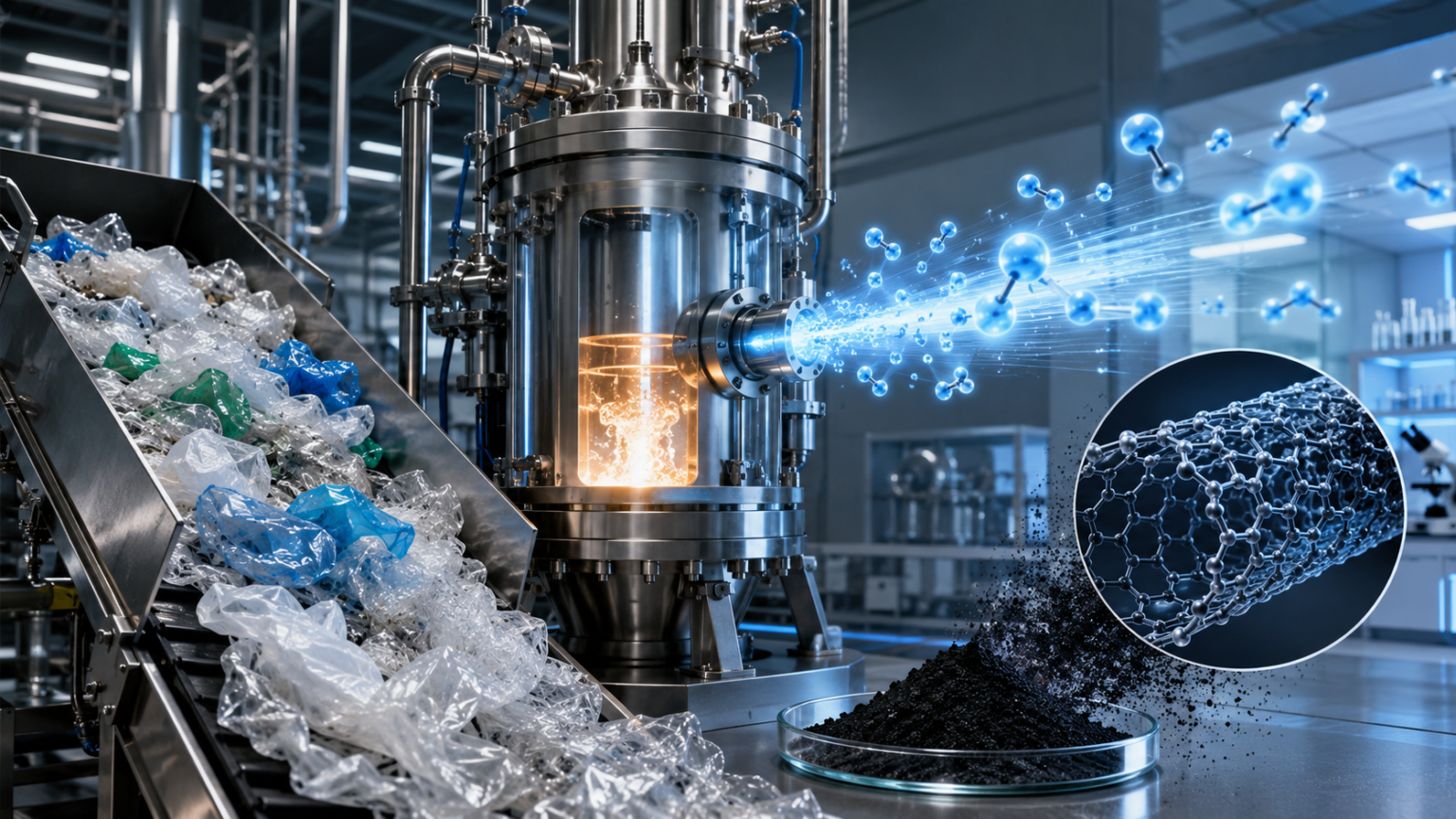

Researchers in Egypt have demonstrated a way to convert low-density polyethylene waste into hydrogen while simultaneously producing carbon nanomaterials, including multi-walled carbon nanotubes.
Published in Scientific Reports on August 19, 2026, the plastic waste hydrogen study does not yet describe a commercial recycling technology. What it does show is a potentially useful chemistry: instead of treating the carbon in discarded plastic purely as waste, the process separates value into a hydrogen-rich gas stream and solid carbon materials.
That distinction is important. Plastic-to-fuel processes have often been criticised because they can simply move fossil carbon from a solid product into another fuel that is later burned. Here, part of the proposition is different. The researchers are trying to recover the hydrogen while directing carbon into solid nanomaterials rather than treating it only as an unwanted residue.
What the Plastic Waste Hydrogen Study Actually Found
The research was conducted by Ahmed M. Haggar, Ahmed E. Awadallah, Ateyya A. Aboul-Enein, and Galal H. Sayed of the Egyptian Petroleum Research Institute and Ain Shams University. The paper was accepted on August 7 and published in Scientific Reports on August 19.
The team tested cobalt-molybdenum catalysts supported on different combinations of aluminium oxide, or alumina, and magnesium oxide, or magnesia. Their feedstock was low-density polyethylene, commonly known as LDPE, a polymer widely used in products such as plastic films and bags.
The strongest result for hydrogen alone came from a cobalt-molybdenum catalyst supported entirely on magnesium oxide. The researchers reported a hydrogen concentration of about 81% by volume and a carbon nanomaterial yield of 32.42% by weight.
But the researchers judged another formulation, CoMo/Al25-Mg75, to provide a better overall balance between hydrogen production and the quality of the solid carbon product. It produced hydrogen at about 72% by volume alongside a 26.14% carbon nanomaterial yield, with the carbon predominantly taking the form of relatively uniform multi-walled carbon nanotubes.
Those figures require careful interpretation. A 72% or 81% hydrogen concentration refers to the composition of the gas produced under the experimental conditions. It is not the same as saying that 72% or 81% of the plastic’s energy was converted into usable hydrogen.
That difference will matter enormously if plastic waste hydrogen technology is ever assessed commercially.
How Plastic Waste Hydrogen Production Works
The process uses two stages rather than trying to convert the plastic directly into finished products in one reaction.
First, LDPE is thermally cracked. Heating the plastic breaks its long polymer chains into smaller hydrocarbon molecules.
Those gases are then passed over a catalyst containing cobalt and molybdenum. The catalyst promotes further decomposition of the hydrocarbons, releasing hydrogen while carbon grows on the catalyst as solid nanostructures. The study describes the system as a continuous-flow catalytic pyrolysis process.
The catalyst itself is central to the experiment. The researchers prepared cobalt, molybdenum, and support materials at a 4:1:5 weight ratio and tested five different support compositions: pure alumina, pure magnesium oxide, and three alumina-magnesium oxide mixtures. The catalysts were dried and then calcined at 600°C before testing.
Each formulation changed both the amount of hydrogen produced and the structure of the carbon left behind.
That is what makes the paper more interesting than a simple demonstration that plastic can produce hydrogen. Similar co-production routes have been investigated before. The advance here is an attempt to tune the catalyst so that both outputs are useful at the same time.
Why Magnesium Oxide Improved the Plastic Waste Hydrogen Results
The chemistry comes down partly to how effectively the catalyst keeps its active metals dispersed.
The researchers found that magnesium oxide interacted more strongly with cobalt and molybdenum species than alumina did. That helped limit cobalt particle agglomeration, or clumping, and created more accessible sites where hydrocarbon molecules could decompose.
Pure magnesium oxide therefore delivered the strongest sustained hydrogen production during the 150-minute test period.
But hydrogen concentration was not the only target.
When a smaller amount of alumina was combined with a larger share of magnesium oxide, the CoMo/Al25-Mg75 catalyst produced somewhat less hydrogen but generated better-organised carbon structures. Raman spectroscopy and electron microscopy indicated relatively well-graphitised multi-walled carbon nanotubes.
Higher-alumina formulations performed less well. The study associates this with the formation of less active phases and larger cobalt particles, reducing the number of active sites available for hydrocarbon decomposition.
For climate-tech developers, that trade-off is worth watching. The most productive hydrogen catalyst may not necessarily create the most commercially useful carbon coproduct.
Carbon Nanomaterials Could Change the Economics
Producing two saleable outputs is the central economic idea behind this form of plastic waste hydrogen research.
Hydrogen on its own is difficult to produce competitively through new pathways because established hydrogen production is deeply integrated into existing industrial systems. A process that also produces a useful solid material could potentially spread its operating costs across two revenue streams.
The study produced several forms of carbon depending on catalyst composition, including multi-walled carbon nanotubes, carbon nanofibres, graphitic structures, bamboo-like nanotubes, and carbon nano-onions.
The CoMo/Al25-Mg75 formulation is particularly relevant because it favoured more homogeneous multi-walled carbon nanotubes with higher structural order. The researchers linked that morphology with more sustained catalyst activity and prolonged hydrogen output.
This is where the concept moves closer to upcycling than to conventional waste treatment.
Instead of merely reducing the volume of plastic, the aim is to transform its molecular components into materials with new industrial value.
That said, laboratory production of carbon nanotubes and profitable industrial manufacturing are very different propositions. Product consistency, purification requirements, catalyst recovery and the size of the addressable market would all affect commercial economics.
The Climate Case for Plastic Waste Hydrogen Is Not Yet Proven
This is the point at which climate-tech reporting needs some restraint.
The paper refers to the product as “turquoise hydrogen,” a term generally associated with processes that split hydrocarbons into hydrogen and solid carbon rather than directly generating carbon dioxide during the main reaction. In this study, the hydrocarbon source is waste LDPE rather than natural gas.
But the publication does not present a full life-cycle assessment of the process. A search of the paper shows no reported life-cycle analysis, and it does not quantify total process energy consumption or provide a commercial techno-economic assessment.
That means the word “turquoise” should not be interpreted as proof that the resulting hydrogen is inherently low-carbon.
The climate outcome would depend on several factors: where the heat comes from, how much energy the reactors consume, how the catalysts are manufactured and recovered, what happens to the solid carbon product, and what alternative fate the plastic waste would otherwise have had.
If the process relies on carbon-intensive heat, its emissions advantage could narrow.
If the carbon nanomaterials are later oxidised or burned, some of the carbon benefits could also disappear.
And if clean LDPE suitable for mechanical recycling is diverted into a high-temperature process, the comparison would be different from using contaminated or difficult-to-recycle waste that would otherwise be landfilled or incinerated.
Those are not reasons to dismiss the technology. They are the questions any credible climate assessment must answer next.
Scale Is the Next Test for Plastic Waste Hydrogen Technology
The experiments establish catalyst behaviour under controlled laboratory conditions. Commercial waste streams are less accommodating.
Real plastic waste can contain different polymers, pigments, food residue, chlorine-containing materials, additives, and other contaminants. Those materials can change reaction chemistry and poison catalysts.
The study itself focused on LDPE, so its performance should not automatically be extrapolated to mixed municipal plastic waste.
Catalyst durability is another issue.
The researchers monitored hydrogen production over 150 minutes. CoMo/MgO remained relatively stable during that period, while the Al25-Mg75 formulation showed a slight decline after about 90 minutes. Industrial plants need catalysts capable of operating reliably for much longer periods, with predictable regeneration and replacement costs.
The carbon product adds another engineering challenge. Carbon nanotubes growing directly on catalyst particles must eventually be separated, processed, and sold at specifications customers will accept.
A credible scale-up programme would therefore need pilot data covering energy use, catalyst lifetime, mixed-feed tolerance, emissions, hydrogen purification, carbon-product quality, and total operating cost.
Without those numbers, plastic waste hydrogen remains an interesting material and catalysis result rather than an investable industrial process.
Why the Research Still Matters for Climate Tech
The most useful part of this paper is the way it treats waste carbon as a resource rather than an inconvenience.
Conventional plastic disposal presents poor choices. Landfilling leaves durable fossil-derived material in the environment. Incineration recovers energy but releases much of the plastic’s carbon. Chemical recycling can recover hydrocarbons, but its economics and emissions vary substantially by process.
A route that can isolate hydrogen while keeping a meaningful share of carbon in a valuable solid form deserves serious investigation.
The researchers have also shown that catalyst design can influence not merely how much hydrogen is produced but what kind of carbon material emerges alongside it. That creates an opportunity to optimise the process around the combined value of both products rather than chasing hydrogen yield alone. For climate technology, that is the more consequential idea.
Plastic waste hydrogen will not become a credible decarbonisation pathway because a laboratory reactor produced hydrogen-rich gas. It becomes credible only if engineers can show that the entire system uses less carbon, consumes acceptable amounts of energy, and produces materials that have genuine markets.
The new Scientific Reports study moves one part of that problem forward. The next stage is no longer simply chemistry. It is proving the carbon accounting and the economics.
Stay connected with Business Herald for the latest business news, insights, and updates.
Follow us on Facebook, Instagram, LinkedIn, and YouTube.
Join our growing community on WhatsApp and Telegram for real-time updates delivered directly to you.