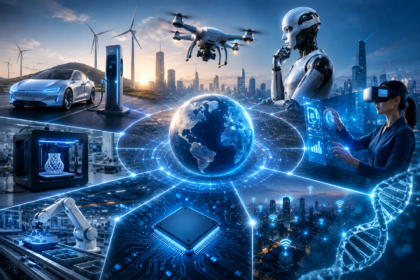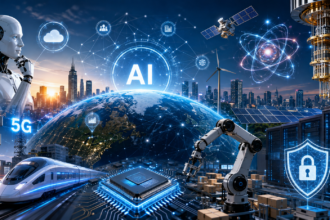


There was a time when tech evolution could be measured through relatively simple milestones: a faster processor, a thinner laptop, a better smartphone or a new generation of mobile connectivity.
That era is disappearing.
The technology story of 2026 is considerably bigger. Artificial intelligence is becoming an operating layer for businesses. Semiconductor capacity has turned into a strategic economic asset. Robots are moving deeper into factories and logistics networks. Quantum computing is progressing from laboratory promise towards measurable commercial experiments, while cybersecurity is being redesigned for threats that may not fully arrive for years.
For businesses and investors, this matters because technological advantage is increasingly tied not only to software, but also to compute, energy, chips, data, talent and infrastructure.
Stanford University’s 2026 AI Index offers perhaps the clearest indication of the pace of change. It found that organisations adopting AI reached 88% among those surveyed, while generative AI was already being used in at least one business function by 70% of organisations. Industry also produced more than 90% of notable frontier AI models in 2025.
Technology is no longer simply supporting business strategy. Increasingly, it is the strategy.
1. Artificial Intelligence Is Moving From Product to Infrastructure
The biggest chapter in today’s tech evolution remains artificial intelligence, but the narrative around AI is changing.
The first phase was about capability: could generative AI create text, code, images and video?
The next phase is about economics.
Can companies deploy those models reliably? Can AI agents perform useful work at scale? Can the productivity gains justify billions of dollars in computing infrastructure?
The capital flowing into the sector suggests that companies and investors are willing to find out.
According to Stanford’s 2026 AI Index, global corporate AI investment more than doubled in 2025. Private investment grew 127.5%, while funding for generative AI increased by more than 200%. The United States alone attracted $285.9 billion in private AI investment during 2025.
At the same time, AI competition is becoming less straightforward.
The performance gap between leading models is narrowing. By March 2026, models from Anthropic, xAI, Google and OpenAI were clustered relatively closely on major comparative rankings. Stanford also notes that the performance gap between leading US and Chinese AI models has effectively narrowed dramatically.
That changes the competitive battlefield.
If several models become “good enough”, businesses may increasingly choose platforms based on:
- price and inference cost
- reliability
- security
- proprietary data integration
- industry specialisation
- regulatory compliance
- speed
- distribution
The winners of the AI economy may therefore not necessarily be those with the flashiest model benchmark.
They may be the companies that make AI cheaper, safer and easier to deploy.
2. Semiconductors Have Become the New Strategic Infrastructure
Behind every AI breakthrough sits something far less glamorous but arguably even more important: silicon.
Demand for GPUs, high-bandwidth memory, networking chips and advanced processors has transformed the semiconductor industry.
The latest World Semiconductor Trade Statistics outlook illustrates the extraordinary scale of this cycle. WSTS projects the global semiconductor market to exceed $1.5 trillion in 2026, driven heavily by AI infrastructure and an exceptional surge in memory demand. Memory revenue alone is forecast to exceed $800 billion under its latest outlook.
That makes semiconductors central not merely to Technology News, but to industrial policy, trade relations, manufacturing strategy and global investment.
AI has effectively turned advanced chips into economic infrastructure.
For investors, the opportunity is consequently broader than AI-model developers. The ecosystem includes:
chip designers → foundries → semiconductor equipment → advanced packaging → high-bandwidth memory → networking → cooling → power management → data centres.
This is one reason countries from the US and Japan to India are investing heavily in domestic semiconductor capabilities.
3. India’s Semiconductor Ambition Is Becoming More Concrete
For readers following Business News India, India’s role in the global technology supply chain deserves particular attention.
On July 15, 2026, the Union Cabinet approved Semicon 2.0 with an outlay of ₹1,27,500 crore, expanding the country’s strategy beyond basic manufacturing incentives towards design intellectual property, equipment, materials, advanced fabs, packaging, research and talent development.
Under the first phase, 12 semiconductor manufacturing units had already been approved with cumulative proposed investment exceeding ₹1.64 lakh crore. Micron, Kaynes and CG Semi had started commercial production by July 2026.
India is also building the talent base required to support the industry. According to the government, 315 universities are now training students using electronic design automation tools, with around 68,000 students already trained.
This represents an important shift.
India has long been a major centre for semiconductor design and engineering talent. Its next challenge is moving deeper into the value chain, from designing chips to manufacturing, packaging and eventually creating more domestic semiconductor intellectual property.
Execution will determine how quickly that ambition translates into global market share.
4. The AI Revolution Is Also an Energy Story
One of the least understood parts of modern technology innovation is electricity.
AI does not live in the cloud in any literal sense. It lives inside data centres filled with processors, networking equipment and cooling infrastructure that require enormous quantities of power.
The International Energy Agency estimates that electricity consumption by data centres could more than double to around 945 terawatt-hours by 2030.
Between 2024 and 2030, global data-centre electricity consumption is expected to rise by around 15% annually. Electricity consumed by accelerated servers, largely associated with AI adoption, is projected to grow approximately 30% each year in the IEA’s base case.
That makes power availability a potential constraint on the next stage of tech evolution.
The AI investment story therefore increasingly overlaps with:
renewable energy, grids, nuclear power, battery storage, cooling technologies, real estate and water infrastructure.
The next great technology bottleneck may not be an algorithm.
It could be the ability to plug everything in.
5. Robotics Is Quietly Becoming a Much Bigger Market
Generative AI attracts headlines because consumers can interact with it directly.
Robotics is undergoing a quieter transformation.
According to the International Federation of Robotics, factories installed 542,000 industrial robots in 2024, more than twice the number installed a decade earlier.
Asia accounted for 74% of new deployments, while China alone represented 54% of global installations.
The next frontier is combining robotics with increasingly sophisticated artificial intelligence.
Traditional industrial robots are exceptionally good at repeating predefined movements. AI-powered machines have the potential to interpret more complex environments, recognise objects and adapt their behaviour.
That could expand automation beyond highly structured automotive factories into:
- warehouses
- construction
- agriculture
- healthcare
- retail
- hospitality
- last-mile logistics
Humanoid robotics remains an emerging and highly speculative category, but the investment flowing into the sector reflects a bigger ambition: bringing AI intelligence out of screens and into the physical world.
6. Quantum Computing Is Moving Closer to a Business Conversation
Quantum computing has spent years sitting somewhere between groundbreaking science and futuristic promise.
That may slowly be changing.
IBM’s updated quantum roadmap says it is targeting the first examples of quantum advantage during 2026, combining quantum systems with high-performance classical computing. Its longer-term roadmap targets a large-scale fault-tolerant quantum computer in 2029.
IBM reinforced that ambition in June 2026 by announcing plans to invest more than $10 billion in quantum computing over five years, covering research, manufacturing, ecosystem expansion and acquisitions.
The important distinction is that quantum computers are not expected to replace conventional computers.
Instead, they may eventually tackle specialised problems that are extremely difficult for classical machines, potentially affecting areas such as:
drug discovery, chemistry, materials science, optimisation and financial modelling.
Commercial usefulness is still far from guaranteed at scale. Investors should therefore separate roadmaps and demonstrations from proven economic value.
But quantum computing is increasingly difficult for technology leaders to ignore.
7. Cybersecurity Is Preparing for a Threat That Hasn’t Fully Arrived Yet
Quantum progress creates another technology challenge.
Much of today’s internet security relies on cryptographic techniques that sufficiently powerful quantum computers could theoretically undermine.
That means cybersecurity systems need to change before those machines arrive.
The US National Institute of Standards and Technology finalised its first three major post-quantum cryptography standards in 2024 and has been encouraging organisations to begin migration.
NIST mathematician Dustin Moody put the urgency plainly:
“We encourage organizations to begin their transition.”
The important business lesson is broader than quantum encryption.
As AI systems, cloud infrastructure and autonomous agents become embedded across companies, cyber risk becomes more interconnected.
Future cybersecurity spending will increasingly need to protect not just computers and databases, but also AI models, autonomous workflows, connected machinery and digital identities.
8. India Is Building Its Own AI Compute Layer
India’s AI strategy offers another significant window into how countries increasingly view computing capacity as strategic infrastructure.
The IndiaAI Mission, backed by an outlay of approximately ₹10,372 crore, is building shared computing infrastructure for startups, researchers and academic institutions.
By March 2026, the government said more than 38,000 GPUs had been onboarded through the IndiaAI Compute programme. A further 20,000 GPUs were in the process of being added.
India is simultaneously backing indigenous foundational AI models. Twelve teams were shortlisted during the first phase, with models from players including Sarvam AI, BharatGen, Gnani and Socket showcased during the IndiaAI Impact Summit 2026.
The strategic objective is becoming clear.
India does not simply want to consume AI developed elsewhere. It wants a larger role in the infrastructure, models, chips, applications and talent that make the technology possible.
For India’s startup economy, lower-cost access to compute could become particularly significant because GPU expenses remain a major barrier for smaller AI companies.
9. Tech Evolution Will Change Jobs, But Not in One Direction
Perhaps no question surrounding technology generates more anxiety than employment.
Will AI eliminate jobs?
The data suggests a more complicated answer.
The World Economic Forum estimates that economic, demographic and technological changes could create 170 million jobs by 2030 while displacing 92 million, resulting in a net increase of 78 million roles.
AI and information-processing technologies alone are expected to create millions of jobs while also eliminating others.
The key issue may therefore be less about whether work disappears and more about which skills lose value and which become more valuable.
The WEF says 77% of employers plan to upskill workers in response to AI, while skills in AI, big data, cybersecurity and technological literacy are expected to see rapid growth in demand.
For professionals, the safest strategy is unlikely to be competing against machines at tasks machines perform cheaply.
It is learning how to use technology to become better at higher-value work.
What Should Businesses and Investors Watch Next?
The next stage of technology innovation will not be defined by a single breakthrough.
Several interconnected themes deserve attention.
AI economics: The focus will increasingly move from impressive demonstrations to measurable revenue, productivity and margins.
Semiconductor capacity: Chips, memory and advanced packaging remain fundamental to the AI infrastructure boom.
Energy availability: Electricity could become one of AI’s most important strategic constraints.
Robotics: AI entering the physical economy could open a new automation cycle.
Cybersecurity: More autonomous systems mean more complex attack surfaces.
Sovereign technology: India and other economies are increasingly treating compute, chips and AI models as strategic national assets.
Quantum computing: Investors should watch technical milestones closely while distinguishing genuine commercial progress from long-dated promises.
The Bigger Picture: Innovation Is Becoming an Ecosystem
The most important lesson from today’s tech evolution is that technologies are no longer developing in isolation.
AI needs chips.
Chips need advanced manufacturing.
Data centres need electricity.
AI agents need cybersecurity.
Robots need sensors, chips and intelligent models.
Quantum computers require new forms of security.
And all of them require skilled people.
That interconnectedness is creating an enormous new technology economy, but also making innovation more capital intensive and strategically important than previous software cycles.
The winners may not simply be the companies creating the most exciting products.
They will be the businesses and countries capable of assembling the complete innovation stack, from energy and semiconductors to computing, software, talent and distribution.
Conclusion
The realm of innovation has entered a period where technological change is becoming both faster and more consequential.
AI adoption is expanding rapidly. Semiconductor demand is entering extraordinary territory. Robotics is scaling throughout manufacturing. Quantum computing is approaching important technical milestones, while governments are racing to secure the infrastructure required to compete.
India, meanwhile, is attempting to convert its deep technology talent and massive digital economy into stronger capabilities across AI compute and semiconductor manufacturing.
For businesses, founders, and investors following technology trends and Business News India, the message is clear: the next decade will not simply be about adopting new technology.
It will be about understanding where the technological value chain is moving, where the bottlenecks are forming, and who owns the infrastructure underneath the innovation.
That may ultimately determine who captures the greatest value from the next stage of tech evolution.
Stay connected with Business Herald for the latest business news, insights, and updates.
Follow us on Facebook, Instagram, LinkedIn, and YouTube.
Join our growing community on WhatsApp and Telegram for real-time updates delivered directly to you.