

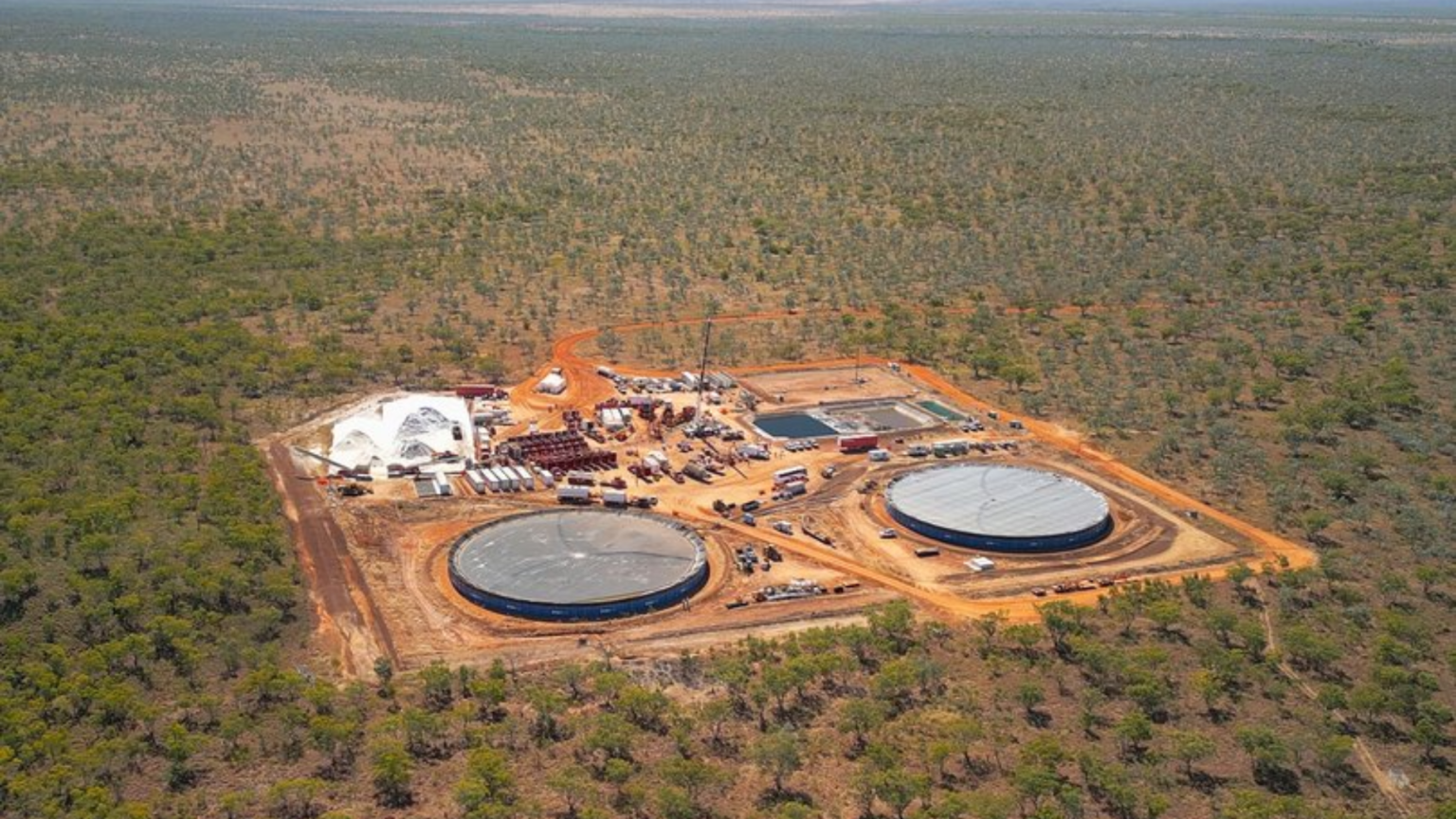

First gas from the Northern Territory’s Beetaloo Basin is now within reach, bringing Australia closer to testing the commercial potential of one of its most ambitious energy plays. But turning an estimated 7.1 Tcf shale resource into a major new industry will depend on scale, infrastructure, and billions of dollars in sustained investment.
Australia is about to find out whether one of its most ambitious energy projects can move from promise to commercial reality.
Beetaloo Basin shale gas is expected to enter its first production phase in September, as Tamboran Resources prepares to supply gas from its Shenandoah South project in Australia’s Northern Territory.
The initial volumes will be modest. But the ambitions surrounding the basin are anything but.
Developers believe the Beetaloo could eventually support domestic industry, help power a new generation of data centres and provide additional gas for Australia’s LNG infrastructure serving Asian markets.
The numbers explain the excitement. Geoscience Australia estimates the Beetaloo Sub-basin contains about 7.13 trillion cubic feet of 2C contingent shale gas resources, making it one of Australia’s most significant undeveloped unconventional gas plays.
Yet the story is not simply about how much gas lies underground.
The bigger question is whether Australia can produce it cheaply enough, build the infrastructure needed to move it and navigate an increasingly complicated energy and climate policy environment.
In other words, could Beetaloo become Australia’s answer to the US shale revolution?
Beetaloo Basin Shale Gas Nears First Production
The next few weeks could mark an important turning point. Tamboran Resources plans to begin supplying about 40 terajoules of gas per day, equivalent to roughly 37–39 million cubic feet per day, from its Shenandoah South Pilot Project.
The gas is contracted to the Northern Territory Government, meaning the first phase is primarily a domestic supply story rather than an LNG export project. Tamboran has a binding gas sales agreement covering the initial output.
Beetaloo Energy is expected to follow with another approximately 15 TJ per day later in 2026, according to Reuters. Those numbers are small compared with Australia’s giant offshore gas projects.
But pilot production serves another purpose. Operators will finally receive commercial-scale information on well performance, production decline rates, and operating costs. That data will help determine whether Beetaloo Basin shale gas can be expanded economically.
For a shale development, that matters enormously. One successful well does not create a shale industry. Hundreds of repeatable, economically viable wells can.
Why the Beetaloo Basin’s 7.1 Tcf Resource Matters
The headline number surrounding the basin requires an important distinction.
Geoscience Australia reported approximately 7.13 Tcf of 2C contingent shale gas resources in the Beetaloo, up 29% during 2024. It accounted for more than 45% of Australia’s reported unconventional tight, deep-coal, and shale gas contingent resources.
These are contingent resources, not proven commercial reserves. This is important to note because a resource can be geologically recoverable without necessarily being economically viable at scale.
The Northern Territory government also lists roughly 430 Tcf of prospective gas resources across the Beetaloo. Prospective resources represent an even earlier-stage estimate and should not be confused with gas that companies can currently book as reserves.
Still, the scale is difficult to ignore. If even a meaningful portion of the resource becomes commercially recoverable, the Beetaloo could change the energy economics of northern Australia.
Could Beetaloo Basin Shale Gas Create an Australian Shale Boom?
The comparison with the United States is inevitable. Horizontal drilling and hydraulic fracturing have transformed US energy markets over the past two decades. Massive shale developments, including the Marcellus, Permian, and Haynesville, helped turn the US into the world’s largest natural gas producer and a major LNG exporter.
Australian developers see a similar opportunity. But geology does not copy itself neatly across borders.
The Beetaloo’s shale formations are around 1.3 billion years old, compared with roughly 400 million years for the Marcellus shale, according to industry experts cited by Reuters. The Beetaloo’s rock is consequently older, harder, and more compacted.
There is another major difference for instance, US shale developed around an enormous network of pipelines, oilfield service companies, roads, processing facilities, and established energy markets.
The Beetaloo is remote. That makes the challenge as much about infrastructure and economics as geology.
Can Beetaloo Basin Shale Gas Power the Data Centre Boom?
One of the most interesting new demand opportunities has little to do with traditional heavy industry.
It is artificial intelligence. The extraordinary growth of AI is driving global demand for power-hungry data centres, and the Northern Territory wants a piece of that investment.
Beetaloo Energy has proposed a large data centre development near Darwin. The company has estimated that 1 gigawatt of data centre capacity could require around 200 TJ of gas per day if supplied using gas-fired power. A proposed site near Darwin could eventually support up to 2 GW of capacity.
That creates an intriguing link between Australia’s gas resources and the global AI infrastructure boom.
However, there is a major policy complication. Australia’s federal government has proposed national standards requiring new data centres to be supported primarily by new renewable electricity generation. Energy Minister Chris Bowen has said a data centre relying solely on gas would not meet the proposed minimum standard.
Gas could still provide firming capacity when renewable generation is unavailable, but it cannot simply become the primary power source under the proposed framework.
That means the real opportunity may be a hybrid model: renewable generation backed by gas when needed.
Could Beetaloo Gas Eventually Reach Asian LNG Markets?
This is where the Beetaloo story becomes globally significant.
Australia is already one of the world’s largest LNG exporters, with major customers across Japan, China, South Korea and other Asian economies.
Northern Australia also has something particularly valuable: existing LNG infrastructure relatively close to the Beetaloo compared with many other potential markets.
Japan’s INPEX operates the Ichthys LNG project near Darwin and acquired interests in Beetaloo acreage earlier this year. The Northern Territory government described the investment as supporting future domestic gas development in the region.
INPEX has indicated Beetaloo gas could eventually help supply its existing LNG operations or support expansion.
Santos is also appraising acreage in the basin and has potential expansion options around Darwin LNG.
Tamboran’s ambitions go further.
CEO Todd Abbott told Reuters the company hopes that within a decade it could produce more than 1 billion cubic feet per day. At that scale, Reuters estimates the additional supply could support an increase of roughly 9% in Australia’s LNG export capacity.
That remains an ambition, not a guaranteed outcome.
But if Beetaloo Basin shale gas reaches that level, it would no longer be merely a Northern Territory development. It could become part of Asia’s long-term energy supply chain.
The Biggest Obstacle Is Infrastructure
Gas underground has limited value if there is no economical way to move it.
This may be Beetaloo’s biggest commercial challenge.
Initial gas can use existing infrastructure connecting the basin to Darwin. Tamboran’s pilot project will feed into the Amadeus Gas Pipeline through infrastructure involving APA Group.
Large-scale production would be different. New pipelines capable of transporting substantially higher volumes toward Australia’s population centres or LNG facilities could require billions of dollars of investment.
The basin’s remoteness also raises costs for equipment, labour, water management and materials.
Developers are already looking for small efficiencies. Beetaloo Energy estimates that using locally sourced sand for hydraulic fracturing could reduce transport expenses by roughly A$5 million per well, or about 15%.
That may sound like an operational detail, but shale economics are built on exactly these kinds of savings. At scale, small reductions in the cost of every well become enormous.
Global Capital Is Starting to Notice Beetaloo
The basin is increasingly attracting more than Australian interest. US capital and shale expertise are already involved.
American oilfield services company Liberty Energy has provided equipment for development in the region, while Tamboran has tapped US investors and listed in New York in 2024 partly to access a market more familiar with unconventional shale projects.
Japan is also entering the picture. INPEX’s 2026 farm-in agreement gave it interests in acreage controlled by Daly Waters Energy, with the possibility of increasing its exposure.
That international participation is strategically important. Commercialising Beetaloo Basin shale gas is likely to require deep pools of capital, specialist technology and years of continuous drilling.
The US shale revolution worked partly because the industry could repeatedly access all three. Australia will also need something similar.
Australia’s Gas Reservation Policy Changes the Export Equation
There is another constraint that prospective LNG developers must now factor into their models.
Australia plans to introduce a new Domestic Gas Reservation Scheme from July 1, 2027.
Under the framework, LNG exporters will be required to supply the domestic market with gas equivalent to 20% of their export volumes. Existing export contracts entered into before the policy’s December 2025 announcement are expected to be respected.
The policy is intended to improve domestic availability and reduce Australia’s exposure to global gas-price shocks.
For Beetaloo developers, it means future LNG ambitions cannot be considered independently of Australia’s domestic energy requirements.
Some of the gas will need to stay home.
That could strengthen Beetaloo’s role in supplying Australian industry, but it also adds another variable to the economics of building export-focused projects.
Environmental Rules Remain Central to Beetaloo Basin Shale Gas
Hydraulic fracturing remains politically and environmentally sensitive in Australia.
Northern Territory regulation requires monitoring across areas including groundwater, drilling waste, hydraulic fracturing fluids and flowback fluids. Operators must also comply with approved environmental management plans.
The region has undergone a Strategic Regional Environmental and Baseline Assessment designed to provide regulators with environmental data before further production approvals are granted.
Water will remain a particularly important issue. Rules developed following the Northern Territory’s scientific inquiry into hydraulic fracturing include controls surrounding groundwater extraction, monitoring, and the management of fluids used during fracking.
These safeguards may increase development complexity and cost, but they are also central to maintaining regulatory and community confidence in a large-scale unconventional gas industry.
The industry’s ability to expand will therefore depend on more than just productivity. Its environmental performance will matter too.
Beetaloo Basin Shale Gas Needs Scale to Become Competitive
This is ultimately the economic test. The first 40 TJ per day does not prove that Australia has created another Permian or Marcellus.
It proves that the industry has reached the starting line. The next stage requires producers to show they can drill repeatedly, improve productivity, and lower costs as activity increases.
Tamboran and its partners have already spent around A$1 billion on exploration and appraisal, according to the company figures reported by Reuters. Much larger capital could be required.
Shale development is fundamentally a scale business. Individual wells decline over time, so operators must continue drilling to maintain and expand production. That creates a relentless focus on cost.
Drilling speed matters. Fracking efficiency matters. Infrastructure costs matter. Local supply chains matter. Financing costs matter.
The commercial future of Beetaloo Basin shale gas will be decided by how efficiently producers manage all of them.
What Happens Next?
September’s expected first gas will be an important milestone, but several larger questions remain unanswered.
Can producers consistently deliver strong well results?
Can drilling costs fall as activity increases?
Will investors fund the pipelines and processing infrastructure needed for large-scale expansion?
Can developers connect Beetaloo to Australia’s LNG system economically?
Will gas-backed data centres work alongside Australia’s renewable-energy requirements?
And perhaps most importantly, can the industry expand while meeting the environmental standards required of unconventional gas development?
Answers to those questions will determine whether Beetaloo becomes a regional gas field or a globally significant energy province.
The Bigger Picture: Australia’s Shale Revolution Is Possible, Not Proven
Australia clearly has an opportunity.
Beetaloo Basin shale gas combines a significant contingent resource, proximity to Asian LNG markets, rising regional energy demand, and growing interest from Australian, American, and Japanese investors.
The emergence of AI infrastructure adds another potential source of demand that few would have considered central to the project’s economics several years ago.
But geological potential alone does not create an energy revolution.
The American shale boom was built through scale, infrastructure, relentless cost reduction, access to capital, and years of technological improvement.
Beetaloo still has to prove every one of those elements.
First gas in September therefore, should not be viewed as the arrival of Australia’s shale revolution.
It is the moment Australia begins to find out whether it is commercially possible.
Frequently Asked Questions
What is the Beetaloo Basin?
The Beetaloo Sub-basin is a large shale gas region in Australia’s Northern Territory covering roughly 28,000 square kilometres. It forms part of the greater McArthur Basin and is Australia’s leading emerging shale gas development.
How much shale gas does the Beetaloo Basin contain?
Geoscience Australia reports approximately 7.13 trillion cubic feet of 2C contingent shale gas resources. This should not be confused with proved reserves.
When will Beetaloo Basin shale gas production begin?
Tamboran Resources is expected to begin supplying initial gas from its Shenandoah South project in September 2026, starting at approximately 40 TJ per day.
Could Beetaloo gas be exported as LNG?
Potentially. Developers and LNG operators have discussed Beetaloo as a possible future source for existing or expanded LNG facilities around Darwin. Large-scale exports would require much greater production and additional infrastructure.
Could Beetaloo gas power AI data centres?
Gas may provide firming or backup generation, but Australia’s proposed national standards require new data centres to be primarily supported by additional renewable energy rather than relying solely on gas.
Stay connected with Business Herald for the latest business news, insights, and updates.
Follow us on Facebook, Instagram, LinkedIn, and YouTube.
Join our growing community on WhatsApp and Telegram for real-time updates delivered directly to you.