

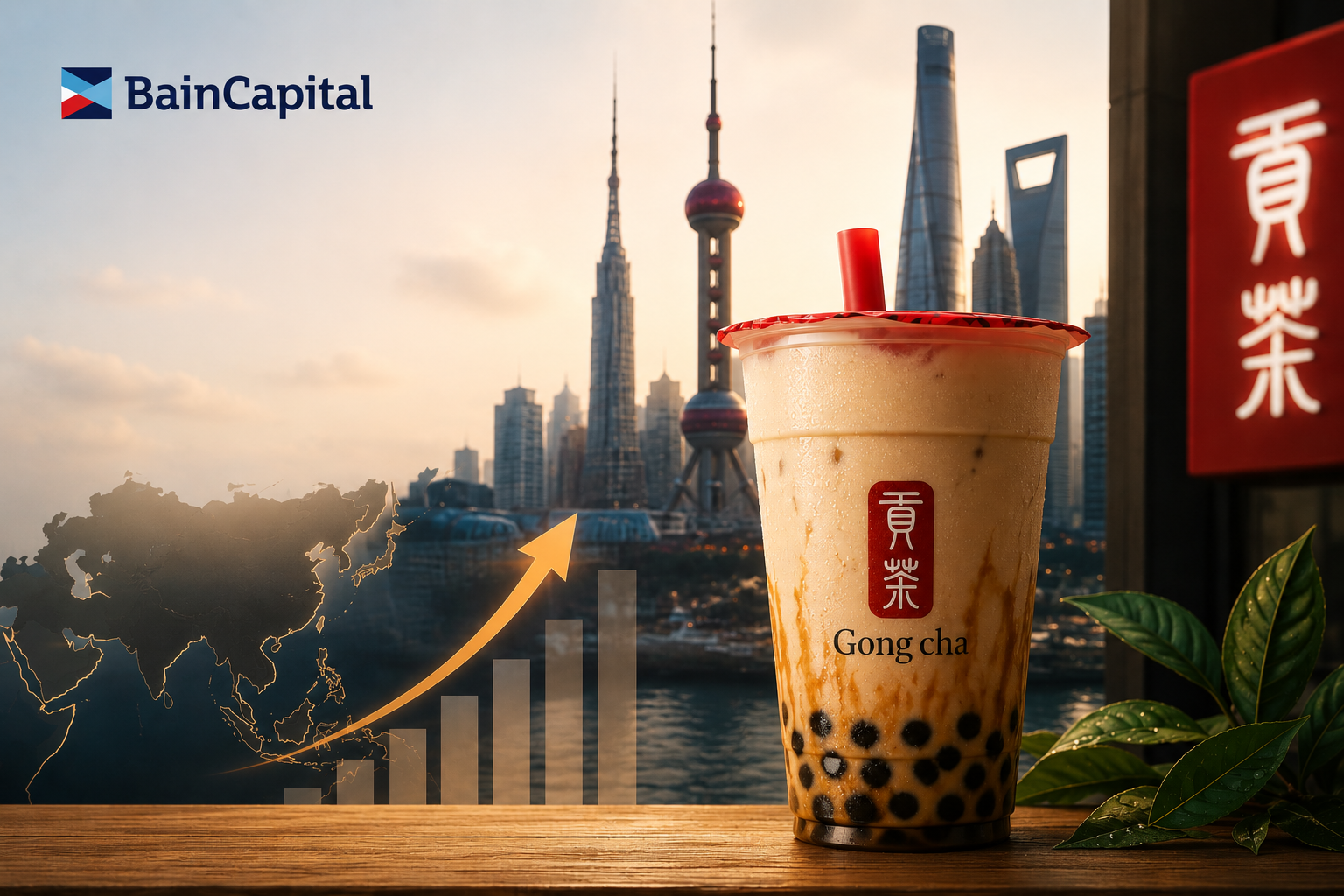

The Gong cha acquisition by Bain Capital is more than another private-equity transaction in the restaurant industry. It is a calculated bet on a global bubble-tea brand with nearly 2,200 stores across 33 markets, a largely franchise-led operating model, and considerable expansion potential across Asia-Pacific and the Americas.
Bain Capital has entered into an agreement to acquire Gong cha from TA Associates and the company’s other shareholders. Financial terms have not been disclosed. The transaction is expected to close in the fourth quarter of 2026, subject to customary closing conditions.
The sale comes after Reuters reported in May 2026 that TA Associates was seeking a valuation of up to $2 billion for the bubble-tea chain. People familiar with the process said Gong cha generated more than $70 million in annual earnings before interest, tax, depreciation and amortisation, or EBITDA.
At the reported upper-end valuation, the business would be valued at nearly 30 times EBITDA. Buyers were reportedly considering lower multiples, making it important to distinguish the earlier valuation expectation from the undisclosed final transaction price.
For investors following global mergers and acquisitions, Asian consumer brands, and Business News India, the deal offers a larger lesson. Private equity is increasingly looking beyond conventional Western restaurant formats for consumer businesses that combine cultural relevance, repeat purchasing, digital appeal, and capital-light expansion.
Gong cha acquisition: Key transaction details
| Transaction detail | Information |
|---|---|
| Acquirer | Bain Capital |
| Seller | TA Associates and other shareholders |
| Financial terms | Not disclosed |
| Previously reported potential valuation | Up to $2 billion |
| Global footprint | Nearly 2,200 stores |
| International markets | 33 |
| Annual beverages served | More than 150 million |
| Expected completion | Fourth quarter of 2026 |
| Headquarters | United Kingdom |
| Brand origin | Taiwan |
| Founded | 2006 |
| Core operating model | Franchise-led tea retail network |
Gong cha was established in Kaohsiung, Taiwan, in 2006. Its name refers to tea offered as a tribute to an emperor, reflecting the brand’s positioning around premium tea quality.
The chain expanded beyond Taiwan through Hong Kong before entering markets including Singapore, Malaysia, South Korea, Japan, Australia, the United States, Canada, Europe, and Latin America. Gong cha crossed 1,000 stores in 2019, passed 2,000 outlets in 2023, and now operates in 33 markets across five continents.
Why the Gong cha acquisition fits Bain Capital’s strategy
The Gong cha acquisition fits a familiar private-equity formula: acquire an established consumer platform, strengthen its operating systems, accelerate geographic expansion, and increase the value generated by each unit.
Gong cha is particularly attractive because Bain is not acquiring a collection of independently managed tea shops. It is acquiring an international brand supported by franchise relationships, standardised products, centralised ingredients, operating technology, and repeatable store formats.
Bain Capital partner Naofumi Nishi said Gong cha has built a globally recognised brand with a loyal customer base and franchisee economics that are “among the strongest in the sector.”
Nishi also identified significant room for expansion across Asia-Pacific, particularly Japan, and the Americas.
The deal therefore gives Bain exposure to both established Asian markets and less mature Western markets without requiring it to create a beverage concept from the beginning.
Several aspects of the business make the investment strategically attractive.
1. A capital-light franchise model
Franchising allows Gong cha to open stores without financing the entire cost of every new location from its own balance sheet.
Franchise partners typically provide much of the capital needed to secure property, build stores and manage local operations. The brand owner can earn revenue through initial franchise fees, recurring royalties, product sales, and supply-chain arrangements.
This structure can produce faster network expansion and stronger returns on corporate capital than a model in which the parent company owns and operates every outlet.
GongChaa tells prospective US franchisees that the estimated initial investment for a single store ranges from approximately $207,450 to $648,460. The company also promotes flexible layouts, simplified inventory management, and operational technology as important features of its franchise proposition.
The figures illustrate why franchising can support rapid expansion. Much of the store-level investment is made by operators rather than the parent company.
For Bain, the attraction is not only the number of stores Gong cha can open. The more important test is whether those locations can generate attractive returns for franchisees. Profitable franchise partners are more likely to open additional outlets, renew agreements, and invest in local marketing.
2. A product suited to repeat consumption
A beverage chain becomes significantly more valuable when customers treat its products as a routine purchase rather than an occasional novelty.
Coffee chains built global businesses by connecting beverages with daily habits, work breaks, meetings, and social occasions. Bubble-tea companies are attempting to develop similar purchasing frequency among younger consumers.
Gong Cha offers hundreds of combinations involving tea bases, fruit flavours, milk, sweetness levels, toppings, pearls, jellies, and foams. This level of customisation encourages customers to return because they can try a different product without leaving the brand.
The model also enables Gong cha to introduce limited-edition flavours and seasonal beverages without changing the basic operating format.
That combination of familiarity and novelty is commercially important. Customers recognise the brand and ordering process, while product variation prevents the menu from becoming repetitive.
3. Strong compatibility with digital culture
Bubble tea is highly suited to visual and social media marketing.
Its colours, transparent cups, layers, pearls, and toppings make the product easy to present through Instagram, TikTok and short-form video. Customers frequently participate in the marketing process by sharing new flavours, customised combinations, and store experiences.
This digital compatibility can reduce dependence on traditional advertising, particularly among younger customers. It can also help a brand generate attention around limited launches and collaborations.
Digital ordering and loyalty programmes create another potential source of value. As Gong cha expands its direct customer relationships, it can gain better information about purchasing frequency, preferred flavours, location performance, and promotional effectiveness.
For a private-equity owner, that data can support more targeted marketing and more disciplined store expansion.
4. Smaller stores and operational flexibility
Beverage businesses can often operate from smaller spaces than full-service restaurants because they do not require extensive kitchens, seating areas or complicated food preparation.
Gong cha says its flexible layouts can serve both in-store and takeaway customers. This allows the brand to consider shopping centres, transport locations, high streets, business districts, university areas and other high-footfall sites.
Smaller formats can reduce property costs and make it easier to enter expensive urban markets. They can also provide franchisees with a wider range of potential locations.
However, smaller stores do not automatically guarantee better economics. Rent, labour costs, delivery commissions, and customer-acquisition spending can still place pressure on margins. The investment case depends on maintaining sufficient order volumes throughout the day.
5. Multiple potential exit routes
Private-equity investors acquire companies with an eventual exit in mind.
A larger and more profitable Gong cha could eventually attract another buyout firm, a strategic food or beverage company, or public-market investors.
A future initial public offering would not be unprecedented for the broader Asian beverage category. Several tea and beverage companies have used public markets to fund expansion and provide exits for early investors.
The category’s public-market development gives private-equity buyers useful valuation benchmarks. It also creates competitive pressure, as well-funded Asian beverage chains accelerate international expansion.
Gong cha’s growth under TA Associates
TA Associates invested in Gong cha in 2019. Since then, the company has expanded geographically, completed strategic acquisitions, and invested in store-level technology.
TA supported Gong cha’s acquisition of master-franchise rights on the US East and West Coasts. Bringing those rights under greater corporate control can provide the brand with more influence over store development, franchisee selection, marketing, and operating consistency.
Under TA’s ownership, Gong cha also introduced its 2.0 “Digital Kitchen”, a more flexible store blueprint centred on drinks-dispensing technology. The system was operating in approximately 250 stores when the Bain transaction was announced.
The technology is intended to improve speed, product consistency, and store efficiency.
That matters because small improvements become financially meaningful when repeated across thousands of locations. A reduction in ingredient waste, preparation time, or labour requirements at one shop may appear limited. Across a 2,200-store network, the cumulative impact can be substantial.
Reuters reported that Gong cha’s group revenue rose 14% to $217 million in the previous year, supported by growth in Japan and South Korea. The company also entered five markets, including Thailand, Colombia, and Ecuador.
Bain is therefore acquiring a business that already has international momentum. Its task will be to maintain that expansion without weakening store-level economics or brand standards.
The bubble tea market is still expanding
The Gong cha acquisition is taking place as bubble tea becomes a mainstream international beverage category.
Market estimates vary depending on methodology, but major research firms agree that the industry is expected to grow.
The Business Research Company estimated the global bubble-tea market at $3.62 billion in 2026 and projected it to reach $5.17 billion by 2030, representing a compound annual growth rate of 9.3%.
Fortune Business Insights offered a more conservative estimate, valuing the market at $3.03 billion in 2026 and projecting it to reach $5.62 billion by 2034. The firm estimated that Asia-Pacific represented 44.06% of the global market in 2025.
Grand View Research estimated the market at about $3.6 billion in 2026 and forecast it could reach $8.3 billion by 2033.
The variation between these projections highlights the uncertainty involved in estimating a fragmented category. Many bubble-tea outlets are independent operators, and market definitions may include different combinations of retail, ingredients, and ready-to-drink products.
The overall direction, however, is consistent. Bubble tea is expanding beyond its Asian base through urbanisation, youth consumption, product customisation, delivery platforms, and greater familiarity with Asian food culture.
Why Asian F&B brands are attracting private equity
The Gong cha acquisition reflects a broader change in the global consumer investment landscape.
For decades, many of the world’s most valuable restaurant franchises were built around Western formats such as burgers, pizza, fried chicken, and coffee.
Asian food and beverage businesses are now producing internationally scalable concepts of their own. Bubble tea, Chinese tea, Korean food, Japanese dining, Asian bakeries, and regional dessert brands are increasingly moving beyond diaspora-led demand.
Several factors explain the shift.
Asian culture now travels globally
Streaming platforms, music, beauty products, tourism, and social media have increased international exposure to Asian culture.
Food and beverages are part of that cultural movement. Consumers who engage with Korean entertainment, Japanese design, Taiwanese products, or Chinese social platforms may be more open to trying associated flavours and dining formats.
Bubble tea has become one of Taiwan’s most recognisable cultural exports. Its growth demonstrates how a regional product can become a global consumer category when combined with strong branding and accessible store formats.
The category supports localisation
International restaurant businesses must balance consistency with local relevance.
A chain cannot change so dramatically between countries that it loses its identity. At the same time, it cannot assume that every market has identical preferences.
Bubble tea provides room for both.
The basic operating system can remain consistent while local teams adjust sweetness levels, flavours, ingredients, pricing and seasonal products. This makes the format adaptable without requiring complete reinvention.
The products can support attractive margins
Tea, milk, syrups, fruit bases, and toppings can produce favourable gross margins relative to the final selling price.
However, ingredient margins alone do not determine profitability. Store economics also depend on rent, labour, utilities, delivery charges, franchise royalties, and marketing expenditure.
The most valuable beverage chains are therefore those that combine attractive product margins with high customer frequency, efficient service, and disciplined site selection.
Expansion can be replicated
Private equity generally prefers businesses that can repeat a successful unit rather than continually inventing new products or operating models.
A store format that works in Seoul, Tokyo, or Sydney may not produce identical results in London or New York. Nevertheless, a standardised menu, supply chain, and franchise system provide a starting point for replication.
This is one reason established brands command premium valuations. Investors are paying not only for current earnings but also for a tested method of opening additional locations.
Competition will remain intense
The bubble-tea category’s growth has attracted significant competition.
Gong cha faces other international chains, including Chatime, CoCo Fresh Tea & Juice, Tiger Sugar, and Happy Lemon, along with Chinese beverage giants expanding through highly aggressive franchise models.
Mixue, for example, has built a network of more than 60,000 stores through low pricing, franchising, and extensive supply-chain control. Other Chinese tea businesses are also pursuing customers in the United States and other Western markets.
Competition is not limited to specialist bubble-tea brands. Coffee chains, dessert businesses, and convenience retailers can add pearls, fruit teas, and Asian-inspired beverages to existing menus.
The product itself is also relatively easy to imitate.
That means Gong cha’s competitive advantage must come from more than recipes. It must defend its position through brand recognition, ingredient quality, convenient locations, reliable service, product innovation, and franchise execution.
The reported valuation sets a demanding target
Valuation is the most important unanswered question surrounding the Gong cha acquisition.
If Bain paid close to the previously reported $2 billion figure, the investment would carry demanding growth expectations.
A valuation approaching 30 times EBITDA would require Bain to increase earnings considerably before a future exit. Value creation could come from several sources:
- Opening more stores in existing markets
- Entering additional countries
- Increasing sales at established outlets
- Improving franchise royalty income
- Expanding digital ordering and loyalty programmes
- Reducing preparation time and ingredient waste
- Strengthening direct control in major regions
- Introducing packaged or ready-to-drink products
- Completing additional acquisitions
Each opportunity also carries execution risk.
Opening stores too quickly can weaken site quality and franchisee performance. Increasing prices can reduce customer frequency. Aggressive cost reduction may affect product quality or service. Expansion into new countries may require substantial marketing before the brand achieves scale.
Because the final price has not been disclosed, investors should avoid treating the $2 billion figure as the confirmed transaction value.
Health concerns are a strategic risk
Bubble tea’s appeal is partly based on indulgence. That can also become a weakness.
Some drinks contain significant amounts of sugar, milk, creamers, and high-calorie toppings. Greater consumer attention to nutrition could affect purchasing frequency or encourage regulation around labelling and sugar content.
Gong cha and its competitors can respond by offering adjustable sweetness, smaller servings, fruit teas, dairy-free alternatives, and lighter products.
Customisation is useful in this respect because it allows consumers to reduce sugar or remove toppings without abandoning the brand.
The challenge is to make healthier products attractive enough to drive demand rather than treating them as a defensive addition to the menu.
Franchise governance will determine long-term value
Franchising accelerates growth, but it can also reduce control.
A poorly managed store can affect customer trust in the entire brand. Problems involving hygiene, service, employee conduct, product consistency or inaccurate marketing may be associated with Gong cha even when the location is independently operated.
Bain will therefore need to invest in franchisee selection, training, audits, technology, and supply-chain oversight.
The quality of the franchise network is more important than the number of franchisees.
A disciplined expansion strategy may produce slower headline growth than approving every interested operator, but it can protect the brand and improve long-term economics.
What the Gong cha acquisition means for Asian F&B brands
The Gong cha acquisition sends a clear message to founders building Asian food and beverage businesses: private equity is interested in the category, but cultural popularity alone is not enough.
Investors want evidence that a concept can become a system.
A scalable F&B brand should be able to demonstrate:
- Consistent store-level unit economics
- A standardised preparation process
- Reliable ingredient sourcing
- Strong franchisee returns
- Repeat customer behaviour
- Disciplined site selection
- Digital ordering and customer data
- Quality control across multiple locations
- A management team that can operate without the founder
- The ability to adapt products without weakening the brand
The distinction is important. A popular café may generate strong local demand, but a private-equity platform must show that the same economics can be reproduced across cities and countries.
What the deal means for India’s consumer market
For investors tracking global mergers and acquisitions and Asian consumer brands, the deal offers a broader lesson.
India has a large tea-drinking population, a rapidly expanding organised food-service industry and a growing consumer base willing to experiment with premium beverages.
However, India’s traditional tea culture does not automatically guarantee success for international bubble-tea chains. Bubble tea remains a relatively premium, urban product compared with mass-market chai.
The strongest opportunity may initially lie in metropolitan areas, malls, university districts, premium high streets, and neighbourhoods, with younger consumers.
Localisation will be essential. Brands may need to adjust sweetness, serving sizes, prices and flavours while competing with established café chains and Indian tea startups.
For domestic founders, the larger lesson is that Indian beverages and snacks could also become global franchise opportunities.
India has multiple products with international potential, including chai, regional coffee, lassi, functional beverages, desserts, and street-food-inspired formats.
The challenge is not a lack of distinctive products. The challenge is building reliable systems around them.
Internal link to insert: Business Herald analysis of private-equity investment in Indian consumer brands.
Internal link to insert: Business Herald report on India’s organised food-service and QSR market.
These two lines should be converted into relevant clickable internal links before publication.
What Bain Capital must achieve next
Bain’s immediate priority will be to ensure continuity during the ownership transition.
The investment firm is likely to focus on expanding Gong cha in Japan, the wider Asia-Pacific region and the Americas, while supporting product innovation, operations, and marketing.
Gong cha Global CEO Paul Reynish said the company intends to keep “building on this momentum” as it begins its next chapter with Bain Capital.
The central performance indicators to watch will include:
- Net store openings
- Same-store sales growth
- Franchisee profitability
- Customer purchasing frequency
- Digital and loyalty participation
- Expansion in Japan and the Americas
- Adoption of the Digital Kitchen format
- Store preparation times
- Product innovation
- Management of ingredient and labour costs
A growing store count will generate headlines, but store-level returns will determine whether the acquisition creates sustainable value.
The investment lesson from the Gong cha acquisition
The Gong cha acquisition shows that private equity increasingly views Asian food and beverage businesses as globally scalable consumer platforms.
Bain Capital is not merely acquiring a bubble-tea chain. It is investing in a franchise system, an internationally recognised brand, a large customer base, and a category with room for continued geographic growth.
The investment thesis is persuasive: compact stores, repeat purchasing, product customisation, strong digital visibility, and franchise-led expansion.
The risks are equally real. Competition is increasing, the products are easy to imitate, health concerns could affect demand, and a premium acquisition valuation would leave little room for weak execution.
Gong cha’s next phase will therefore test whether bubble tea can develop into a durable global beverage habit rather than remain a fast-growing consumer trend.
For Bain Capital, the opportunity lies in converting cultural relevance into predictable cash flow.
For Asian founders, the message is broader: the brands most likely to attract global capital will not simply have popular products. They will have scalable systems, profitable partners, and the operational discipline to reproduce their success across borders.
Stay connected with Business Herald for the latest business news, insights, and updates.
Follow us on Facebook, Instagram, LinkedIn, and YouTube.
Join our growing community on WhatsApp and Telegram for real-time updates delivered directly to you.