



You are halfway through explaining slide three when you notice the investor has stopped asking questions. They are still looking at the screen, but the energy has changed. The conversation has moved from curiosity to courtesy.
For founders raising their first pre-seed or seed round, this is one of the most frustrating pitch deck mistakes because the underlying business may not be the problem at all. The deck simply took too long to make the opportunity clear.
In early-stage fundraising, the first few slides are not administrative introductions. They are where investors begin deciding whether the rest of the story deserves their attention.
The 90-Second Reality of How Investors Actually Read Decks
There is no universal rule that an investor rejects a startup after exactly 90 seconds. But available data makes one thing clear: founders have far less time to establish relevance than they often assume.
Dropbox DocSend, which tracks engagement with fundraising documents, says investors spend an average of two minutes and 42 seconds reviewing a pitch deck. The company has also noted that more viewing time does not automatically translate into funding, but the figure illustrates the speed at which investors process startup material.
That matters because founders and investors approach the same deck very differently. A founder sees a 12-slide presentation they spent weeks refining.
An investor sees another opportunity that needs to be classified quickly.
Before studying unit economics or debating market size, an investor is trying to establish a basic mental model:
- What does this company actually do?
- Who has the problem?
- Is the problem painful enough to matter?
- Why is this becoming possible or urgent now?
- Could this become a meaningful business?
- Is there something here worth investigating further?
Y Combinator’s Michael Seibel has repeatedly argued that clarity must come before sophistication. His guidance to founders starts with an apparently simple question: what does the company do?
As Seibel puts it: “You don’t need to sound cool. You need to be clear.”
Founders should strip away jargon, marketing language, acronyms, and vague terminology that force investors to decode the pitch before they can evaluate the business.
Sequoia Capital takes a similar approach. Its pitching framework begins with company purpose, followed immediately by the customer problem, solution, and the question of “why now?” Sequoia advises founders to “define your company in a single declarative sentence.”
There is an important lesson in that sequencing. Slides one to three are not the warm-up. They are the audition for the rest of the deck.
The 3 Reasons Pitch Decks Lose Investors Early
Weak decks tend to fail in one of two ways:
A narrative failure means the investor can read the slide but still does not understand why the opportunity matters.
A design failure means the underlying argument may be strong, but the investor has to work too hard to extract it.
Founders often try to solve the first problem with better graphics and the second with more explanation. Usually, that makes both worse.
1. The Opening Slide Sounds Impressive but Says Very Little
One of the most common mistakes in an investor pitch deck appears before the pitch has properly begun.
The founder uses the opening slide as a branding exercise.
Consider this illustrative example:
WEAK OPENING
ProcuraAI
Transforming Procurement Through Intelligent Automation
It looks credible but leaves several obvious questions unanswered.
What is ProcuraAI?
Who buys it?
What does it automate?
What changes for the customer?
Now compare it with this version:
STRONGER OPENING
ProcuraAI
An AI purchasing assistant for mid-sized manufacturers that automates supplier quoting and comparison.
The second version is less theatrical. It is also far more valuable to an investor because it creates a category, identifies a customer, and explains the function.
This is where founder psychology works against clarity.
After months or years inside a business, phrases such as “intelligent infrastructure,” “next-generation platform,” and “AI-powered ecosystem” begin to sound meaningful because the founder already knows what sits behind them.
An investor does not. The fix is straightforward. Your first slide should make this sentence easy to complete:
” We help [specific customer] achieve [valuable outcome] by [plain-language description of the product].“
Do not make the investor decode the company before they can evaluate it.
2. The Problem Slide Describes a Market but Not a Pain
The next failure is more subtle. A founder identifies a genuine market problem but describes it in language so broad that the urgency disappears.
Common examples include “Recruitment is broken,” “Small businesses struggle to access finance,” and “Procurement workflows are inefficient.”
These statements may all be true. But they are too generic to establish why the problem is painful, expensive, or worth solving now.
Words such as “broken,” “fragmented,” “inefficient,” and “outdated” describe a category of problems. They do not show investors what actually happens to the customer.
A strong problem slide should answer three questions immediately:
- Who experiences the problem?
- What are they forced to do today?
- What does that behaviour cost them?
This distinction matters in a seed round pitch deck because investors are not simply assessing whether a problem exists. They are trying to determine whether the pain is serious enough to drive adoption, retention and, eventually, a large business.
Before: A Weak Problem Slide
The Problem
Procurement teams face inefficient workflows.
Manual processes create delays.
Existing software is complex and expensive.
Nothing here is necessarily incorrect. The problem is that almost any enterprise software company could make the same claims.
There is no clear customer behaviour, no visible consequence, and very little sense of urgency.
After: A Stronger Problem Slide
Buyers Still Spend Their Week Chasing Supplier Quotes
Mid-sized manufacturers often collect supplier pricing through email, spreadsheets and phone calls.
A single sourcing request can require repeated follow-ups across multiple vendors.
Purchasing teams spend hours coordinating information before they can compare offers or negotiate better terms.
The difference is specificity. The second version gives the investor something concrete to understand. There is a defined customer, a visible workflow, identifiable friction, and a clear opening for a product that removes that friction.
The goal is not to make the problem slide longer. In fact, the strongest problem slides often do the opposite. They reduce the argument to the most important behaviour and consequence.
Founders often confuse more explanation with greater conviction. A crowded slide rarely makes a problem feel bigger. A precise one does.
Specificity can do more persuasive work than an extra two slides ever will.
3. The Deck Explains the Product but Never Explains Why Now
A useful product solving a real problem is still not automatically an investable venture opportunity.
Investors also want to understand timing.
Why should this company exist now rather than five years ago?
What changed?
The trigger could be technological. It could be regulatory. Customer behaviour may have shifted. Infrastructure costs may have fallen. A new distribution channel may have opened. Incumbents may have failed to respond to a structural change.
Sequoia treats this as a distinct part of the fundraising narrative, asking founders why the solution has not been built before. Its framework says the best companies tend to have a clear answer to the “why now?” question.
This is where many startup pitches become product demonstrations instead of investment arguments.
A founder spends three slides explaining how the software works but never identifies the external shift that makes adoption plausible at scale.
For the hypothetical procurement company, the “why now” case might be that improvements in language models now allow software to extract and compare information from unstructured supplier emails, PDFs and spreadsheets with far greater reliability, while procurement departments are simultaneously facing pressure to automate repetitive administrative work.
The precise argument would need evidence.
But the structure is what matters:
The problem existed before. Something changed. That change creates an opening.
Without the third piece, your startup fundraising story can sound like an idea that happens to exist rather than an opportunity whose timing has arrived.
The Fix: A Slide 1-3 Framework That Holds Attention
A useful pitch deck framework for the first three slides is simple enough to remember:
The 3C Framework: Clarity, Cost, Catalyst
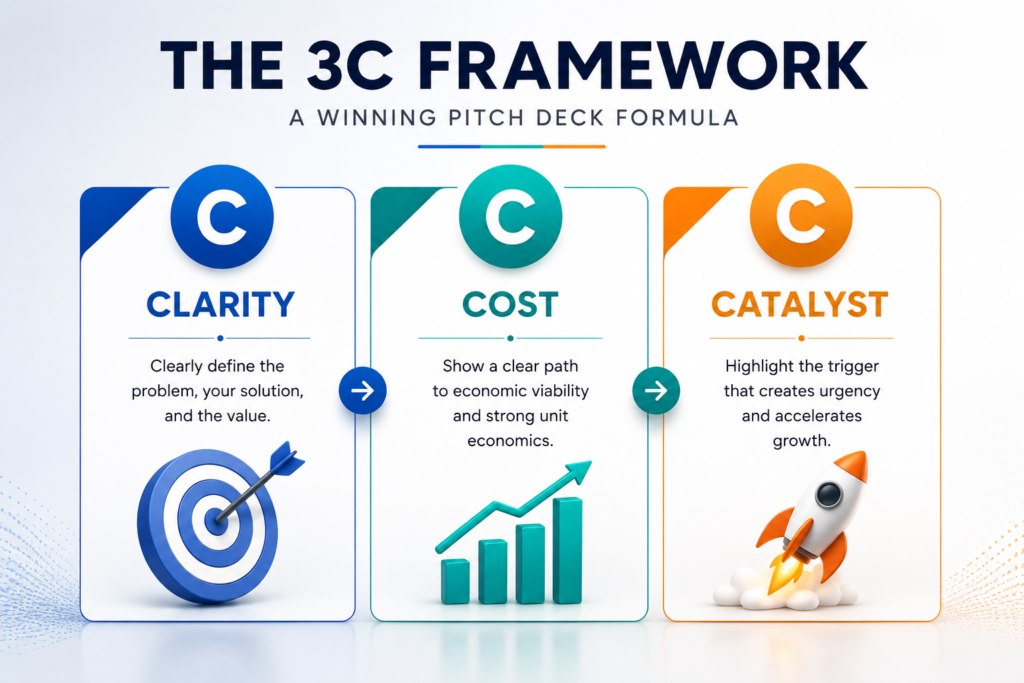
Each slide answers a different investor question.
Slide 1: Clarity
What is this company?
Identify:
- the product;
- the customer;
- the primary outcome.
A founder should be able to explain the business before explaining the industry.
If traction is genuinely strong, one proof point can sit underneath the company description. But do not turn the opening slide into a dashboard.
Slide 2: Cost
Why does the customer care?
Show the cost of the status quo. That cost might involve money, lost time, foregone revenue, risk, poor conversion, labour intensity, or another measurable consequence.
Avoid a list of five unrelated pain points. Choose the one that best explains why someone actively looks for a solution.
Slide 3: Catalyst
Why is this opportunity opening now?
Identify the external change making the business more feasible, urgent, or valuable.
Together, the slides should create a logical progression:
This is what we do.
This is the expensive problem behind it.
This is what changed to make the opportunity possible now.
Only then does the investor need the deeper evidence: product, traction, market, business model, competition, team, and financing requirements.
This structure also makes the deck easier to circulate internally.
A good investor pitch deck needs to work when the founder is not in the room. If a partner forwards it to another investor with no accompanying explanation, the basic argument should survive.
That principle extends beyond slide structure. First Round Review’s profile of Front founder Mathilde Collin describes her starting fundraising presentations with the story rather than the slide software itself.
Her advice is unusually useful: “Think of the pitch as a story waiting to be told, not a set of slides to be strung together.“
Only after establishing that story would she decide which metrics belonged in the presentation.
That is the demarcation many founders miss. The slides are not the pitch, but the argument is the pitch.
Common Mistakes Founders Make Even After “Fixing” Their Deck
Some pitch deck mistakes only appear during revision.
Overdesigning the Story
Once founders realise their deck is underperforming, the instinct is often to redesign it.
Better typography and hierarchy can certainly help. But design cannot rescue an unclear proposition.
The right test is functional: does the visual treatment make the central idea easier to identify within seconds? If not, it is decoration.
Turning Every Slide Into a Document
A deck that can stand alone still does not need to contain everything you know.
Dense paragraphs, six callout boxes, and multiple small charts force the investor to decide where to look first.
That is your job. Each slide needs one dominant conclusion.
Saving the Strongest Evidence for Later
Founders sometimes follow pitch-deck templates too rigidly.
If your company is growing unusually quickly, has secured remarkable early customers, owns defensible technology, or has a founding team uniquely suited to the problem, the investor may need to know that earlier.
YC’s pitching guidance emphasises leading with the strongest, most memorable facts rather than treating slide order as sacred.
A seed round pitch deck is an argument, not a compliance exercise.
Making the Ask Ambiguous
The investor should eventually know what you are raising and what the money is expected to unlock.
“Join us as we transform the future of commerce” is not an ask. “We are raising $2 million to expand the engineering team and reach 100 enterprise deployments” is.
The actual milestones will differ by company, but specificity signals that the founder understands the relationship between capital and execution.
A Quick Self-Audit Checklist
Before changing another colour or moving another logo, open your deck and review only the first three slides and ask:
- Can a smart outsider explain what the company does after seeing slide one?
- Is the customer specific?
- Have I described an observable problem rather than labelled an industry “broken”?
- Is the consequence of that problem clear?
- Have I identified what changed to make this opportunity timely?
- Does each slide communicate one dominant idea?
- Can I remove jargon without losing meaning?
- Would slides one through three still make sense if I were not there to explain them?
If several answers are no, revising slide ten is unlikely to change your fundraising outcome. Start at the beginning.
The Best Decks Earn Attention Before They Explain
A polished presentation cannot manufacture product-market fit, customer demand, or founder credibility.
First Round Review has made this point bluntly in its startup coverage: founders can spend enormous effort redesigning decks, but early-stage investors are ultimately evaluating fundamentals such as team, market, and evidence of traction.
Yet good companies can still make raising capital unnecessarily difficult by communicating badly.
That is why the most damaging pitch deck mistakes are rarely about fonts, icons, or whether the competition slide comes sixth or eighth.
They are failures of prioritisation. You know more about your company than any investor seeing it for the first time. The difficult part is not deciding what is true.
It is deciding what they need to understand first. A strong startup fundraising deck does not attempt to answer every possible investor question before slide three.
It establishes enough clarity, economic relevance, and timing to make the investor want to continue.
Your first three slides do not need to win the investment. They need to earn the next three minutes.
Stay connected with Business Herald for the latest business news, insights, and updates.
Follow us on Facebook, Instagram, LinkedIn, and YouTube.
Join our growing community on WhatsApp and Telegram for real-time updates delivered directly to you.