
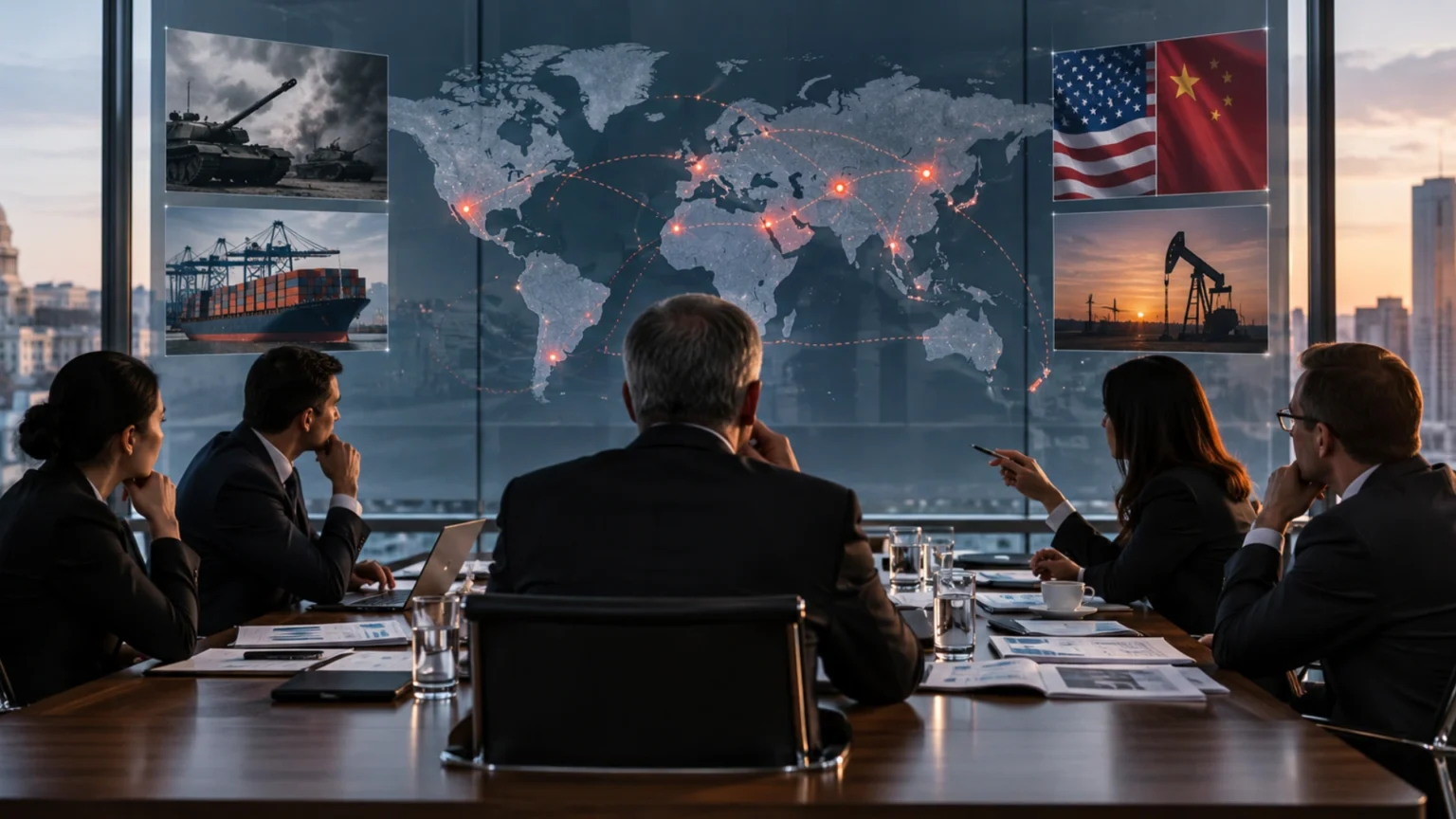

A factory approved this year may still be operating in the 2040s, but the tariff regime used to justify it may not survive the next election. A supplier selected for its efficiency can become inaccessible after an export restriction, while a shipping route treated as dependable can close within hours of a military escalation. This mismatch between the lifespan of corporate investments and the speed of political change has brought geopolitical uncertainty into decisions once governed mainly by cost, demand and expected return.
For boards, foreign policy is no longer distant context. It increasingly determines where companies invest, what they source and how much flexibility they must retain.
The shortening horizon of corporate strategy
Long-range planning has not disappeared, but its character is changing. Boards still need a view of where a company should be in five or ten years, yet they are less willing to rely on a single forecast for how it will get there.
Trade rules, sanctions, subsidies, and conflict can change faster than a conventional planning cycle. Investments are consequently being divided into stages, with further spending tied to events that management can observe.
The effect is strongest when decisions are expensive to reverse. Research from the Federal Reserve Bank of Boston found that companies in industries with high perceived geopolitical exposure subsequently reduced investment, particularly firms holding less cash.
Uncertainty therefore acts as a tax on commitment before a tariff or conflict produces a direct loss, while strong balance sheets give companies more room to preserve options.
Geopolitical uncertainty becomes a budgeted function
For many companies, geopolitical analysis once meant an occasional briefing following an election, an invasion, or a sanctions announcement. It is becoming a recurring management responsibility with its own people, information systems and budget.
In an EY-Parthenon survey of 1,200 chief executives across 21 countries, 56% identified geopolitical uncertainty as their most significant business risk over the following 12 months. The same research found that executives were becoming more selective in their investments rather than withdrawing from growth altogether.
The institutional response varies. Some large companies are creating senior geopolitical or geostrategy roles. Others are expanding the responsibilities of government affairs, enterprise risk, security, or corporate strategy teams and giving them more direct access to the chief executive and board.
Demand for geopolitical analysis is also rising among investors seeking to understand how political events should affect valuations and capital allocation.
Simply hiring a political specialist is not sufficient. The function becomes useful only when analysis changes an operating or financial decision. A warning about deteriorating relations must be connected to suppliers, licences, currency exposure, contracts and intellectual property. The emerging role translates political developments into consequences for revenue, cost, legality and continuity.
From global efficiency to regional decentralisation
The multinational operating model was built around centralisation. Production could be concentrated where scale and cost were most attractive, while technology, procurement and data were managed across borders.
That model assumes that goods, information and expertise can move with limited political friction. As the assumption weakens, companies are giving regional operations enough suppliers, capacity and authority to continue functioning when another part of the network is restricted.
Investment data already show a more selective geography. UN Trade and Development reported that global foreign direct investment increased 6% to $1.6 trillion in 2025, yet more than 80% went to the 20 largest host economies.
Strategic sectors accounted for 44% of global greenfield investment, compared with 16% in 2020. Capital is not simply retreating; it is concentrating in countries and industries considered important for technology, energy, security and access to major markets.
The pharmaceutical industry provides a visible example. AstraZeneca announced plans to invest $50 billion in US manufacturing and research by 2030 while the American government was considering tariffs on pharmaceutical imports.
The company said the policy environment influenced the announcement, although some investment would have taken place regardless. Geopolitics often redirects or accelerates a project that already has commercial logic rather than creating it by itself.
Friend-shoring, with limits
Friend-shoring means placing production and sourcing in countries considered politically reliable or aligned. It reflects the possibility that governments will use tariffs, technology controls or access to raw materials as instruments of policy. Political alignment has therefore entered the calculation alongside labour costs, infrastructure and market access.
Yet friendship between states is neither permanent nor commercially sufficient. Mexico benefits from proximity and preferential access to the United States, but uncertainty surrounding the US-Mexico-Canada Agreement has caused some companies to reconsider new investment.
Reuters reported that new foreign investment in Mexico fell 13% in the first half of 2026 even as total inflows reached a record, largely through reinvested earnings. Existing operators can often tolerate uncertainty more easily than a new entrant considering an irreversible commitment.
Nor does moving final assembly necessarily remove dependence on the original production centre. Foxconn’s investment in India supports Apple’s development of an alternative manufacturing base to China, but electronics assembled elsewhere can still contain Chinese components or rely on Chinese machinery and technical knowledge.
The practical model is often China plus one, or China plus several, rather than a clean separation. Boards must examine where the economic value originates, not merely the country printed on the shipping label.
Supply chains become a board-level design question
Supply-chain resilience has moved beyond procurement because interruptions now affect revenue, working capital, and strategic access. McKinsey’s 2025 survey of 100 global supply-chain leaders found that 82% said new tariffs affected their networks. Among affected respondents, 45% were increasing inventories, 39% were pursuing dual sourcing, and 33% were developing nearshoring or onshoring plans.
These were largely extensions of measures begun after the pandemic and earlier conflicts, which indicates that tariffs are accelerating an existing redesign rather than starting one.
The most practical response is targeted. Companies are identifying hidden supplier risks, keeping extra stocks of essential components, and preparing backup suppliers in advance. Some are also redesigning products so parts can be sourced from different countries. Boards must weigh these added costs against the financial damage a supply disruption could cause.
The most practical response is targeted. Companies are identifying hidden supplier risks, keeping extra stocks of essential components and preparing backup suppliers in advance. Some are also redesigning products so parts can be sourced from different countries. Boards must weigh these added costs against the financial damage a supply disruption could cause.
Conflict adds a further layer. When shipping groups rerouted vessels around southern Africa during the 2026 escalation in the Middle East, the consequences extended beyond freight charges. Longer journeys tied up goods for more time, increased insurance costs, and forced customers to hold more working capital. Logistics routes and port access can therefore become matters of capital allocation rather than routine purchasing.
The danger of paying too much for security
The growing attention to resilience does not make every relocation sensible. OECD modelling suggests that broad efforts to bring supply chains home could reduce global trade by more than 18% and global real output by more than 5%, without consistently making economies more stable.
Concentrating production domestically can simply exchange geopolitical exposure for local risks such as energy shortages, natural disasters, skills constraints or cyberattacks.
Boards must therefore distinguish critical dependence from ordinary international trade. A sole source of an irreplaceable material deserves more attention than a widely available commodity purchased abroad. A second factory may be justified for a highly profitable product that cannot tolerate interruption, but not for every item in the catalogue. Resilience creates value when it protects important cash flows at a proportionate cost.
Geopolitical fluency becomes a leadership requirement
Over the next five years, geopolitical fluency is likely to become part of the standard expectations placed on senior leaders. Executives will not need to become diplomats, but they will need to understand how state competition reaches pricing, technology, capital and operations.
Chief financial officers will have to connect geopolitical scenarios with liquidity and investment returns. Operations leaders will need to understand rules of origin and political concentration, while directors will need to challenge assumptions about market access and regulatory stability.
This will also affect succession and board composition. International experience will remain valuable, but experience operating across incompatible regulatory systems may become more important than familiarity with a large number of countries.
Boards may seek directors with backgrounds in government, security, trade policy or regulated industries, while leadership development will increasingly include simulations of tariffs, sanctions and supply interruptions. Geopolitical expertise will still require specialists, but responsibility for acting on it will sit with the wider leadership team.
The companies that adapt best will not be those that claim to predict the next conflict or election. They will be those that know which political developments can materially damage their business, maintain the financial capacity to respond, and make decisions before complete certainty arrives.
Long-term strategy will survive, but it will become less rigid and more conditional. In a world where policy can change faster than factories can be built, freedom of action is becoming a corporate asset in its own right.
Stay connected with Business Herald for the latest business news, insights, and updates.
Follow us on Facebook, Instagram, LinkedIn, and YouTube.
Join our growing community on WhatsApp and Telegram for real-time updates delivered directly to you.