



From Berkshire Hathaway chairman Warren Buffett’s bridge table to Microsoft chairman and chief executive Satya Nadella’s cricket pitch, prominent business leaders have long treated leisure as more than escape. Research suggests the right pursuits can sharpen judgment, restore confidence and make demanding careers more sustainable.
For years, hobbies have occupied an awkward place in professional life. They appear near the bottom of a résumé, surface briefly during an introductory meeting, and then disappear beneath the supposedly serious business of work. In ambitious circles, an outside interest can even look like evidence of divided attention. The admired executive is still imagined as relentlessly available, moving from one decision to the next with little need for interruption.
Yet many accomplished leaders describe a different relationship with their time away from work. Warren Buffett, chairman and former chief executive of the multinational conglomerate Berkshire Hathaway, has often spoken about bridge, a game that requires patience, probability, and constant adjustment as new information arrives. Satya Nadella, chairman and chief executive of Microsoft, has credited cricket with teaching him enduring lessons about teams and leadership. Richard Branson, the British entrepreneur who founded the Virgin Group, has argued that physical activity gives him energy rather than taking away hours of productivity.
These accounts are personal, not controlled experiments, and no pastime can explain an extraordinary career. But they challenge the familiar assumption that serious achievement requires a life stripped of unrelated interests. A growing body of workplace research points in the same direction: hobbies can help people recover from pressure, develop a sense of mastery and return to work with greater creative capacity. The value is not simply that leisure feels pleasant. It gives the mind somewhere else to go.
That distinction has become more relevant as work has expanded beyond the workplace. Email, messaging platforms and smartphones have turned many jobs into an ambient presence. An employee may leave the office while remaining cognitively tethered to it, replaying a difficult exchange or anticipating the next request. Passive rest can be enjoyable, but it does not always create psychological distance from the working day.
A hobby asks for a different kind of attention. A gardener responds to weather, soil and living systems that will not obey a quarterly timetable. A musician listens for timing and tone. A cyclist reads terrain and bodily effort. Someone repairing furniture works with material limits that cannot be negotiated away in a meeting. These activities are useful partly because they are absorbing. For a while, professional identity loses its monopoly on attention.
What Leaders Learn Outside the Office
Nadella’s reflections on cricket illustrate how lessons can travel without being forced. He has described the sport as an education in putting the team first and drawing out the strengths of other players. Cricket does not replicate the management of a technology company, and that is precisely why the comparison is useful. The connection comes through principles of judgment, collective responsibility and the handling of individual talent rather than through another rehearsal of office tasks.
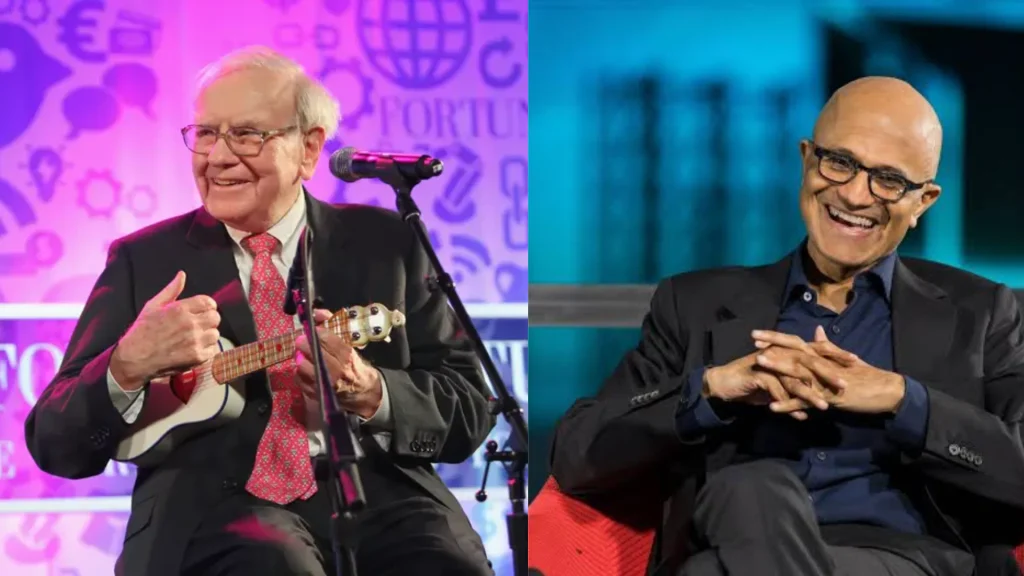
Buffett’s enthusiasm for bridge offers a different example. Players make decisions with incomplete knowledge, interpret signals from a partner and revise their view as each card changes the available evidence. The resemblance to investing is easy to see, but the game remains bounded. A hand ends. The stakes can stay modest. Mistakes become information for the next round rather than a threat to a company or career.
Branson’s preference for exercise draws attention to the physical side of sustained performance. Movement can create a clean break in a day dominated by screens, conversation and abstract problems. It also produces immediate feedback: balance, pace and fatigue cannot be delegated. For leaders whose work consists largely of influencing other people and navigating uncertain outcomes, a concrete activity can be unusually clarifying.
The broader lesson is not that executives should imitate any of these men. Taking up bridge because Buffett plays it would miss the point. Hobbies work through personal interest. Their motivational force comes from being chosen rather than prescribed, and from offering rewards that are not determined by an employer.
Research on creative activity outside work supports this view, while also requiring some restraint in how the findings are presented. In a study involving employees across different occupations and a second sample of US Air Force captains, people who engaged more frequently in creative activities reported or received stronger performance assessments. They were also associated with greater creativity and helpful behaviour at work. The researchers did not establish that hobbies directly caused better performance; personality, resources or other factors could contribute to both. Still, the relationship was substantial enough to warrant attention.
More recent work on “leisure crafting”, the deliberate pursuit of meaningful off-job activities, has linked it with work engagement, creativity and performance. This concept is more demanding than simply filling spare time. It involves choosing an activity that provides something work may not: autonomy, connection, learning or a manageable challenge.
That final element matters. A useful hobby often creates what psychologists call mastery: the experience of making progress through effort. Learning a chord, finishing a difficult trail or producing an imperfect ceramic bowl provides evidence that ability can grow. At work, especially in senior roles, progress is rarely so visible. Outcomes depend on markets, budgets, politics and other people. Leisure can restore a sense of agency that complex organisations routinely dilute.
The Benefit is Difference, Not Additional Output
Not every hobby provides the same protection. Research on sustainable careers suggests that an outside activity can strengthen self-efficacy, the belief that one can take on challenges and recover from setbacks, but the effect may weaken when the pursuit closely resembles one’s job or becomes overly serious.
This helps explain why a side project does not always function as leisure. A software engineer who spends every evening building another application may enjoy the work, but the activity draws on familiar skills, screens, and thought patterns. A finance professional who turns personal investing into a constant performance contest may never leave the psychological territory of the office. What appears to be variety on a calendar can feel like one continuous shift.
Seriousness can also alter the character of an activity. The runner who once enjoyed an unhurried weekend route may begin tracking every split, comparing rankings and treating recovery as failure. An amateur photographer may gradually become more concerned with expanding an audience and finding commercial opportunities than with the craft itself. When income, recognition and public approval begin to determine its value, the hobby risks recreating the very pressures it was meant to provide relief from.
Modern work culture makes this conversion tempting. Nearly every interest can now be monetised, branded or displayed. Baking becomes a venture. Reading becomes content. Exercise becomes a public streak. The language of optimisation follows people into the hours that once belonged to curiosity. Even rest is sold as a technique for producing more.
Leisure deserves a stronger defence than productivity alone. A hobby need not justify itself by improving quarterly results. Its deeper value may lie in preserving parts of a person that an occupation does not use or reward. That broader identity can, in turn, make professional setbacks easier to absorb. A failed proposal hurts differently when work is important but not total.
For leaders, this has consequences beyond personal wellbeing. Executives who recognise the legitimacy of life outside work are more likely to question cultures built on constant responsiveness. Their example shapes what employees believe is safe. A leader may praise balance in a town hall, but if every visible habit signals permanent availability, the unwritten rule will prevail.
Companies should be cautious, however, about turning hobbies into another managed programme. Mandatory sharing sessions, competitive wellness targets and requests to document personal goals can feel intrusive. The employer’s role is not to select leisure on an employee’s behalf. It is to protect the conditions in which genuine leisure remains possible: predictable time off, realistic workloads and boundaries around communication.
Access to meaningful leisure is not evenly distributed. Hobbies are easier to sustain when care responsibilities are shared, working hours are predictable and financial pressure is manageable. Advice that presents leisure as a matter of personal discipline ignores these material constraints. Organisations seeking healthier performance must examine the workloads and insecurity they create, rather than placing the entire responsibility for recovery on employees.
Why Sustainable Success Requires a Life Beyond Work
The mythology of leadership still rewards visible sacrifice. Long hours are easy to count, and relentless focus makes a compelling biography. But careers are not won in a single burst. They develop across years of decisions, reversals, changing responsibilities, and periods when motivation is less abundant than it once was.
Hobbies can support that long horizon because they interrupt the narrowing effect of intense work. They introduce different standards of success and different communities. They allow a beginner’s mind to survive in people who are expected to have answers. They can also expose leaders to the humbling experience of being average at something—and enjoying it anyway.
A worthwhile pursuit should differ sufficiently from professional life to offer genuine separation, yet remain engaging enough to hold attention without becoming another source of pressure. Its value may lie precisely in producing nothing measurable or publicly impressive. The right hobby should restore energy and equilibrium, not impose another obligation.
Buffett at the bridge table, Nadella recalling cricket, and Branson in motion offer memorable illustrations, but the idea is not reserved for famous executives. Nor does it require an expensive pursuit or large blocks of free time. The essential shift is to stop treating every hour outside work as unused capacity.
Ambition does not always need more intensity. Sometimes it needs range: another skill, another source of pleasure, another place in which the consequences are smaller, and attention can reset. A career built to last may depend, in part, on having something worthwhile that has nothing to do with the career at all.
Stay connected with Business Herald for the latest business news, insights, and updates.
Follow us on Facebook, Instagram, LinkedIn, and YouTube.
Join our growing community on WhatsApp and Telegram for real-time updates delivered directly to you.